
Is an AI-Assisted Analysis Reproducible? What to Keep So Results Can Be Rerun
Reproducibility of AI-assisted analysis depends on preserving the inputs, executable procedures and decisions that produced the published result. AI can draft code, and that code can be rerun, but a chat transcript alone may not reconstruct an analysis. Save approved scripts, software information, dataset access rules and a clear record of analytical decisions (Sandve et al., 2013; Dunn et al., 2026).
The most important distinction is whether AI appears in the live path that generates the final results or only helps create a fixed analysis script.
Two ways AI can be used in a research pipeline
| Workflow | What runs at publication time? | Reproducibility focus |
|---|---|---|
| AI drafts syntax; researcher checks and freezes it | A fixed SPSS/R/Stata script on an authorized dataset | Preserve code, versions, inputs and validation checks |
| AI directly labels cases, extracts values or generates an output on each run | A changing or stochastic model may be part of the active analysis | Preserve prompts, model identification, configuration, outputs and repeatability assessment |
Dunn et al. (2026) identify this distinction as whether an LLM is on or off the published analysis’s data path. Where feasible, using AI to draft durable, verified artifacts rather than making the analysis depend on a live model simplifies reproducibility.
What should a reproducible analysis package contain?
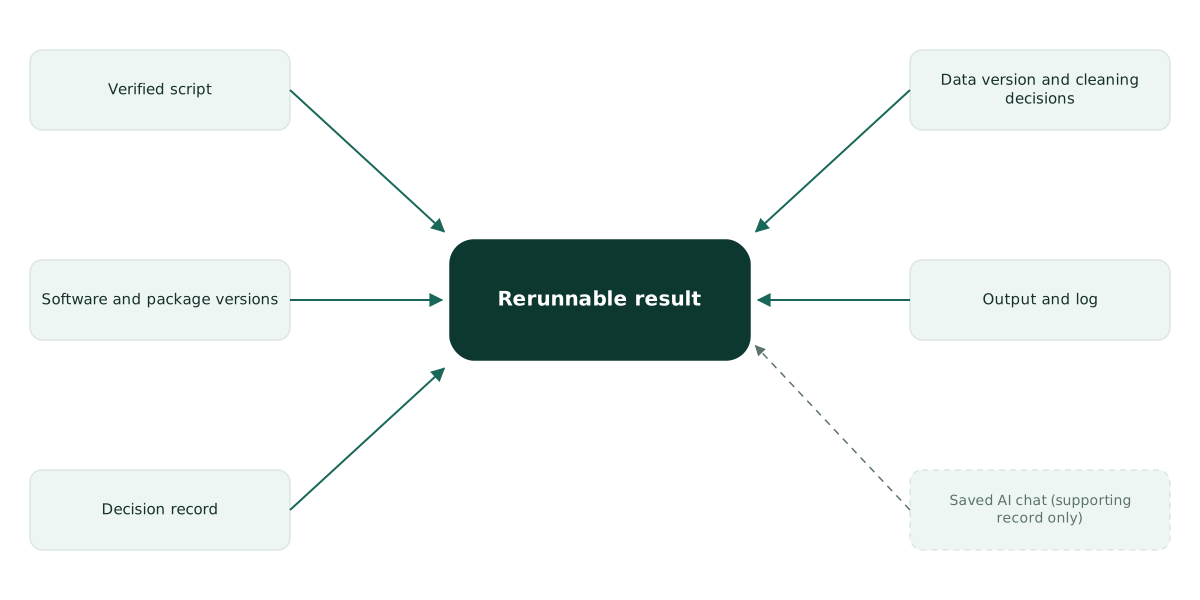
1. Source and version control. Preserve the exact scripts used to produce reported tables and figures. Store revisions in a version-controlled location, not a series of ambiguously named attachments.
2. A data dictionary. Explain variable definitions, coding, response ranges, derived variables and source units. Do not put restricted raw data into a public repository.
3. Sample-flow rules. Record eligibility, exclusions, missing-data handling and the sample used for each analysis.
4. Software environment. Keep software and package versions, relevant computational settings and enough configuration information to rerun the procedure.
5. AI provenance appropriate to its role. Document the AI task, model or tool and relevant settings when needed by the journal or when the model operates in the live analytical workflow. A fixed script does not necessarily require full prompt history for numerical reproducibility, although transparency may still require disclosure (Dunn et al., 2026).
6. Outputs and verification. Retain reproducible tables/figures, tests performed, reviewer checks and the final mapping from outputs to manuscript statements.
Why might two AI answers differ?
Large language models can produce different responses across runs because of sampling behavior, settings, model updates and changes in surrounding context. Repeatability should therefore be tested where the model itself is generating study data, labels or numerical answers. A frozen analysis script offers a different guarantee: it can be tested against a known dataset and environment even if the AI chat that originally suggested it is unavailable.
Sandve et al. (2013) recommend archiving exact software versions and tracking intermediate results in computational research. Those practices remain relevant whether code was written by a person, drafted with AI or adapted from a published method.
Example: rebuilding a Results table
Illustrative workflow, not a client case. An analyst asks AI to suggest code for fitting a mixed model using a synthetic dataset with a subject identifier and repeated visits. The analyst revises the fixed-effects structure, specifies the covariance model and runs diagnostics on the approved research system. The final script generates a table of estimates and confidence intervals from the authorized dataset. The script, variable dictionary, software versions and review notes are archived. The published values trace to this executed workflow, not to an AI summary pasted from the chat.
A final audit for reproducibility of AI-assisted analysis
| Question | Evidence to retain |
|---|---|
| Which dataset version was analyzed? | Controlled data identifier and relevant access record |
| Which code produced Table 2? | Script/file, version, output reference |
| Did any rows disappear? | Inclusion, exclusion and missingness log |
| Who reviewed method suitability? | Check log noting what was examined |
| Did AI directly transform data? | Role description, approved prompts and validation as appropriate |
| Could a second authorized analyst rerun it? | Rerun instructions and test result |
Frequently asked questions
Is saving the entire ChatGPT conversation enough?
No. The final data-access arrangement, executable artifacts and computational environment matter. A chat can explain choices but is usually not the complete reproducibility package.
Must researchers share confidential datasets publicly?
No. Reproducible research may rely on controlled access, synthetic test data, code and a documented authorized rerun process rather than public release of protected records.
Does using AI always make an analysis irreproducible?
No. AI-assisted code can become a stable, tested and rerunnable artifact. The concern is undocumented decisions or model-dependent steps that cannot be reconstructed.
Quantitative Data AnalysisNeed an analysis you can document and rerun? The analytical work and deliverables are confirmed before work begins.
Quantitative Data Analysis
In Quantitative Data Analysis at OnlineSPSS, the analytical work, deliverables and timeline are confirmed with one fixed project fee before work begins. The agreed analysis is carried out by an in-house statistician, and the agreed outputs are delivered.
References
- Dunn, C. W., Schultz, D. T., & Musser, J. M. (2026). Designing reproducible large-language-model-assisted scientific analyses. Patterns, 7(9), 101644. https://doi.org/10.1016/j.patter.2026.101644
- Sandve, G. K., Nekrutenko, A., Taylor, J., & Hovig, E. (2013). Ten simple rules for reproducible computational research. PLOS Computational Biology, 9(10), e1003285. https://doi.org/10.1371/journal.pcbi.1003285
Last reviewed November 2026 by the OnlineSPSS Statistical Team. Worked examples use hypothetical values and are not client data.
NEXT STEP
Need this done for
your study?
Share your research in about a minute and receive a complimentary assessment the same day: scope, timeline and one fixed fee.
No Commitment Required
Strictly Confidential
Fixed Project Fee
In-House PhD-Level Statisticians
Same-Day Response
Serving Researchers Since 2014