
Home / Resources / Psychological Measures / YMRS
Young Mania Rating Scale:
Scoring and Interpretation
The Young Mania Rating Scale (YMRS) is an 11-item clinician rating of manic symptom severity. Young Mania Rating Scale scoring has a weighting rule that is easy to apply twice, so the key, interpretation limits, SPSS and R code, psychometric evidence and a model reporting paragraph are set out here.
What the Young Mania Rating Scale Measures
The YMRS measures the clinician-rated severity of manic symptoms. Young and colleagues (1978) developed it to quantify symptoms in bipolar disorder research and to monitor clinical change during treatment. It is not the same as the Mood Disorder Questionnaire, which is a screening instrument with a different purpose.
The YMRS rates mood, activity, speech, behavior and other features of mania. Its weighting matters for data analysis: four items use a wider 0 to 8 scale, so a count or average of unweighted responses is not the published total. Rater training remains important in longitudinal and multicenter studies, because the score depends on the clinician’s judgment.
Structure of the YMRS
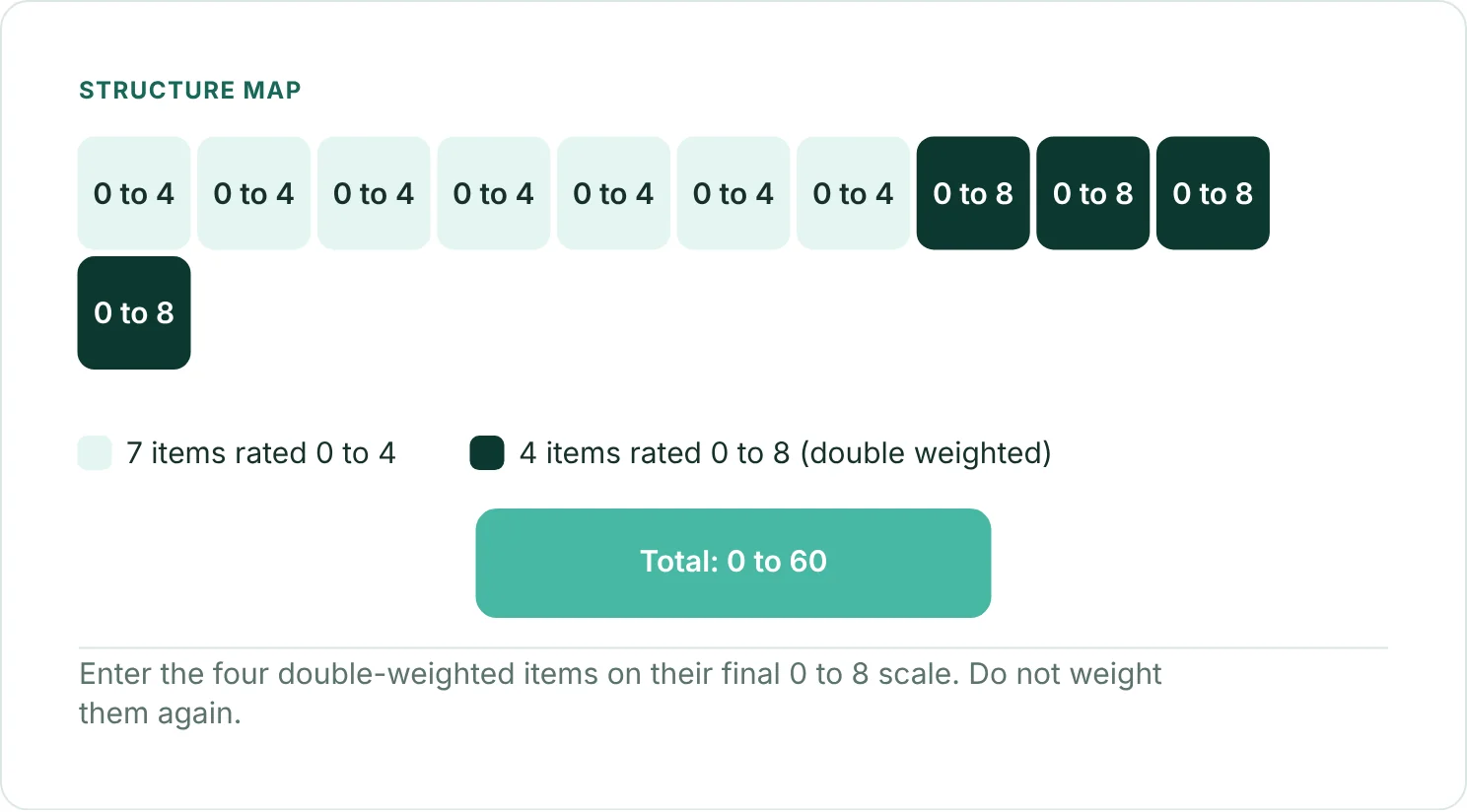
- Items: eleven clinician-rated domains.
- Item order: no reverse-coded items. The item rubric and weighting belong to the assessment itself and are not post-hoc multipliers.
- Response scale: seven items rated 0 to 4 and four items rated 0 to 8 under the standard weighting scheme.
- Subscales: none in standard clinical use; the usual endpoint is the total.
- Total: one summed score from 0 to 60.
- Recall period and unscored items: commonly the recent 48 hours, with assessment-specific context, and no unscored items.
- Translations: use a validated version for the intended population and name the language and its source. If no validated translation exists, say so and describe how the version was adapted.
The instrument itself is available from the original Young et al. (1978) study and authorized clinical rating resources.
How to Score the YMRS
- Confirm that all 11 final YMRS item scores were entered using the correct clinician rating rubric.
- Verify that the four double-weighted items are already stored on their final 0 to 8 scale. Do not weight them again.
- Sum the 11 final item scores to obtain ymrs_total, which ranges from 0 to 60.
- Apply a missing-item rule. The code below assumes complete, final-weighted ratings. No developer-endorsed prorating rule was verified, so follow the study protocol, justify any other rule, and report how missing ratings were handled in the methods section.
* Illustrative syntax: ymrs1 to ymrs11 must contain final weighted clinician ratings.
* Four items are already on a 0 to 8 scale; do not weight them again.
COMPUTE ymrs_total = SUM.11(ymrs1 TO ymrs11).
EXECUTE.# data: one row per respondent; ymrs1 to ymrs11 hold final weighted ratings.
# Four items are already on a 0 to 8 scale; do not weight them again.
items <- paste0("ymrs", 1:11)
data$ymrs_total <- rowSums(data[items], na.rm = FALSE)Interpreting YMRS Scores
| Score band | Interpretation |
|---|---|
| 0 to 60 | Continuous severity; higher = greater manic symptom severity |
| Treatment-response threshold | Use a prespecified, published study definition rather than a universal category |
Source: Young et al. (1978); thresholds in specific clinical trials depend on the protocol.
Higher totals indicate greater clinician-rated mania severity. Interpretation depends on the clinical sample, the intervention and the timing of the rating. Research definitions of response or remission may use absolute score ranges or relative reductions, but they should be chosen before the results are examined and justified against the relevant treatment literature.
If every item was entered in raw 0 to 4 categories, summing them gives the wrong YMRS metric. Verify the four weighted items against the rating rubric before running any code.
Psychometric Properties
| Property | Published finding | Source |
|---|---|---|
| Interrater agreement, total | A correlation of .93 between ratings by two independent clinicians in the original study | Young et al. (1978) |
| Interrater agreement, items | Item-level correlations ranged from .66 to .92 in the original study; estimate agreement again with your own raters | Young et al. (1978) |
| Validity and sensitivity | The original study examined associations with severity and sensitivity to clinical change | Young et al. (1978) |
| Generalization | The original sample was small, so reliability and rater variation should be examined in new settings | Young et al. (1978) |
These are source-specific results and cannot be assumed to hold as reliability or accuracy estimates in a new sample.
Using the YMRS in a Study
In bipolar treatment trials, record the rater, the visit and any protocol deviations, because ratings by the same clinician are not independent. A baseline-adjusted longitudinal model can estimate group differences, with attention to the bounded score and to clustering by rater or site. Distinguish a bipolar diagnosis from current manic symptom severity: the YMRS addresses only the latter.
If you report remission proportions, define the threshold in advance. Define the primary outcome before examining the data, and plan sample size around the precision or model complexity of the main analysis rather than a generic rule.
Reporting the YMRS
Manic symptom severity was assessed with the 11-item Young Mania Rating Scale (YMRS; Young et al., 1978), administered by [trained clinicians]. The standard weighted item scores were summed to give totals from 0 to 60, with higher scores indicating greater mania severity. Ratings were obtained at [time points], and treatment effects were estimated using [analysis].
References
Young, R. C., Biggs, J. T., Ziegler, V. E., & Meyer, D. A. (1978). A rating scale for mania: Reliability, validity and sensitivity. The British Journal of Psychiatry, 133(5), 429-435. https://doi.org/10.1192/bjp.133.5.429
Frequently Asked Questions
Why is the YMRS maximum 60 rather than 44?
Four of the 11 items use a wider 0 to 8 rating range, which gives a maximum of 60. The seven other items contribute at most 4 each.
Does the YMRS diagnose bipolar disorder?
No. It rates current manic symptoms, and diagnosis requires a comprehensive clinical assessment.
Can the YMRS replace the MDQ?
No. The MDQ is a screening questionnaire for bipolar-spectrum features, whereas the YMRS is a clinician-rated severity scale.
How do I report response?
State the prespecified response criterion and cite the clinical study or protocol that supports it.
NEXT STEP
Need a YMRS Score Set Up
or Checked?
OnlineSPSS is a statistical consultancy for researchers. Share your design and dataset, and a statistically trained Research Coordinator reviews it. The scope and one fixed project fee are confirmed before work begins.
No Commitment Required
Strictly Confidential
Fixed Project Fee
In-House PhD-Level Statisticians
Same-Day Response
Serving Researchers Since 2014