
Home / Resources / Psychological Measures / WISC-V
WISC-V:
Score Interpretation and Analysis
The Wechsler Intelligence Scale for Children, Fifth Edition (WISC-V) is an individually administered cognitive test for children aged 6 years 0 months to 16 years 11 months in the US edition. WISC-V score interpretation starts from norm-referenced composites that qualified examiners derive with the publisher's materials, so this guide explains the index structure, the score metrics, the limits of a single IQ value, and how researchers analyze scored composites without reproducing the scoring.
What the WISC-V Measures
The test belongs to the Wechsler series and estimates overall intellectual functioning while describing performance across several cognitive domains (Wechsler, 2014). It is administered and interpreted by qualified assessment professionals using standardized materials and norms. Results inform psychological assessment, educational planning and research, and they are read alongside developmental history, language, schooling and observed behavior.
Raw performance on the tasks is not comparable across ages, so a raw total cannot be read as an IQ. Every reported score is a norm-referenced conversion made with the publisher’s tables or scoring software, and its meaning depends on the edition, the normative sample and the conditions of testing. Researchers therefore analyze the composites that examiners supply and do not recompute them.
Structure of the WISC-V
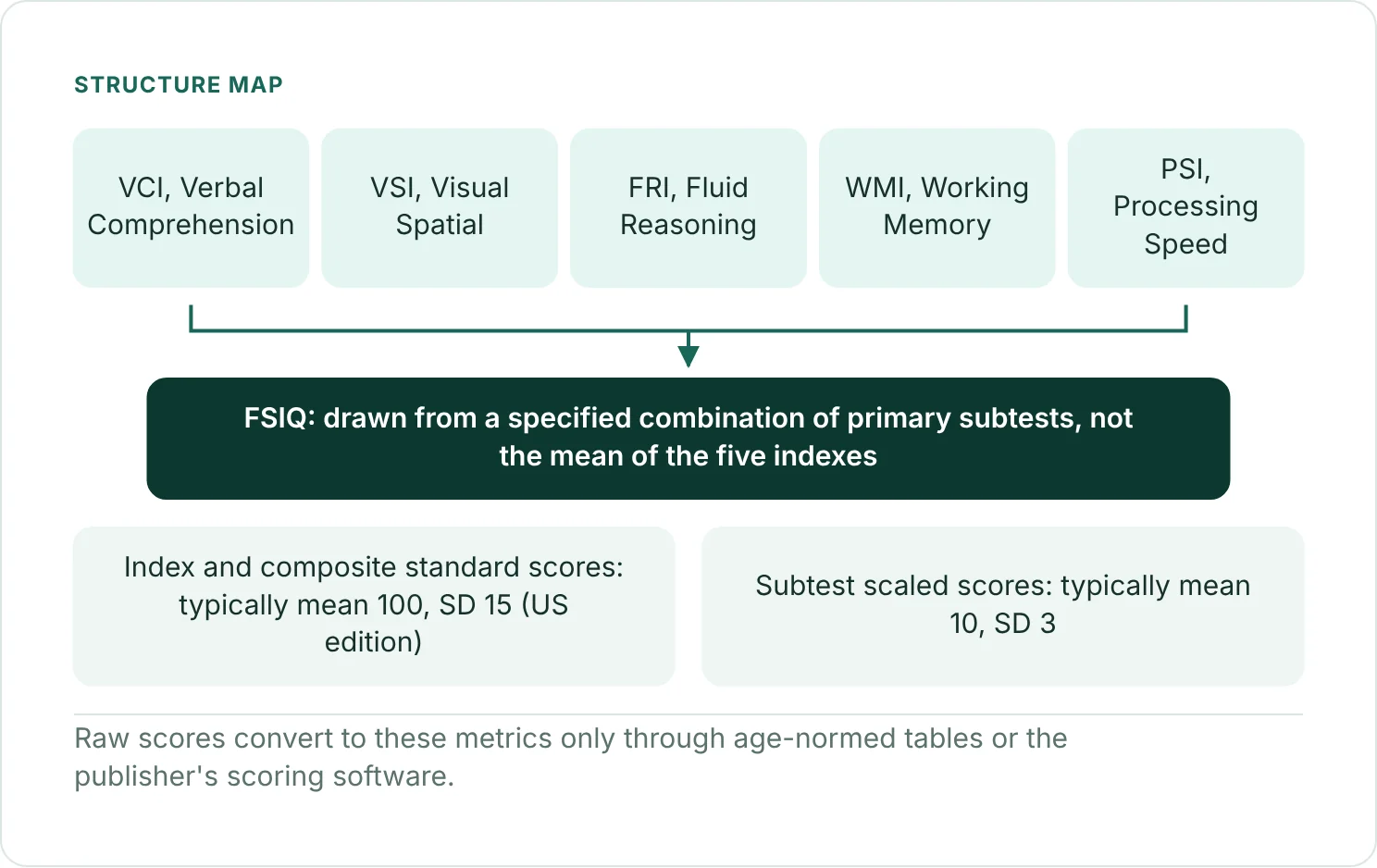
- Primary indexes: Verbal Comprehension (VCI), Visual Spatial (VSI), Fluid Reasoning (FRI), Working Memory (WMI) and Processing Speed (PSI).
- Full Scale IQ: FSIQ is derived from a specified combination of primary subtests. It is not the arithmetic mean of the five index scores.
- Other scores: ancillary and complementary composites are available, and the subtests needed depend on which scores a referral requires.
- Metrics: subtest scaled scores and composite standard scores come from age-specific norm conversions, and percentile ranks and confidence intervals accompany them.
- Edition: the US edition and separately normed language or country adaptations are not interchangeable, and neither is the WISC-IV.
- Validity conditions: standardized administration, language suitability, sensory and motor accommodations and testing behavior all affect how far a profile can be trusted.
The instrument itself is available from the publisher, Pearson.
Scoring the WISC-V
- A qualified examiner administers the US edition or a locally normed adaptation under the standardized procedures, recording exact age, version and test conditions.
- Raw subtest results are produced with the publisher’s rules, which include age-specific start, stop and timing provisions.
- Raw results are converted with the publisher’s age-normed tables or scoring software into scaled scores, index standard scores and FSIQ. No arithmetic on raw scores yields a valid IQ.
- For research, receive these final composites in de-identified form together with age, edition, language and any note on validity, and keep raw responses and norm tables out of the analytic file.
- Handle missing or unadministered subtests only by substitution or proration rules the publisher specifies, and report any that were used.
* Illustrative syntax: wisc_* variables are final composite standard scores already supplied by examiners.
DESCRIPTIVES VARIABLES=wisc_fsiq wisc_vci wisc_vsi wisc_fri wisc_wmi wisc_psi
/STATISTICS=MEAN STDDEV MIN MAX.# data: one row per child; composites already scored by examiners, not raw responses.
vars <- c("wisc_fsiq", "wisc_vci", "wisc_vsi", "wisc_fri", "wisc_wmi", "wisc_psi")
summary(data[vars])Interpreting WISC-V Scores
| Score | Interpretation |
|---|---|
| FSIQ | Overall composite of selected subtests; consider scatter before relying on one summary |
| VCI | Verbal reasoning and acquired verbal knowledge |
| VSI | Analysis of spatial relationships and visual construction |
| FRI | Nonverbal reasoning with novel information |
| WMI | Holding and working with information |
| PSI | Efficiency and speed on visual processing tasks |
Source: Wechsler (2014); these rows describe constructs and are not numerical cutoff bands.
Composite standard scores typically have a mean of 100 and a standard deviation of 15 in the US norms, and subtest scaled scores a mean of 10 and a standard deviation of 3. Percentile ranks and confidence intervals give more honest context than a fixed label, because every score carries measurement error. Compare scores only within the same edition and norms.
A low index score alone does not establish a neurodevelopmental or learning disorder, and a single IQ value can hide uneven performance across domains. Interpretation belongs to qualified examiners.
Psychometric Properties
| Property | Published finding | Source |
|---|---|---|
| Normative basis | US standardization sample of 2,200 children aged 6 years 0 months to 16 years 11 months | Wechsler (2014) |
| Reliability | Composite precision varies by age and composite; no single coefficient describes the whole battery | Wechsler (2014) |
| Test-retest | Stability depends on age, interval, composite and practice effects | Wechsler (2014) |
| Validity | Index structure and convergent and clinical evidence are described in the technical manual | Wechsler (2014) |
| Measurement error | Standard errors and confidence intervals should accompany every composite | Wechsler (2014) |
These are descriptions from the publisher’s materials and cannot be assumed to hold in a new sample, language or special group.
Using the WISC-V in a Study
Treat FSIQ and index composites as standardized, age-normed outcomes and not as raw totals. Check edition, age, language and administration mode before combining groups, and report how many valid composites exist for each index and why any test could not be scored. Regression, ANCOVA or MANOVA fit when the design supports them, and the choice follows the research question.
Index comparisons within a child are correlated, so tests of many index differences need adjustment for multiplicity and attention to the manual’s base rates for discrepancies. Repeated testing carries practice and developmental effects. Statistical power depends on the variation of the composite in your sample and the difference you care about, not on the norm standard deviation alone. Prespecify whether the primary outcome is FSIQ or a particular index.
Related guides: ANCOVA · MANOVA · Multiple Linear Regression · Psychology & Behavioral Sciences
Reporting the WISC-V
Cognitive functioning was assessed with the Wechsler Intelligence Scale for Children, Fifth Edition (WISC-V; Wechsler, 2014), administered and scored by [examiner qualification] using [US or local] norms. Analyses used the age-standardized Full Scale IQ and the prespecified index scores [name indexes] and not raw subtest results. Scores are reported as composite standard scores with confidence intervals, and interpretation considered test validity, language, age and variation across domains.
References
Wechsler, D. (2014). Wechsler Intelligence Scale for Children (5th ed.). Pearson.
Frequently Asked Questions
Can I compute FSIQ by adding or averaging subtests?
No. FSIQ comes from a publisher-defined combination of subtests and age-specific norm conversions.
Are WISC-V scores comparable across countries?
Not automatically. The language edition, norm sample and accommodations must be documented before pooling or cross-country comparison.
What ages does the US WISC-V cover?
Children aged 6 years 0 months through 16 years 11 months. Other batteries are used outside that range.
Should I analyze FSIQ or the index scores?
Prespecify according to the research question. FSIQ is an overall summary, while index analyses need clear hypotheses and adjustment for multiplicity.
NEXT STEP
Need WISC-V Composites Analyzed
or Checked?
OnlineSPSS is a statistical consultancy for researchers. Share your design and dataset, and a statistically trained Research Coordinator reviews it. The scope and one fixed project fee are confirmed before work begins.
No Commitment Required
Strictly Confidential
Fixed Project Fee
In-House PhD-Level Statisticians
Same-Day Response
Serving Researchers Since 2014