
Home / Resources / Psychological Measures / WAIS-IV
WAIS-IV:
Scoring and Interpretation
The Wechsler Adult Intelligence Scale, Fourth Edition (WAIS-IV), is an individually administered test of adult cognitive ability that yields four index scores and a Full Scale IQ (FSIQ). WAIS-IV scoring converts raw subtest performance through age-referenced tables in the manual and its scoring software, so the analysis stage gets the attention here: which scores to model, how to treat their correlations and what to record about the edition. The code covers scored composites only.
What the WAIS-IV Measures
Wechsler (2008) standardized the test for people aged 16 years to 90 years 11 months, and every score it reports is relative to an age-referenced normative group. Subtest scaled scores have a mean of 10 and a standard deviation of 3 within each age band, and the index scores and the FSIQ have a mean of 100 and a standard deviation of 15 in the normative sample. A raw task result therefore carries no fixed meaning across ages.
Researchers use the scores to describe cognitive profiles in clinical and neuropsychological samples. One methodological point shapes the analysis: factor analyses of the standardization data found that a general factor accounted for a large share of the total and common variance, while the four first-order factors accounted for little, and the authors concluded that clinical interpretation should be mainly at the general level (Canivez & Watkins, 2010). The indexes are correlated, and they are not independent measures.
Structure of the WAIS-IV
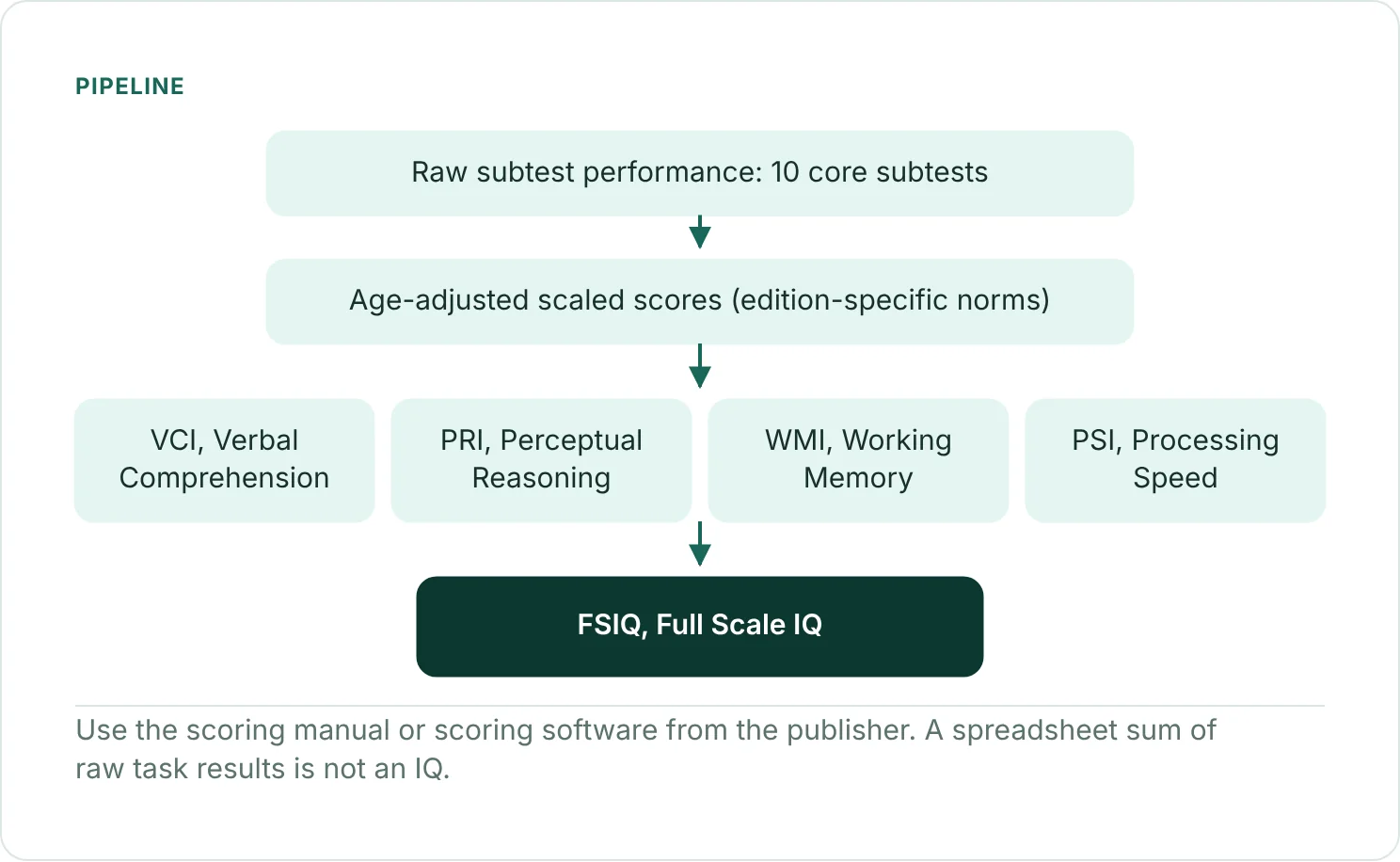
- Battery: ten core subtests contribute to four index scores, Verbal Comprehension (VCI), Perceptual Reasoning (PRI), Working Memory (WMI) and Processing Speed (PSI), and the FSIQ is built from all ten. Supplemental subtests exist, and the manual defines when one may substitute for a core subtest.
- Conversion: each raw subtest performance becomes an age-referenced scaled score, and the scaled scores are combined into composites by the documented procedure (Wechsler, 2008).
- Direction: higher scores mean higher performance relative to the age group. There are no reverse-scored items and no questionnaire response scale.
- No raw total: a sum of raw subtest results is not an IQ and should not be approximated in a spreadsheet.
- Editions: the WAIS-5, released after the WAIS-IV, is a separate edition with its own index organization and norms. Scores from the two editions are not interchangeable.
- Norms and language: identify which normative sample and which language edition produced the scores. Adaptations for other countries have their own norms.
The test materials, conversion tables and scoring software come from the publisher, Pearson. This post reproduces none of them and treats the scored composites as the data to analyze.
How to Score the WAIS-IV
- Record the edition, the administration format, the date of testing and the age at testing, because the age band determines which conversions apply.
- Convert each raw subtest performance to a scaled score with the manual or the scoring software, and not by an ad hoc formula.
- Obtain the four index scores and the FSIQ through the documented procedure for the scaled scores you hold.
- Record every substituted, spoiled or omitted subtest, and note whether a standard composite could be computed. Do not fill a missing composite from raw data.
- Import the scored composites with a clear missing-value code, and analyze those values.
* Illustrative syntax: these variables hold composites exported from the scoring system, not raw task results.
DESCRIPTIVES VARIABLES=wais_vci wais_pri wais_wmi wais_psi wais_fsiq /STATISTICS=MEAN STDDEV MIN MAX.
CORRELATIONS /VARIABLES=wais_vci wais_pri wais_wmi wais_psi /MISSING=PAIRWISE.# data: one row per person; composites exported from the scoring system.
vars <- c("wais_vci", "wais_pri", "wais_wmi", "wais_psi", "wais_fsiq")
stopifnot(all(vars %in% names(data)))
summary(data[vars])
round(cor(data[vars[1:4]], use = "pairwise.complete.obs"), 2)Interpreting WAIS-IV Scores
| Score | Interpretation |
|---|---|
| VCI, PRI, WMI, PSI | Standing on each index relative to the age-referenced normative group |
| FSIQ | Standing on the overall composite of the ten core subtests, on the same standard-score metric |
| Descriptive labels | Take labels and confidence intervals from the manual, and do not borrow generic IQ category lists |
Source: Wechsler (2008); Canivez & Watkins (2010).
A composite describes performance relative to the normative sample for that edition and age group. Whether a difference between two index scores is meaningful depends on measurement error and on how often such a difference occurs in the normative sample, so report the uncertainty the manual provides. The factor-analytic findings above also mean that an index may add little beyond general ability, so a domain-specific claim needs more than a single index contrast.
Do not approximate a WAIS-IV score by adding raw subtest values, and do not treat scores from a different edition, including the WAIS-5, as on the same footing. An FSIQ can be hard to interpret when the component indexes differ markedly.
Psychometric Properties
| Property | Published finding | Source |
|---|---|---|
| Standardization | US age-referenced norms for ages 16 to 90 years 11 months; scaled scores with mean 10 and SD 3, composites with mean 100 and SD 15 | Wechsler (2008) |
| Factor structure | Subtests associated with the four proposed first-order factors, with a large general factor accounting for most of the common variance | Canivez & Watkins (2010) |
| Reliability and validity | The technical manual reports reliability and validity evidence for the composites | Wechsler (2008) |
| Retest and practice effects | No single value applies; consider the interval and the design | Study-specific |
These are source-specific findings and cannot be assumed to hold in a different sample, edition or language version.
Using the WAIS-IV in a Study
Decide first whether the question concerns overall ability or a specific domain. For overall ability, the FSIQ is the natural outcome. For domain hypotheses, model the indexes jointly and account for their correlations, for example with a multivariate model, and not as unrelated outcomes. Do not enter the FSIQ alongside the indexes it is built from, since it is a composite of the same subtests. Because the composites are already age-referenced, adding age as a covariate answers a different question, namely the relation of the score to age beyond what the norms remove.
In repeated assessments, consider retest effects and whether the same edition was used each time. In multi-site data, keep the edition, language version, normative sample, age at testing and examiner as variables. Do not convert WAIS-IV values to WAIS-5 values by a formula. Report whether the scores were professionally scored and quality checked before analysis.
Related guides: Confirmatory Factor Analysis (CFA) · MANOVA · Measurement Invariance · Cognitive Psychology
Reporting the WAIS-IV
Cognitive ability was assessed with the Wechsler Adult Intelligence Scale, Fourth Edition (WAIS-IV; Wechsler, 2008). Trained examiners administered the [battery] and age-referenced [VCI, PRI, WMI, PSI and FSIQ] composites were generated with [scoring system]. Analyses used [selected composites], and incomplete batteries were handled by [documented procedure].
References
Canivez, G. L., & Watkins, M. W. (2010). Investigation of the factor structure of the Wechsler Adult Intelligence Scale-Fourth Edition (WAIS-IV): Exploratory and higher order factor analyses. Psychological Assessment, 22(4), 827-836. https://doi.org/10.1037/a0020429
Wechsler, D. (2008). Wechsler Adult Intelligence Scale-Fourth Edition: Technical and interpretive manual. Pearson.
Frequently Asked Questions
Can I score the WAIS-IV from raw totals in SPSS?
No. Scoring needs the age-referenced conversions of the manual, so a spreadsheet sum of raw results is not an IQ.
What are the four WAIS-IV indexes?
Verbal Comprehension, Perceptual Reasoning, Working Memory and Processing Speed, with the Full Scale IQ as the overall composite.
Is the WAIS-5 the same as the WAIS-IV?
No. They are separate editions with their own index organization and norms, so scores should not be pooled without a justified harmonization plan.
Can I analyze the FSIQ as a continuous outcome?
Yes, once it has been scored correctly and suits the research question and the planned model.
NEXT STEP
Need WAIS-IV Data Modeled
or Checked?
OnlineSPSS is a statistical consultancy for researchers. Share your design and dataset, and a statistically trained Research Coordinator reviews it. The scope and one fixed project fee are confirmed before work begins.
No Commitment Required
Strictly Confidential
Fixed Project Fee
In-House PhD-Level Statisticians
Same-Day Response
Serving Researchers Since 2014