
Home / Resources / Psychological Measures / Vanderbilt ADHD
Vanderbilt ADHD Scales:
Scoring and Interpretation
The Vanderbilt ADHD Diagnostic Rating Scales collect structured parent and teacher ratings of attention, activity and functioning in school-age children. Vanderbilt ADHD scoring is not one total, because two nine-item symptom counts and a separate performance check each play a role, so the sections below set out the counting rule, the screening logic and how to handle missing items in SPSS or R.
What the Vanderbilt ADHD Scales Measure
Wolraich and colleagues designed the scales to support the evaluation of attention-deficit/hyperactivity disorder symptoms and related difficulties, including whether the concerns affect a child’s everyday performance (Wolraich et al., 2003).
The logic is not a total of all answers. Nine inattention symptoms, nine hyperactivity/impulsivity symptoms and the performance items are separate elements, and parent and teacher reports describe different settings. A US national norm study examined parent ratings for 1,570 children aged 5 to 12 (Anderson et al., 2022).
Structure of the Vanderbilt ADHD Scales
- Core symptoms: the first 18 items form two nine-item groups, inattention (items 1 to 9) and hyperactivity/impulsivity (items 10 to 18), each rated 0 to 3.
- Symptom count: for screening, ratings of 2 or 3 count as endorsed. A common initial-form rule asks for at least six endorsed symptoms in one group, plus impairment.
- Performance: a separate section rated 1 to 5, evaluated apart from the symptom counts.
- Other screens: oppositional, conduct and anxiety/depression items differ between the parent and teacher forms, and follow-up forms have different sections and functions.
- Translations: language and school context matter. Name the version, the language and its source.
The instrument itself is available from the National Institute for Children’s Health Quality (NICHQ) assessment-scale resources.
How to Score the Vanderbilt ADHD Scales
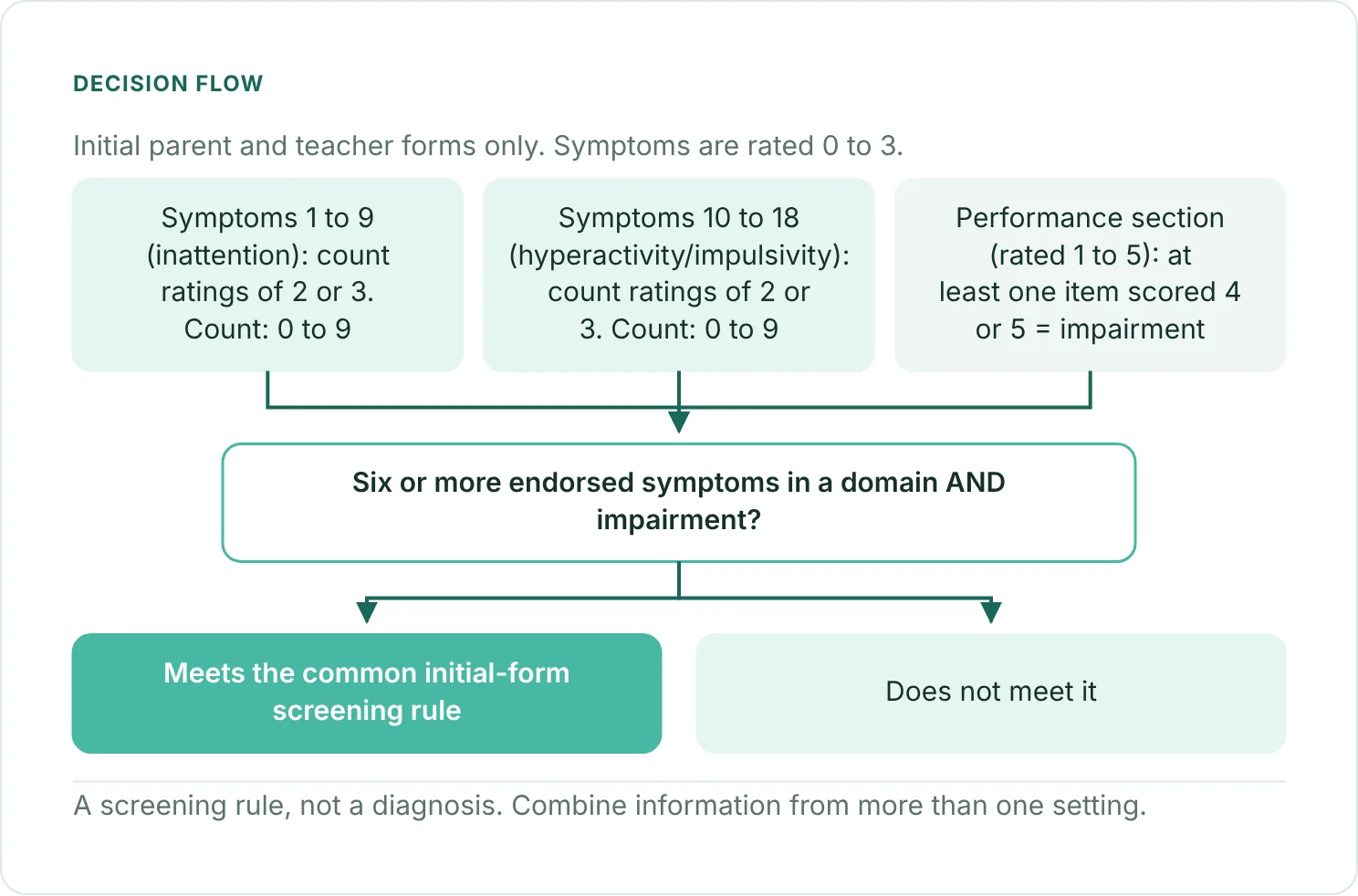
- Confirm whether the records come from the initial parent, initial teacher or a follow-up form, and never mix their rules.
- For the initial forms, count ratings of 2 or 3 among items 1 to 9 (inattention) and among items 10 to 18 (hyperactivity/impulsivity).
- Evaluate performance separately. In the common initial NICHQ scoring, at least one performance item rated 4 or 5 indicates impairment. Check the rule and the item numbering in the edition of the scoring instructions you use, because editions and forms differ.
- Apply the symptom threshold only in its screening context, with information from more than one setting.
- Handle missing symptom or performance items by a prespecified rule. A missing item does not mean “never”.
* Illustrative syntax: initial-form symptoms vad1 to vad18 coded 0 to 3.
COUNT vad_inatt_n = vad1 vad2 vad3 vad4 vad5 vad6 vad7 vad8 vad9 (2,3).
COUNT vad_hyper_n = vad10 vad11 vad12 vad13 vad14 vad15 vad16 vad17 vad18 (2,3).
IF (NMISS(vad1, vad2, vad3, vad4, vad5, vad6, vad7, vad8, vad9) > 0) vad_inatt_n = $SYSMIS.
IF (NMISS(vad10, vad11, vad12, vad13, vad14, vad15, vad16, vad17, vad18) > 0) vad_hyper_n = $SYSMIS.
EXECUTE.
* Performance impairment is evaluated separately with the form-specific items.# data: one row per rater; symptoms vad1 to vad18 coded 0 to 3.
sym <- paste0("vad", 1:18)
stopifnot(all(sym %in% names(data)))
count_endorsed <- function(cols) {
ifelse(rowSums(is.na(data[cols])) > 0, NA_integer_, rowSums(data[cols] >= 2))
}
data$vad_inatt_n <- count_endorsed(sym[1:9])
data$vad_hyper_n <- count_endorsed(sym[10:18])
# Evaluate performance separately with the matching parent or teacher items.Interpreting Vanderbilt ADHD Scores
| Output | Interpretation |
|---|---|
| Inattention count, 0 to 9 | Number of ratings of 2 or 3 among items 1 to 9 |
| Hyperactivity/impulsivity count, 0 to 9 | Number of ratings of 2 or 3 among items 10 to 18 |
| Six or more in a group | Common initial-form screening threshold, contingent on impairment |
| Performance impairment | A separate check: a rating of 4 or 5 on a performance item in common initial scoring |
| Clinical diagnosis | Not established by the questionnaire alone |
Source: NICHQ Vanderbilt scoring instructions; Wolraich et al. (2003).
The two symptom counts are useful but incomplete without impairment information and context. If the scale serves as a quantitative research measure and not as a screen, name the chosen count, mean or threshold, the rationale, and whether the reporter was a parent or a teacher.
Do not diagnose ADHD from the 18 symptom ratings alone, and do not mix parent, teacher and follow-up rules. The symptom-count rule is a screening aid and not a substitute for a full clinical evaluation.
Psychometric Properties
| Property | Published finding | Source |
|---|---|---|
| Parent scale validation | Psychometric properties of the parent scale were examined in a referred sample | Wolraich et al. (2003) |
| National norms | US norms for parent ratings were reported from caregivers of 1,570 children aged 5 to 12 | Anderson et al. (2022) |
| Scoring structure | The nine-item symptom groups and the performance section are defined in the scoring instructions | NICHQ scoring instructions |
| Reliability | No single coefficient is asserted; estimate internal consistency in your own sample | Study-specific |
These are source-specific findings and cannot be assumed to hold as reliability or accuracy estimates in a new sample.
Using the Vanderbilt ADHD Scales in a Study
In school-based or longitudinal work, keep the child identifier, respondent type, assessment time and school. When parents and teachers both rate a child, a multi-informant analysis is more defensible than choosing the higher value, and children nested in classrooms call for a multilevel model. Agreement between informants on screen status can be summarized with a chance-corrected statistic.
Symptoms can be analyzed as counts or means when that fits the question, while “screen positive” status requires the full stated algorithm. Check missing data, and ask whether the cutoff transfers to the age and clinical context studied. A national norm study is not a diagnostic gold standard, and screening accuracy needs its own reference-standard design.
Reporting the Vanderbilt ADHD Scales
Attention-deficit/hyperactivity symptoms were assessed with the [initial parent or initial teacher] Vanderbilt ADHD Diagnostic Rating Scale (Wolraich et al., 2003). Ratings of 2 or 3 were counted within the nine-item inattention and hyperactivity/impulsivity groups. Impairment was evaluated separately using [performance items]. Analyses used [symptom count, continuous severity or a prespecified screening indicator], with missing data handled by [rule].
References
Anderson, N. P., Feldman, J. A., Kolko, D. J., Pilkonis, P. A., & Lindhiem, O. (2022). National norms for the Vanderbilt ADHD Diagnostic Parent Rating Scale in children. Journal of Pediatric Psychology, 47(6), 652-661. https://doi.org/10.1093/jpepsy/jsab132
National Institute for Children’s Health Quality. (n.d.). NICHQ Vanderbilt Assessment Scales: Scoring instructions.
Wolraich, M. L., Lambert, E. W., Doffing, M. A., Bickman, L., Simmons, T., & Worley, K. A. (2003). Psychometric properties of the Vanderbilt ADHD Diagnostic Parent Rating Scale in a referred population. Journal of Pediatric Psychology, 28(8), 559-568. https://doi.org/10.1093/jpepsy/jsg046
Frequently Asked Questions
How many core ADHD symptoms do the Vanderbilt scales measure?
Eighteen: nine inattention items and nine hyperactivity/impulsivity items on the initial forms.
Do six endorsed symptoms establish ADHD?
No. Six is one element of the common initial-form screening rule, alongside impairment and other diagnostic evidence.
Are the parent and teacher scales identical?
Their core ADHD symptoms are aligned, but the performance and other screening sections are not completely identical.
Can I use Vanderbilt symptom counts in a regression model?
Yes, if the counting rule and its rationale are documented and the model respects the design, for example children clustered in classrooms.
NEXT STEP
Need Vanderbilt ADHD Ratings Scored
or Checked?
OnlineSPSS is a statistical consultancy for researchers. Share your design and dataset, and a statistically trained Research Coordinator reviews it. The scope and one fixed project fee are confirmed before work begins.
No Commitment Required
Strictly Confidential
Fixed Project Fee
In-House PhD-Level Statisticians
Same-Day Response
Serving Researchers Since 2014