
Can You Upload Research Data to ChatGPT? Questions to Ask First
Whether you may upload research data to ChatGPT depends on the data, the product configuration, your organization's policies and your research permissions. It is not a universal yes or no. Before uploading patient, participant, student or institutional records, confirm the applicable consent, IRB and contractual requirements, as well as how the chosen service processes and retains files (U.S. Department of Health and Human Services [HHS], n.d.; U.S. Department of Education, n.d.).
AI is useful for research. But using it does not require sending identifiable or restricted records to a general-purpose service. For many projects, generating and reviewing generic analysis code while executing it in an approved environment is a practical alternative.
Which types of research data deserve an additional check?
| Data you plan to upload | Question to answer before uploading |
|---|---|
| Participant-level survey responses | Did the consent and IRB-approved data-management plan permit this disclosure? |
| Patient records or protected health information | Is the service authorized for the specific processing, with the required safeguards and agreements? |
| Student education records | Is access and disclosure allowed under institutional FERPA arrangements? |
| Interview transcripts | Could quotations, occupations, events or small groups identify individuals? |
| Unpublished datasets from collaborators | Does the data-use agreement allow an external processor to access them? |
| Synthetic data or generic code | Are the examples genuinely synthetic, with no fragments of real records? |
Even a file without names can contain indirect identifiers, combinations of rare characteristics or open-text disclosures. Removing a name does not, on its own, establish anonymization or permission to share.
What does HIPAA mean for an AI service?
In the United States, HIPAA applies to specified covered entities and business associates and to protected health information within its scope; not every research dataset is automatically subject to HIPAA. HHS explains that covered entities and business associates may use a cloud service to handle electronic protected health information where the required HIPAA-compliant business associate agreement and other safeguards are in place (HHS, n.d.). This is why blanket claims that all cloud use is illegal are incorrect.
A research team must verify that the specific product and account arrangement is authorized for its use case. A general promise that a vendor will not train on the data is not, by itself, the same as fulfilling all relevant HIPAA, consent or security requirements. This article is not legal advice.
What does FERPA mean for student data?
The U.S. Department of Education describes restrictions and exceptions for disclosing personally identifiable information from education records under FERPA. Certain vendor arrangements may be allowed under applicable conditions, but they are not automatic permission to paste student-level records into an unfamiliar service (U.S. Department of Education, n.d.). The institution’s approved technology and data-sharing policies matter.
Do privacy settings make it acceptable to upload research data to ChatGPT?
ChatGPT offers different consumer and organizational products, and their data controls are not identical. OpenAI’s published guidance distinguishes individual settings for model improvement from default data-use arrangements in certain business and institutional offerings (OpenAI, n.d.). Product features and terms can change, so check the current documentation for the actual workspace, retention settings and approved data flow.
Privacy settings are one part of the decision, not a substitute for authorization. A researcher’s institution may prohibit a transfer even where a vendor does not use the file for model training. Conversely, a properly approved enterprise workflow may meet requirements that an ordinary personal account does not.
Seven questions to ask before you upload
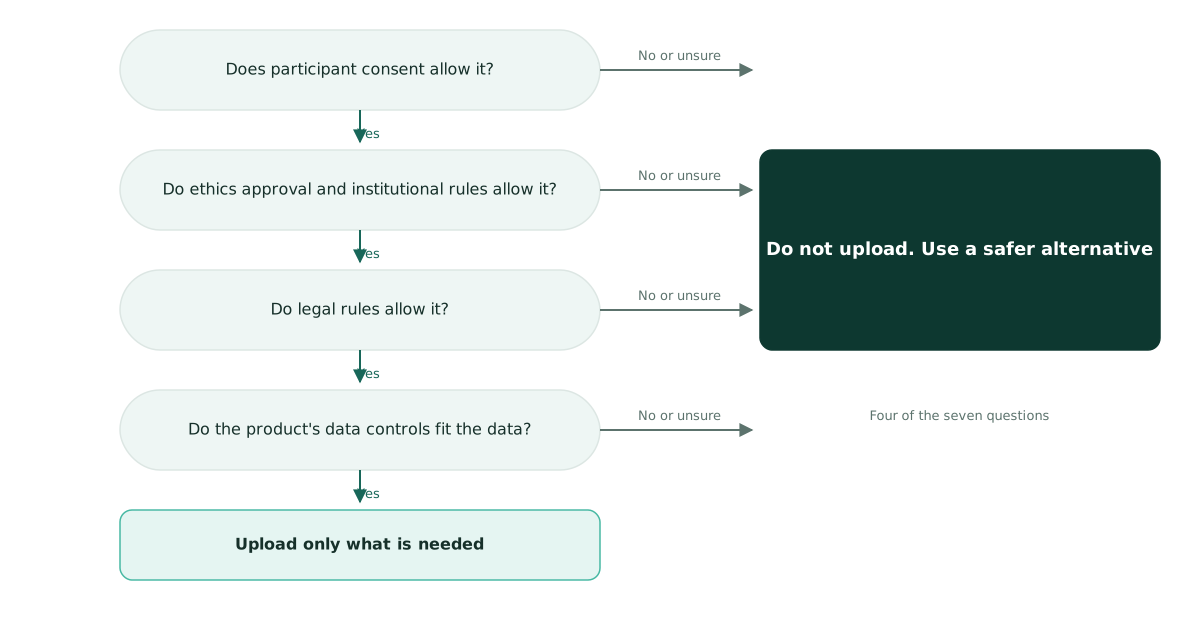
- Who owns or controls this dataset, and who can authorize external processing?
- Does the participant consent, protocol, IRB or data-use agreement permit this particular upload?
- Are direct or indirect identifiers present, including in notes and open-text fields?
- Which product, workspace, service provider and retention arrangement will receive the file?
- Are applicable access, transfer, contractual and security safeguards in place?
- Is there a locally executable alternative that achieves the same analysis goal?
- Can the researcher document who reviewed and approved the workflow?
If the answer to a material question is unknown, stop the upload until the responsible institutional team resolves it. In a regulated or high-risk project, involve the data controller, privacy office, information security lead or IRB as relevant.
What can you do with AI without uploading the study dataset?
A statistician can describe a variable structure abstractly, request an example script using invented variable names and synthetic records, then run and validate it on approved local computers. The AI tool need not see the participants. A script can be checked for missing-data behavior, variable transformations, unit of analysis and reproducibility before execution on real data.
This does not automatically solve every security issue: tools integrated with cloud editors, external APIs or telemetry may still transmit information. The execution environment needs an appropriate review too.
Frequently asked questions
Is de-identified research data always safe to upload?
No. Re-identification risk and permissions depend on the data, the method of de-identification, applicable rules and the proposed recipient. A separate article in this series covers de-identification methods in more depth.
Can I paste only my regression output into ChatGPT?
Possibly, if the output contains no restricted information and the institution permits the sharing. Some outputs or rare-subgroup tables can still disclose information, so assess the content rather than assuming that results are anonymous.
Does the same advice apply to Claude and other tools?
Yes in principle: examine the particular tool, account, contracts, processing and institutional approval rather than relying on the brand name alone.
Quantitative Data AnalysisPlanning analysis of sensitive research data? Research data and project details are handled confidentially, and an NDA is available where required, before sensitive materials are shared.
Quantitative Data Analysis
OnlineSPSS is a specialist statistical consultancy for researchers, and Quantitative Data Analysis is carried out in-house by PhD-level statisticians. Research data and project details are handled confidentially. An NDA is available where required and can be arranged before sensitive materials are shared.
References
- OpenAI. (n.d.). Data controls in ChatGPT. https://help.openai.com/en/articles/7730893-data-controls-in-chatgpt
- U.S. Department of Education, Student Privacy Policy Office. (n.d.). Privacy and data sharing. https://studentprivacy.ed.gov/privacy-and-data-sharing
- U.S. Department of Health and Human Services. (n.d.). Guidance on HIPAA and cloud computing. https://www.hhs.gov/hipaa/for-professionals/special-topics/health-information-technology/cloud-computing/index.html
Last reviewed November 2026 by the OnlineSPSS Statistical Team. Worked examples use hypothetical values and are not client data.
NEXT STEP
Need this done for
your study?
Share your research in about a minute and receive a complimentary assessment the same day: scope, timeline and one fixed fee.
No Commitment Required
Strictly Confidential
Fixed Project Fee
In-House PhD-Level Statisticians
Same-Day Response
Serving Researchers Since 2014