
Home / Resources / Psychological Measures / TIPI
TIPI:
Scoring and Interpretation
The Ten-Item Personality Inventory (TIPI) is a 10-item self-report measure of the Big Five dimensions, with two items for each. TIPI scoring is simple in principle but easy to get wrong in a survey export, so this guide sets out the pairing and the five reversed items, the 1 to 7 means, how to judge reliability for two-item scales, SPSS and R code, and reporting wording.
What the TIPI Measures
Gosling et al. (2003) designed the TIPI for situations where a longer Big Five inventory is not practical, such as a large survey with little room for personality items or a study in which personality is a secondary variable. Each trait is represented by only two items, and the five traits are Extraversion, Agreeableness, Conscientiousness, Emotional Stability and Openness to Experience.
The trade-off is depth. Two items cover a narrow slice of each broad trait, so the TIPI is better suited to descriptive and control purposes than to detailed trait assessment. The developers evaluated it against longer Big Five measures, and short-scale reliability needs a different lens than a conventional alpha. It is a personality measure and not a diagnostic or mental health screening tool.
Structure of the TIPI
- Items: ten, each a pair of descriptive terms rated for how well the pair describes the respondent. The item order is fixed and must match your survey columns.
- Response format: seven points from disagree strongly (1) to agree strongly (7).
- Traits: five, each the mean of two items. Emotional Stability is the opposite pole of neuroticism, so its direction should be stated and not relabeled silently.
- Reverse-keyed items: 2, 4, 6, 8 and 10, rescored as 8 minus the response. Every trait pairs one regular item with one reversed item.
- Total: none. The TIPI yields five separate scores.
- Translations: use a translation with documented evidence, and name it. Check the item order of the translated form.
The instrument itself is available from Gosling, the developer, whose website publishes the scale and its scoring key.
How to Score the TIPI
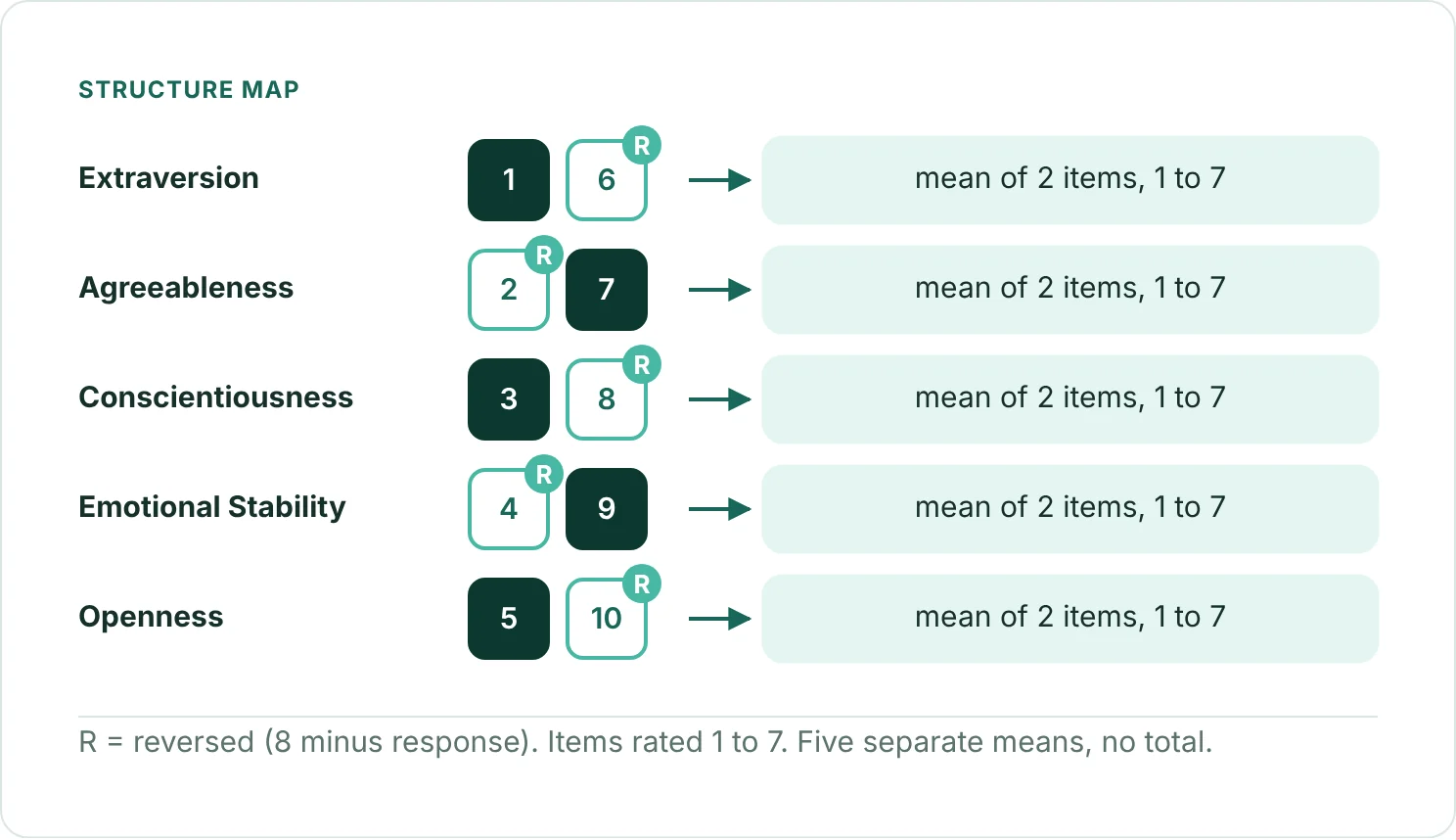
- Check that tipi1 to tipi10 hold whole numbers from 1 to 7, with missing responses coded as missing, and that the column order matches the original item order.
- Reverse items 2, 4, 6, 8 and 10 once only (8 minus the response), creating new variables so the originals stay unchanged.
- Average each pair: Extraversion (1, 6R), Agreeableness (2R, 7), Conscientiousness (3, 8R), Emotional Stability (4R, 9) and Openness (5, 10R).
- With two items per trait, leave a trait missing if either item is missing, unless a rule is prespecified and reported. The code below does this.
- Report the five means separately and do not sum them into a personality total.
* Illustrative syntax: tipi1 to tipi10 coded 1 to 7 in the original item order.
COMPUTE tipi2r = 8-tipi2.
COMPUTE tipi4r = 8-tipi4.
COMPUTE tipi6r = 8-tipi6.
COMPUTE tipi8r = 8-tipi8.
COMPUTE tipi10r = 8-tipi10.
COMPUTE tipi_extraversion = MEAN.2(tipi1, tipi6r).
COMPUTE tipi_agreeableness = MEAN.2(tipi2r, tipi7).
COMPUTE tipi_conscientiousness = MEAN.2(tipi3, tipi8r).
COMPUTE tipi_emotional_stability = MEAN.2(tipi4r, tipi9).
COMPUTE tipi_openness = MEAN.2(tipi5, tipi10r).
EXECUTE.# data: one row per respondent; tipi1 to tipi10 coded 1 to 7 in the original item order.
items <- paste0("tipi", 1:10)
stopifnot(all(sapply(data[items], function(x) all(is.na(x) | x %in% 1:7))))
rev_item <- function(j) 8-data[[paste0("tipi", j)]]
pair_mean <- function(x, y) ifelse(is.na(x) | is.na(y), NA_real_, (x + y) / 2)
data$tipi_extraversion <- pair_mean(data$tipi1, rev_item(6))
data$tipi_agreeableness <- pair_mean(rev_item(2), data$tipi7)
data$tipi_conscientiousness <- pair_mean(data$tipi3, rev_item(8))
data$tipi_emotional_stability <- pair_mean(rev_item(4), data$tipi9)
data$tipi_openness <- pair_mean(data$tipi5, rev_item(10))Interpreting TIPI Scores
| Score band | Interpretation |
|---|---|
| Extraversion, 1 to 7 | Higher = more self-described extraversion |
| Agreeableness, 1 to 7 | Higher = more self-described agreeableness |
| Conscientiousness, 1 to 7 | Higher = more self-described dependability and self-discipline |
| Emotional Stability, 1 to 7 | Higher = greater emotional stability, so lower neuroticism |
| Openness, 1 to 7 | Higher = more openness to new experiences |
Source: Gosling et al. (2003); the TIPI has no clinical cutoffs and no total score.
Each mean is a continuous self-description and is read within its own trait. Two respondents with the same mean can have different responses to the two items, so a TIPI score has limited precision for an individual. The scores suit group-level analysis, where the question is how a trait relates to other variables, and are not appropriate for classifying people.
A short form is a design choice and not evidence that it can replace a longer inventory. Low alpha for two items is not automatic evidence of a poor scale, and a high one does not validate it.
Psychometric Properties
| Property | Published finding | Source |
|---|---|---|
| Convergent validity | Reached adequate convergence with widely used Big Five measures in self, observer and peer reports, though somewhat below standard multi-item instruments | Gosling et al. (2003) |
| Test-retest reliability | Reached adequate levels in the development studies | Gosling et al. (2003) |
| External correlates | Showed the predicted patterns of external correlates and adequate convergence between self and observer ratings | Gosling et al. (2003) |
| Internal consistency | Two-item scales have limited alpha by design; assess more than alpha | Gosling et al. (2003) |
| Reliability | Report the inter-item correlation and a suitable coefficient in your own sample | Study-specific |
These are source-specific findings and cannot be assumed to hold as reliability or validity estimates in a new sample.
Using the TIPI in a Study
Use the TIPI where personality is a covariate or a secondary construct in a larger survey. If personality is the main explanatory construct, a longer inventory with fuller domain coverage will usually serve the question better. Prespecify which traits enter each model and report standardized effects with confidence intervals, not a list of nominally significant associations.
For two-item scales, inspect distributions and missingness, and summarize reliability with the inter-item correlation, a Spearman-Brown type coefficient or both, in addition to alpha. Because each trait mean takes only a limited set of values between 1 and 7, check floor and ceiling effects before choosing a model. If the TIPI is validated in a new population, compare it with a longer measure in the same respondents.
Reporting the TIPI
Personality was assessed with the Ten-Item Personality Inventory (TIPI; Gosling et al., 2003), rated from 1 (disagree strongly) to 7 (agree strongly). Items 2, 4, 6, 8 and 10 were reverse-scored, and each of the five traits was computed as the mean of its two items (range = 1 to 7), with higher scores indicating more of the trait. A trait was set to missing when either item was missing. The correlation between the two items in the present sample was [r per trait], and traits were used as [covariates or outcomes].
References
Gosling, S. D., Rentfrow, P. J., & Swann, W. B., Jr. (2003). A very brief measure of the Big-Five personality domains. Journal of Research in Personality, 37(6), 504-528. https://doi.org/10.1016/S0092-6566(03)00046-1
Frequently Asked Questions
Which TIPI items are reverse scored?
Items 2, 4, 6, 8 and 10 in the original item order. For responses from 1 to 7, the reversed value is 8 minus the response.
Do I sum all ten TIPI items?
No. The intended output is five separate two-item means, one per trait.
Why is the TIPI alpha often low?
Alpha depends on the number of items, and a two-item scale gives it very little to work with. Report the inter-item correlation and judge the scale against the developers’ validity evidence and your purpose.
Can the TIPI replace a full Big Five inventory?
It can serve as a practical brief measure in some designs, but it is not equivalent to a longer inventory when detailed trait assessment is needed.
NEXT STEP
Need TIPI Scores Set Up
or Checked?
OnlineSPSS is a statistical consultancy for researchers. Share your design and dataset, and a statistically trained Research Coordinator reviews it. The scope and one fixed project fee are confirmed before work begins.
No Commitment Required
Strictly Confidential
Fixed Project Fee
In-House PhD-Level Statisticians
Same-Day Response
Serving Researchers Since 2014