
Home / Resources / Psychological Measures / TAS-20
TAS-20:
Scoring and Interpretation
The Toronto Alexithymia Scale (TAS-20) is a 20-item self-report measure of difficulty identifying and describing feelings and of externally oriented thinking. TAS-20 scoring hinges on five reversed items scattered across the subscales, and the conventional 51 and 61 bands are often quoted with more authority than they carry. The sections below cover the key, the code and a methods paragraph you can adapt.
What the TAS-20 Measures
Bagby, Parker and Taylor (1994a) selected the 20 items from earlier, longer versions of the Toronto Alexithymia Scale and cross-validated a three-factor structure. The factors capture trouble identifying feelings and telling them apart from bodily sensations, trouble describing feelings to others, and a style of thinking oriented toward external events more than inner experience.
The scale is used in psychosomatic medicine, clinical psychology and emotion research to study how emotional processing relates to physical and mental health. A TAS-20 score describes a self-reported trait. It is not a clinical assessment, and correlations with depression, somatic symptoms or clinical status do not show that alexithymia causes them.
Structure of the TAS-20
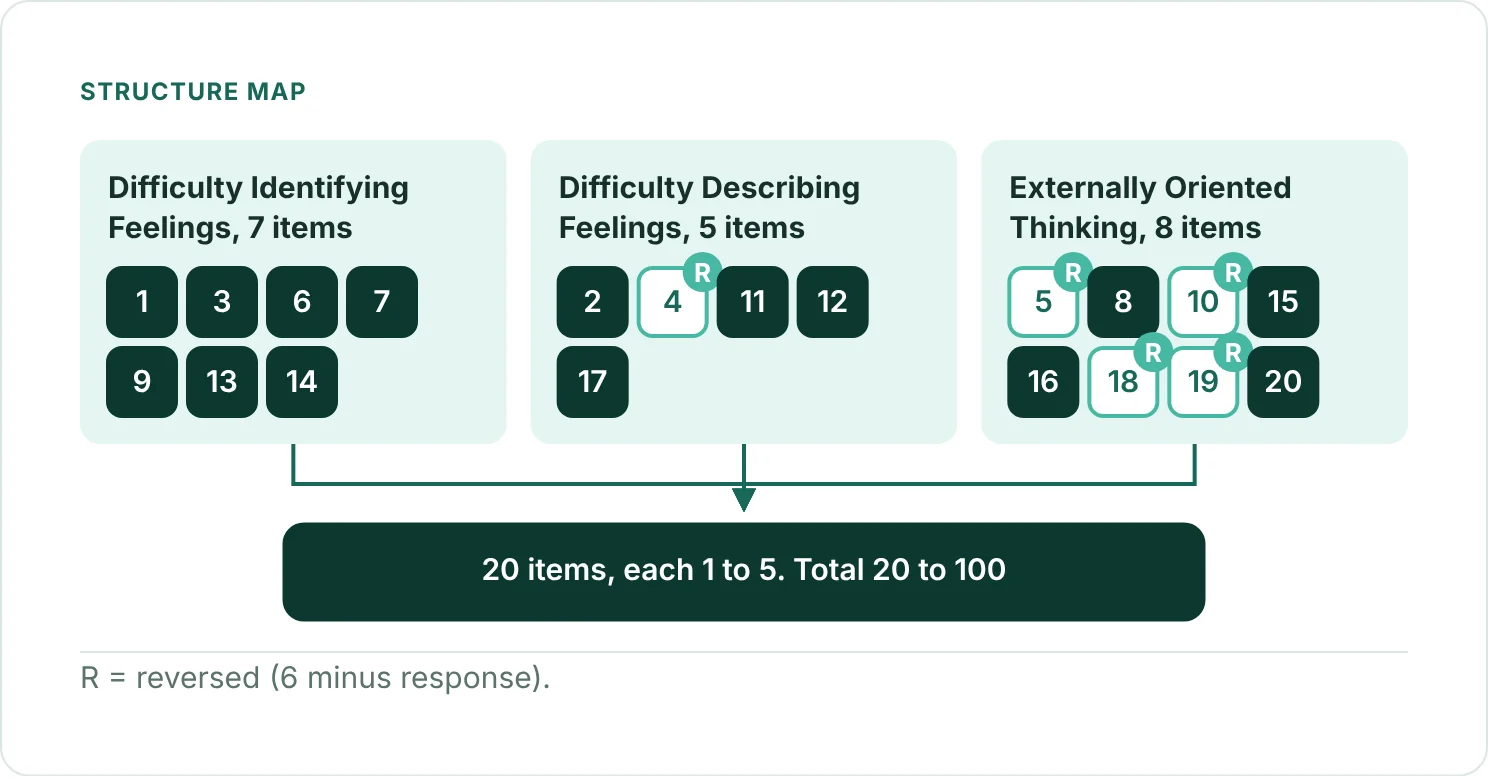
- Items: twenty statements rated from 1 to 5 on an agreement scale.
- Subscales: Difficulty Identifying Feelings (items 1, 3, 6, 7, 9, 13, 14), Difficulty Describing Feelings (2, 4, 11, 12, 17) and Externally Oriented Thinking (5, 8, 10, 15, 16, 18, 19, 20).
- Direction: items 4, 5, 10, 18 and 19 are reverse-scored. They fall in two different subscales, so a subscale cannot be keyed by reversing a block. After keying, higher scores mean more alexithymia-related difficulty.
- Total: the sum of all 20 keyed items, from 20 to 100. Subscale sums are shorter and have their own ranges.
- Versions: the TAS-20 is distinct from earlier, longer Toronto scales, and their scores are not interchangeable with it.
- Translations: name the language and its source, and check the factor structure again, especially for Externally Oriented Thinking.
The scale is described in Bagby et al. (1994a). Use the item wording and instructions of the version you administered and name it in the methods.
How to Score the TAS-20
- Check that the items are in the original 20-item order and that every response is an integer from 1 to 5.
- Reverse items 4, 5, 10, 18 and 19 by subtracting each response from 6, keeping the raw items unchanged.
- Sum all 20 keyed items to obtain tas20_total, which ranges from 20 to 100. Sum the items of each subscale separately if the analysis needs them.
- Apply a missing-item rule set in the protocol. No developer-endorsed prorating rule was verified, so the code below requires all 20 responses. Report how incomplete responses were handled.
* Illustrative syntax: tas1 to tas20 coded 1 to 5, standard item order.
COMPUTE tas4r = 6 - tas4.
COMPUTE tas5r = 6 - tas5.
COMPUTE tas10r = 6 - tas10.
COMPUTE tas18r = 6 - tas18.
COMPUTE tas19r = 6 - tas19.
COMPUTE tas20_total = SUM.20(tas1, tas2, tas3, tas4r, tas5r, tas6, tas7, tas8, tas9, tas10r, tas11, tas12, tas13, tas14, tas15, tas16, tas17, tas18r, tas19r, tas20).
EXECUTE.# data: one row per respondent; items tas1 to tas20 coded 1 to 5.
x <- data[paste0("tas", 1:20)]
stopifnot(all(vapply(x, function(z) all(is.na(z) | z %in% 1:5), logical(1))))
rev_items <- c(4, 5, 10, 18, 19)
x[rev_items] <- lapply(x[rev_items], function(z) 6 - z)
data$tas20_total <- rowSums(x, na.rm = FALSE)
data$tas20_identify <- rowSums(x[c(1, 3, 6, 7, 9, 13, 14)], na.rm = FALSE)
data$tas20_describe <- rowSums(x[c(2, 4, 11, 12, 17)], na.rm = FALSE)
data$tas20_external <- rowSums(x[c(5, 8, 10, 15, 16, 18, 19, 20)], na.rm = FALSE)Interpreting TAS-20 Scores
| Score band | Interpretation |
|---|---|
| 20 to 51 | At or below the conventional lower band (no alexithymia by convention) |
| 52 to 60 | Conventional intermediate band (possible alexithymia) |
| 61 to 100 | At or above the conventional upper band (alexithymia by convention) |
Source: cutoffs proposed by the TAS-20 developers (Bagby, Parker and Taylor) for research classification; descriptive conventions, not diagnostic thresholds.
Higher totals indicate more self-reported difficulty identifying and describing feelings and more externally oriented thinking. The bands of 51 or below, 52 to 60 and 61 or above are widely used to describe groups, but they are not diagnoses, and their classification accuracy should not be assumed to be the same in every population or language. When the analysis allows it, use the continuous total or the subscales and avoid sorting people into bands.
The total and the three subscales can tell different stories. Externally Oriented Thinking is often reported to be less reliable than the other two factors, so check each subscale in your own sample before interpreting it alone.
Psychometric Properties
| Property | Published finding | Source |
|---|---|---|
| Item selection and structure | Twenty items selected and a three-factor structure cross-validated | Bagby et al. (1994a) |
| Convergent and discriminant validity | Examined in a companion validation study | Bagby et al. (1994b) |
| Reliability | Differs by sample, language and subscale; compute coefficients for each score you analyze | Study-specific |
| Diagnostic accuracy | No single sensitivity and specificity applies across populations | Not established universally |
These are source-specific findings and cannot be assumed to hold as reliability or accuracy estimates in a new sample.
Using the TAS-20 in a Study
Treat the total as a continuous trait measure in most analyses, and use the conventional bands only when the protocol and the population justify them. Where depression, anxiety or somatic symptoms are covariates, remember that these constructs overlap with alexithymia, so adjusted associations need careful interpretation. In repeated or clustered designs, use a model that accounts for the dependence.
Report reliability for the total and for each subscale you analyze, using a coefficient appropriate to the dimensionality you found. After translation or adaptation, examine whether the three-factor structure holds and whether the scale works equivalently across the groups you compare. Plan sample size from the primary contrast or model and not from the 20 items.
Reporting the TAS-20
Alexithymia was measured with the 20-item Toronto Alexithymia Scale (TAS-20; Bagby et al., 1994a). Items 4, 5, 10, 18 and 19 were reverse scored, and responses were summed to a total score (range = 20 to 100), with higher scores indicating more alexithymia-related difficulty. Scores were analyzed [continuously or using prespecified bands, with their source]. Internal consistency in the present sample was [coefficient and 95% CI] for the total and [coefficients] for the subscales. Incomplete responses were handled by [rule].
References
Bagby, R. M., Parker, J. D. A., & Taylor, G. J. (1994a). The twenty-item Toronto Alexithymia Scale-I. Item selection and cross-validation of the factor structure. Journal of Psychosomatic Research, 38(1), 23-32. https://doi.org/10.1016/0022-3999(94)90005-1
Bagby, R. M., Taylor, G. J., & Parker, J. D. A. (1994b). The twenty-item Toronto Alexithymia Scale-II. Convergent, discriminant, and concurrent validity. Journal of Psychosomatic Research, 38(1), 33-40. https://doi.org/10.1016/0022-3999(94)90006-X
Frequently Asked Questions
Which TAS-20 items are reverse scored?
Items 4, 5, 10, 18 and 19, each recoded as 6 minus the response before summing.
Does a score of 61 or more mean someone has alexithymia?
It places the score in the conventional upper band used in research. It is not a diagnosis, and its accuracy depends on the population.
Should I report subscale reliability separately?
Yes, whenever you interpret the subscales, because Externally Oriented Thinking is often less reliable than the other two.
Can I use scores from older, longer Toronto scales?
Not interchangeably. The TAS-20 has its own items and score range, so bands and norms do not transfer between versions.
NEXT STEP
Need TAS-20 Data Scored
or Checked?
OnlineSPSS is a statistical consultancy for researchers. Share your design and dataset, and a statistically trained Research Coordinator reviews it. The scope and one fixed project fee are confirmed before work begins.
No Commitment Required
Strictly Confidential
Fixed Project Fee
In-House PhD-Level Statisticians
Same-Day Response
Serving Researchers Since 2014