
Home / Resources / Psychological Measures / Self-Compassion Scale
Self-Compassion Scale:
Scoring and Interpretation
The Self-Compassion Scale (SCS) is a 26-item self-report measure of how people respond to their own suffering, mistakes and perceived inadequacy (Neff, 2003). Self-Compassion Scale scoring is easy to get wrong because the total is the mean of six subscale means, three of them reversed, and not an average of the raw items, so the page explains that rule, the six subscales, SPSS and R syntax, and reporting wording.
What the Self-Compassion Scale Measures
The SCS assesses how a person treats themselves when things go badly. Its model pairs three positive components, self-kindness, common humanity and mindfulness, with their opposing counterparts, self-judgment, isolation and over-identification (Neff, 2003).
The 26-item scale yields six subscale scores and, under the developer’s scoring approach, a total self-compassion score. That total is the mean of the six subscale means after the three negative subscales are reversed. It is not an unweighted mean of all 26 raw responses, because the subscales contain different numbers of items (Neff et al., 2019).
Structure of the SCS
- Items: 26 in the full scale, with a separate 12-item short form that has its own key.
- Subscales: self-kindness, self-judgment, common humanity, isolation, mindfulness and over-identification.
- Direction: self-judgment, isolation and over-identification are negatively oriented and are reversed when forming the total. The positive subscales are not reversed.
- Response scale: five frequency options coded 1 to 5.
- Total: the equally weighted mean of the six correctly oriented subscale means, from 1 to 5.
- Translations: assess the factor structure of an adapted version and name its source.
The instrument itself is available from Kristin Neff’s self-compassion scales page for researchers.
How to Score the SCS
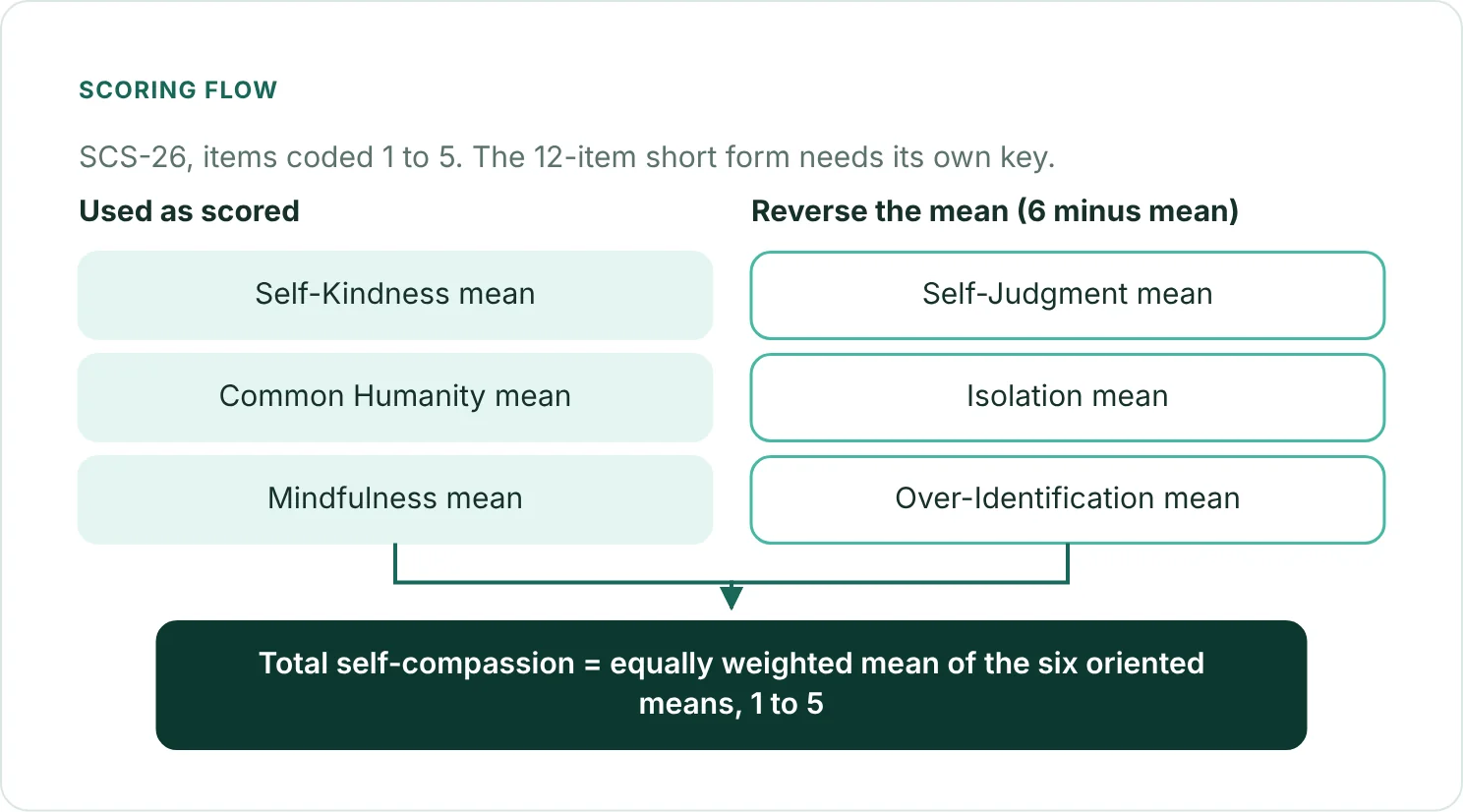
- Establish whether the 26-item SCS or the 12-item short form was administered, and verify that all raw responses lie between 1 and 5.
- Apply the developer’s item key to form the six subscale means, matching item numbers to your questionnaire.
- Reverse the means of the three negatively oriented subscales (self-judgment, isolation and over-identification) as 6 minus the mean.
- Compute total self-compassion as the equally weighted mean of the six oriented subscale means.
- Use no undocumented missing-data threshold, and do not present separate positive and negative totals as universally validated.
* Illustrative syntax: six subscale means already computed; the three negative means are unreversed.
COMPUTE scs_judgment_rev = 6 - scs_judgment.
COMPUTE scs_isolation_rev = 6 - scs_isolation.
COMPUTE scs_overid_rev = 6 - scs_overid.
COMPUTE scs_total = MEAN.6(scs_kindness, scs_judgment_rev, scs_humanity,
 scs_isolation_rev, scs_mindfulness, scs_overid_rev).
EXECUTE.# data: one row per respondent; six subscale means already computed from the item key.
vars <- c("scs_kindness", "scs_judgment", "scs_humanity",
"scs_isolation", "scs_mindfulness", "scs_overid")
stopifnot(all(vapply(data[vars], function(z) all(is.na(z) | (z >= 1 & z <= 5)), logical(1))))
keyed <- data.frame(kind = data$scs_kindness, judgment = 6 - data$scs_judgment,
humanity = data$scs_humanity, isolation = 6 - data$scs_isolation,
mindful = data$scs_mindfulness, overid = 6 - data$scs_overid)
data$scs_total <- ifelse(complete.cases(keyed), rowMeans(keyed), NA_real_)Interpreting SCS Scores
| Score | Interpretation |
|---|---|
| Higher total | Greater overall self-compassion as the scale defines it |
| Subscale mean | Read in its own direction; an unreversed self-judgment mean points the opposite way |
| Clinical severity bands | None established for the scale |
Source: Neff (2003); no diagnostic bands are part of the scale.
A higher fully keyed total indicates greater self-compassion. The six subscales can be informative, but each needs a clear direction label, because an unreversed self-judgment mean has the opposite conceptual direction from a reversed one. Self-compassion is not a psychiatric diagnosis, so the total should not be given severity bands.
These are research scores for groups and not individual diagnoses. Read differences and change with confidence intervals and the study design, since a score does not by itself explain its cause.
Psychometric Properties
| Property | Published finding | Source |
|---|---|---|
| Original development | Reliability and validity evidence for the 26-item scale was reported, including internal consistency and test-retest stability | Neff (2003) |
| Factor structure | Analysis of 20 samples supported reporting a total score and six subscale scores, within the models tested | Neff et al. (2019) |
| Short form | The 12-item version correlated very highly with the long scale, but it is a distinct instrument with its own key | Raes et al. (2011) |
| Sample reliability | Estimate for the total and each subscale in your own data | Study-specific |
These are source-specific findings and cannot be assumed to hold as reliability or factor-structure estimates in a new sample.
Using the SCS in a Study
State whether self-compassion serves as a predictor, a mediator or an outcome, and interpret mediation or temporal claims cautiously in cross-sectional data. Before treating the six subscales as separate endpoints, confirm that each has adequate reliability in your sample, since subscales built from few items can be imprecise.
How positive and negative self-responding should be modeled remains a methodological question. Report the model you chose and the score direction clearly, and do not present one representation as settled. The short form is mainly suited to the total, so subscale analyses rest on the full 26-item scale.
Reporting the SCS
Self-compassion was measured with the [26-item or 12-item] Self-Compassion Scale (Neff, 2003; [form-specific reference]). Six subscale means were computed, and the means of the three negatively oriented subscales were reversed before forming the total. The total was the mean of the six oriented subscale means (range = 1 to 5), with higher scores indicating greater self-compassion. Reliability in the present sample was [α = XX], and missing responses were handled by [method].
References
Neff, K. D. (2003). The development and validation of a scale to measure self-compassion. Self and Identity, 2(3), 223-250. https://doi.org/10.1080/15298860309027
Neff, K. D., Tóth-Király, I., Yarnell, L. M., Arimitsu, K., Castilho, P., Ghorbani, N., Guo, H. X., Hirsch, J. K., Hupfeld, J., Hutz, C. S., Kotsou, I., Lee, W. K., Montero-Marin, J., Sirois, F. M., de Souza, L. K., Svendsen, J. L., Wilkinson, R. B., & Mantzios, M. (2019). Examining the factor structure of the Self-Compassion Scale in 20 diverse samples: Support for use of a total score and six subscale scores. Psychological Assessment, 31(1), 27-45. https://doi.org/10.1037/pas0000629
Raes, F., Pommier, E., Neff, K. D., & Van Gucht, D. (2011). Construction and factorial validation of a short form of the Self-Compassion Scale. Clinical Psychology & Psychotherapy, 18(3), 250-255. https://doi.org/10.1002/cpp.702
Frequently Asked Questions
Which SCS subscales are reversed?
Self-judgment, isolation and over-identification are reversed before the total is formed. The positively worded subscales are not.
Why not average all 26 raw responses?
The developer’s total is the equally weighted mean of the six subscale means after correct keying, and the subscales contain different numbers of items.
Is there a short form of the SCS?
Yes, a 12-item version exists. It has its own key and should be named explicitly in the methods.
Can the SCS diagnose poor mental health?
No. It measures self-compassionate responding and is not based on diagnostic criteria.
NEXT STEP
Need SCS Reverse
Scoring Checked?
OnlineSPSS is a statistical consultancy for researchers. Share your design and dataset, and a statistically trained Research Coordinator reviews it. The scope and one fixed project fee are confirmed before work begins.
No Commitment Required
Strictly Confidential
Fixed Project Fee
In-House PhD-Level Statisticians
Same-Day Response
Serving Researchers Since 2014