
Home / Resources / Psychological Measures / SDQ
SDQ:
Scoring and Interpretation
The Strengths and Difficulties Questionnaire (SDQ) is a brief behavioral screening questionnaire for children and adolescents, completed by parents, teachers or youth. SDQ scoring gives five 0 to 10 subscales and a 0 to 40 total difficulties score that excludes prosocial behavior, so this guide covers the keying, informant differences, interpretation without universal cutoffs, SPSS and R code, and reporting wording.
What the SDQ Measures
The Strengths and Difficulties Questionnaire describes emotional and behavioral adjustment in children and adolescents. Its five subscales cover four kinds of difficulty (emotional symptoms, conduct problems, hyperactivity and inattention, and peer problems) and one strength, prosocial behavior. Parent, teacher and youth versions make it useful in developmental, school and mental health research (Goodman, 1997).
It should not be treated as a single 25-item problem score, because total difficulties leaves out the five prosocial items. Differences between parent, teacher and youth reports can carry real information about context and are not automatically measurement failure. Goodman (2001) examined its psychometric properties in a nationwide British sample of 10,438 children aged 5 to 15, but bands and norms should be chosen for your own population and not carried over unchecked.
Structure of the SDQ
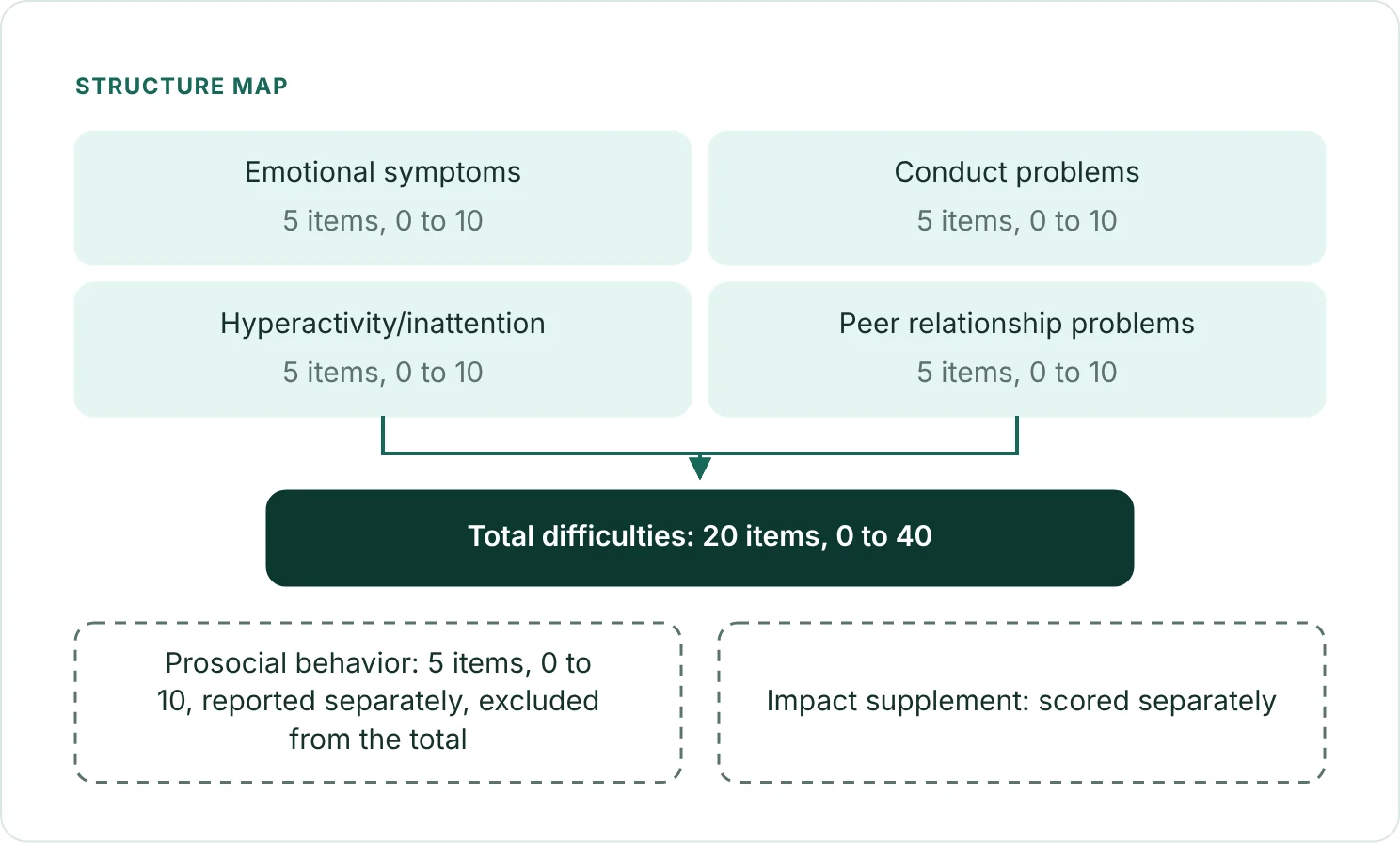
- Items: 25 core items in five scales of five. Each item has three response options keyed 0, 1 or 2.
- Keying: several positively worded items are reverse keyed, so that a higher score on every difficulty scale means more reported difficulty.
- Total difficulties: the sum of the emotional, conduct, hyperactivity and peer scales (20 items, 0 to 40). The prosocial scale is reported separately.
- Impact supplement: an optional supplement on distress and impairment is scored separately and is not part of the total.
- Versions: parent, teacher and youth self-report forms, with age-specific versions including a preschool form. Wording, recall period and interpretation can differ between them, and the common form asks about the past six months.
- Translations: use a validated version for the intended population and name the language and its source. If no validated translation exists, say so and describe how the version was adapted.
The instrument itself is available from the official SDQ website (sdqinfo.org).
How to Score the SDQ
- Identify the respondent form, age band, language and the 25-item scoring key.
- Key each item with the official form, reversing the positively worded items, so that every difficulty item points in the same direction.
- Sum the five keyed items of each subscale to a score from 0 to 10. The developer’s published SPSS syntax prorates a subscale when at least three of its five items are valid, by multiplying the mean of the valid items by five and rounding.
- Add the four problem subscales to obtain total difficulties (0 to 40), which the developer’s syntax computes only when all four subscale scores are available. Leave prosocial behavior separate.
- Score any impact supplement with its own guide and report it separately.
* Illustrative syntax: items already keyed 0 to 2 and grouped by subscale.
* Subscales are prorated when at least 3 of 5 items are valid (developer's approach).
COMPUTE sdq_emotional = RND(MEAN.3(sdq_e1, sdq_e2, sdq_e3, sdq_e4, sdq_e5) * 5).
COMPUTE sdq_conduct = RND(MEAN.3(sdq_c1, sdq_c2, sdq_c3, sdq_c4, sdq_c5) * 5).
COMPUTE sdq_hyperactivity = RND(MEAN.3(sdq_h1, sdq_h2, sdq_h3, sdq_h4, sdq_h5) * 5).
COMPUTE sdq_peer = RND(MEAN.3(sdq_p1, sdq_p2, sdq_p3, sdq_p4, sdq_p5) * 5).
COMPUTE sdq_prosocial = RND(MEAN.3(sdq_s1, sdq_s2, sdq_s3, sdq_s4, sdq_s5) * 5).
COMPUTE sdq_total = SUM.4(sdq_emotional, sdq_conduct, sdq_hyperactivity, sdq_peer).
EXECUTE.# data: one row per respondent; items keyed 0 to 2 (sdq_e1 to sdq_e5, c, h, p, s).
score5 <- function(prefix) {
m <- data[paste0("sdq_", prefix, 1:5)]
ok <- rowSums(!is.na(m)) >= 3
ifelse(ok, floor(rowMeans(m, na.rm = TRUE) * 5 + 0.5), NA)
}
data$sdq_emotional <- score5("e")
data$sdq_conduct <- score5("c")
data$sdq_hyperactivity <- score5("h")
data$sdq_peer <- score5("p")
data$sdq_prosocial <- score5("s")
data$sdq_total <- rowSums(data[c("sdq_emotional", "sdq_conduct",
"sdq_hyperactivity", "sdq_peer")], na.rm = FALSE)Interpreting SDQ Scores
| Score band | Interpretation |
|---|---|
| Four problem subscales, 0 to 10 each | Higher = more reported difficulty |
| Prosocial behavior, 0 to 10 | Higher = more reported prosocial strengths |
| Total difficulties, 0 to 40 | Sum of the four problem scales only |
| Normal, borderline and high bands | Depend on respondent, age, country and the published norm chosen |
Source: Goodman (1997, 2001); the SDQ developer website. Bands vary by norm and respondent.
The same total can mean something different when a teacher completes it than when a parent does, and older band labels may not be the best wording for a research article. Name the reference norms you use and decide whether continuous or categorized reporting suits the design. For clinical prediction, rely on diagnostic-accuracy evidence for your population and respondent type and not on one universal cutoff.
Do not add the prosocial scale into total difficulties, and do not treat divergent parent and teacher scores as data-entry errors without looking at the context.
Psychometric Properties
| Property | Published finding | Source |
|---|---|---|
| Development | Five domains covering difficulties and strengths | Goodman (1997) |
| Internal consistency | Mean Cronbach’s alpha of .73 in 10,438 British children aged 5 to 15 | Goodman (2001) |
| Informant agreement | Mean cross-informant correlation of .34 | Goodman (2001) |
| Retest | Mean correlation of .62 after 4 to 6 months | Goodman (2001) |
| Scoring | The 25 items, five scales and separate impact supplement are documented by the developer | SDQ website |
These are source-specific estimates for one sample, version and scoring method and cannot be assumed to hold in a new sample. Report reliability for the scores you actually use.
Using the SDQ in a Study
Use SDQ scores as outcomes in studies of child well-being or intervention effects, or as predictors of school functioning and service need. Children are clustered in classrooms, schools and families, so the analysis should reflect that structure. Repeated assessments need within-child correlation modeled and an explicit time variable.
When data come from several informants, analyze informant-specific scores separately or define a justified multi-informant model. Do not average parent and teacher scores as if the two reports were interchangeable, since moderate cross-informant agreement is expected. Estimate internal consistency for each subscale in your sample, and keep prosocial behavior and any impact score as separate variables.
Reporting the SDQ
Child emotional and behavioral adjustment was measured with the [parent, teacher or youth] Strengths and Difficulties Questionnaire (SDQ; Goodman, 1997). Five keyed subscale scores (range = 0 to 10 each) were calculated, and total difficulties (range = 0 to 40) combined the emotional, conduct, hyperactivity and peer scales, excluding prosocial behavior. Internal consistency for each scale was [values], missing items were handled by [method], and score categories used [named norms, if applied].
References
Goodman, R. (1997). The Strengths and Difficulties Questionnaire: A research note. Journal of Child Psychology and Psychiatry, 38(5), 581-586. https://doi.org/10.1111/j.1469-7610.1997.tb01545.x
Goodman, R. (2001). Psychometric properties of the Strengths and Difficulties Questionnaire. Journal of the American Academy of Child & Adolescent Psychiatry, 40(11), 1337-1345. https://doi.org/10.1097/00004583-200111000-00015
SDQ. (n.d.). What is the Strengths and Difficulties Questionnaire? [Web page]. SDQ information website.
Frequently Asked Questions
Does SDQ total difficulties include the prosocial scale?
No. It combines the emotional, conduct, hyperactivity and peer scales only, so prosocial behavior stays separate.
What is the SDQ total difficulties range?
0 to 40 for a correctly keyed score from the 20 difficulty items.
Can teacher and parent scores be pooled?
Not without an explicit analytic strategy, because informant differences can be meaningful and agreement is only moderate.
Are SDQ bands the same for every country and age?
No. Use the norms and validation evidence for your age group, respondent and population.
NEXT STEP
Need SDQ Data Scored
or Checked?
OnlineSPSS is a statistical consultancy for researchers. Share your design and dataset, and a statistically trained Research Coordinator reviews it. The scope and one fixed project fee are confirmed before work begins.
No Commitment Required
Strictly Confidential
Fixed Project Fee
In-House PhD-Level Statisticians
Same-Day Response
Serving Researchers Since 2014