
Home / Resources / Psychological Measures / SCARED
SCARED Questionnaire:
Scoring and Interpretation
The Screen for Child Anxiety Related Emotional Disorders (SCARED) is a child and caregiver report screen for anxiety symptoms. SCARED questionnaire scoring sums 41 items rated 0 to 2 into a total of 0 to 82, with five domain scores, so below you will find the structure, the screening convention of 25, advice on child and parent forms, worked SPSS and R code, and model reporting text.
What the SCARED Measures
The SCARED screens for anxiety symptoms in children and adolescents through a child report and a parallel parent report. The revised 41-item instrument covers panic and somatic complaints, generalized anxiety, separation anxiety, social anxiety and school avoidance, so several symptom patterns can be captured in one assessment instead of through a single diagnosis-specific scale (Birmaher et al., 1999).
Research that relies on SCARED questionnaire scoring spans child psychiatry, school mental health, pediatric services and intervention research. The development study documented only moderate parent and child agreement, so the two informants should be studied as separate sources and not averaged into one total (Birmaher et al., 1997).
Structure of the SCARED
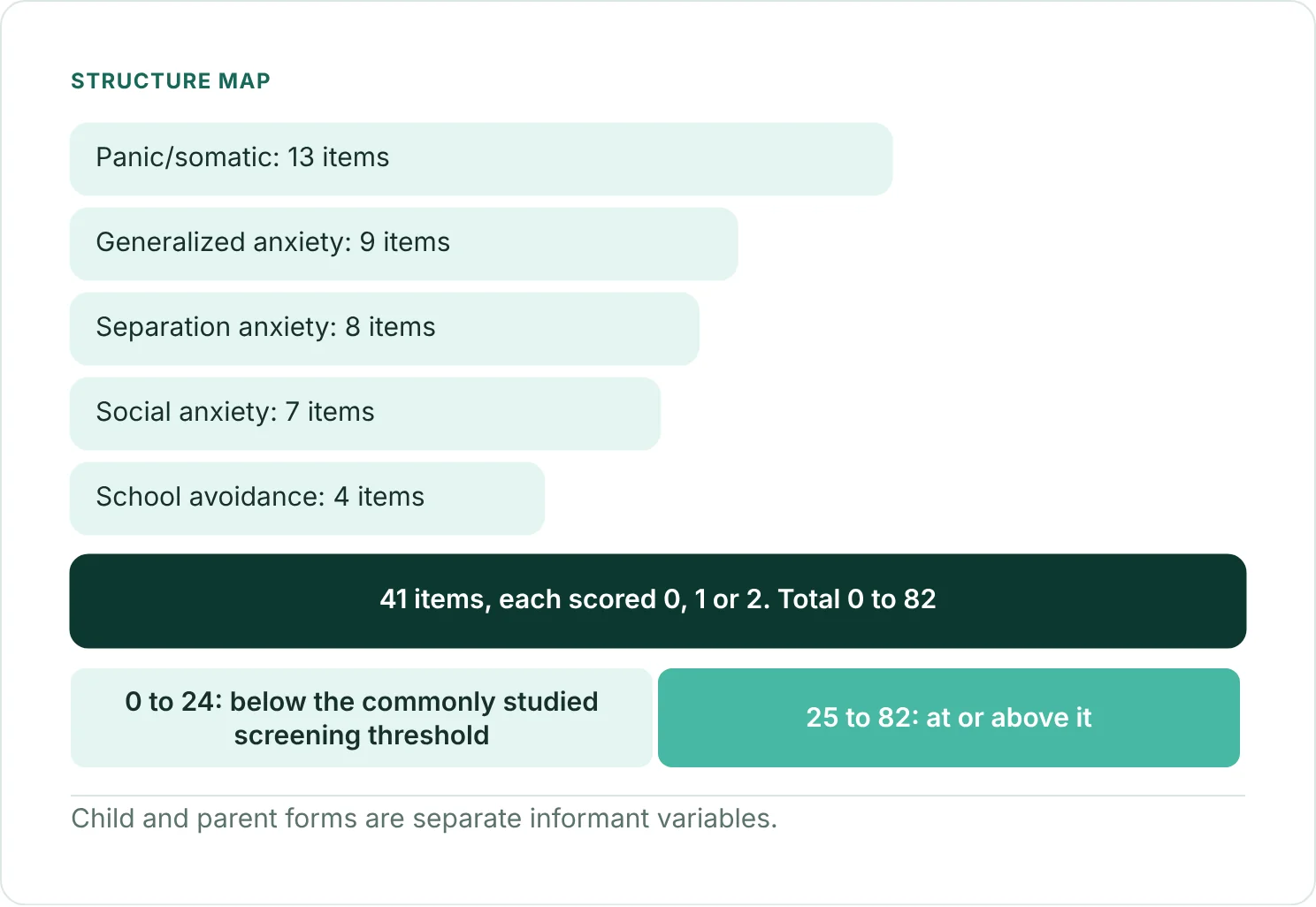
- Items: 41 in the widely used revised form, each rated 0, 1 or 2. The original development paper described a 38-item form, so state which edition you used.
- Subscales: panic or somatic (13 items), generalized anxiety (9), separation anxiety (8), social anxiety (7) and school avoidance (4). They are symptom domains, not independent diagnoses.
- Direction: no reverse-scored items in the usual 41-item scoring. Confirm this against the exact form you hold. Higher scores mean more anxiety symptoms.
- Informants: the child and parent forms stay as distinct variables in the data dictionary.
- Caution: school avoidance has only four items, so its reliability and interpretation need separate attention.
The instrument itself is available from the Birmaher research publications and clinical or academic SCARED repositories.
How to Score the SCARED
- Confirm the form has 41 items, all coded 0, 1 or 2, and record whether the respondent is the child or a parent.
- Sum the 41 item responses to obtain scared_total, which ranges from 0 to 82.
- Compute the five domain sums only with the item-to-domain key that matches your exact 41-item form.
- Apply a missing-item rule set by the protocol. No developer-endorsed prorating rule was verified for this guide, so the code below requires all 41 responses. State in the methods how incomplete forms were handled, and never replace a missing item with zero.
* Illustrative syntax: scared1 to scared41 already hold responses coded 0 to 2.
* Keep child and parent totals in separate columns or files.
COMPUTE scared_total = SUM.41(scared1 TO scared41).
EXECUTE.# data: one row per respondent and informant; items scared1 to scared41 coded 0 to 2.
items <- paste0("scared", 1:41)
stopifnot(all(vapply(data[items], function(x) all(is.na(x) | x %in% 0:2), logical(1))))
data$scared_total <- rowSums(data[items], na.rm = FALSE)Interpreting SCARED Scores
| Score band | Interpretation |
|---|---|
| 0 to 24 | Below the commonly studied screening threshold |
| 25 to 82 | At or above a frequently used screening threshold; further assessment may be warranted |
Source: Birmaher et al. (1999) and subsequent clinical use; threshold performance depends on sample and informant.
Higher totals indicate more reported anxiety symptoms and not necessarily an anxiety disorder. The cutoff of 25 is a screening convention, not a diagnosis and not a universally optimized threshold. In a screening evaluation, report the reference diagnostic interview and the sensitivity and specificity in your own population.
A positive screen is easy to overinterpret when age, informant, language or local prevalence differ from the validation sample. A child and parent who disagree may be reporting different observations, not one of them incorrectly.
Psychometric Properties
| Property | Published finding | Source |
|---|---|---|
| Internal consistency | Alpha values from .74 to .93 across scores in the development study of the 38-item form | Birmaher et al. (1997) |
| Test-retest | Intraclass correlations from .70 to .90 (38-item form) | Birmaher et al. (1997) |
| Factor structure | Five factors supported in the 41-item revision | Birmaher et al. (1999) |
| Informant agreement | Moderate parent and child agreement | Birmaher et al. (1997) |
| Cutoff accuracy | A sensitivity and specificity estimate should not be transferred across settings | Population-specific validation |
These are source-specific findings and cannot be assumed to hold as reliability or accuracy estimates in a new sample.
Using the SCARED in a Study
In a cross-sectional study the total can serve as a continuous anxiety outcome or predictor. Domain scores suit hypotheses about particular anxiety patterns, and they should be prespecified to limit multiplicity. In a trial, decide whether the target is broad anxiety reduction or improvement in a named domain.
Retain respondent type, date, visit and language fields. When child and parent reports are both available, a paired informant analysis or a multilevel model is more defensible than averaging, and the two sources should not be treated as interchangeable measures. Report the share of missing responses and estimate reliability for the key scores in your own sample.
Reporting the SCARED
Child anxiety symptoms were assessed with the 41-item Screen for Child Anxiety Related Emotional Disorders (SCARED; Birmaher et al., 1999), completed by [child, parent or both]. Items were coded 0 to 2 and summed (range = 0 to 82), with higher values indicating more anxiety symptoms. The prespecified analysis used [continuous total or domain scores], and missing items were handled by [procedure]. Reliability in this sample was [estimate].
References
Birmaher, B., Khetarpal, S., Brent, D., Cully, M., Balach, L., Kaufman, J., & Neer, S. M. (1997). The Screen for Child Anxiety Related Emotional Disorders (SCARED): Scale construction and psychometric characteristics. Journal of the American Academy of Child & Adolescent Psychiatry, 36(4), 545-553.
Birmaher, B., Brent, D. A., Chiappetta, L., Bridge, J., Monga, S., & Baugher, M. (1999). Psychometric properties of the Screen for Child Anxiety Related Emotional Disorders (SCARED): A replication study. Journal of the American Academy of Child & Adolescent Psychiatry, 38(10), 1230-1236. https://doi.org/10.1097/00004583-199910000-00011
Frequently Asked Questions
Does a SCARED score of 25 diagnose an anxiety disorder?
No. It is a commonly used screen-positive threshold that should prompt further assessment, not a diagnosis.
Can child and parent SCARED scores be averaged?
They are distinct informant reports. Averaging needs a defensible analytic model and is not the standard scoring rule.
Can I substitute the 38-item form for the 41-item version?
No. Document the edition and scoring key, because totals and available domains may differ.
Should I report five subscales or just the total?
Choose from prespecified constructs, power and multiplicity. The total suits broad symptom burden.
NEXT STEP
Need SCARED Data Scored
or Checked?
OnlineSPSS is a statistical consultancy for researchers. Share your design and dataset, and a statistically trained Research Coordinator reviews it. The scope and one fixed project fee are confirmed before work begins.
No Commitment Required
Strictly Confidential
Fixed Project Fee
In-House PhD-Level Statisticians
Same-Day Response
Serving Researchers Since 2014