
Home / Resources / Psychological Measures / RCADS
RCADS:
Scoring and Interpretation
The Revised Child Anxiety and Depression Scale (RCADS) is a youth and caregiver report of anxiety and depressive symptoms. RCADS scoring differs sharply between the 47-item form, with six domain scores, and the 25-item form, with two broad scores, and T-scores depend on official norms, so the sections below set out the forms, the raw-versus-T distinction, missing-item limits, example SPSS and R code, and a reporting template.
What the RCADS Measures
The RCADS captures anxiety and depression symptoms in children and adolescents. The 47-item version separates six domains aligned with DSM-based categories, while the 25-item version reduces response burden and emphasizes broad anxiety and depression scores (Chorpita et al., 2000; Ebesutani et al., 2012).
It is used in pediatric psychological assessment, school-based programs and youth mental-health trials. The key distinction is between raw symptom sums and norm-referenced T-scores. A T-score depends on the correct form, respondent, US normative reference and grade or demographic grouping, and an analysis cannot be reproduced if the scoring program and norms are undocumented.
Structure of the RCADS
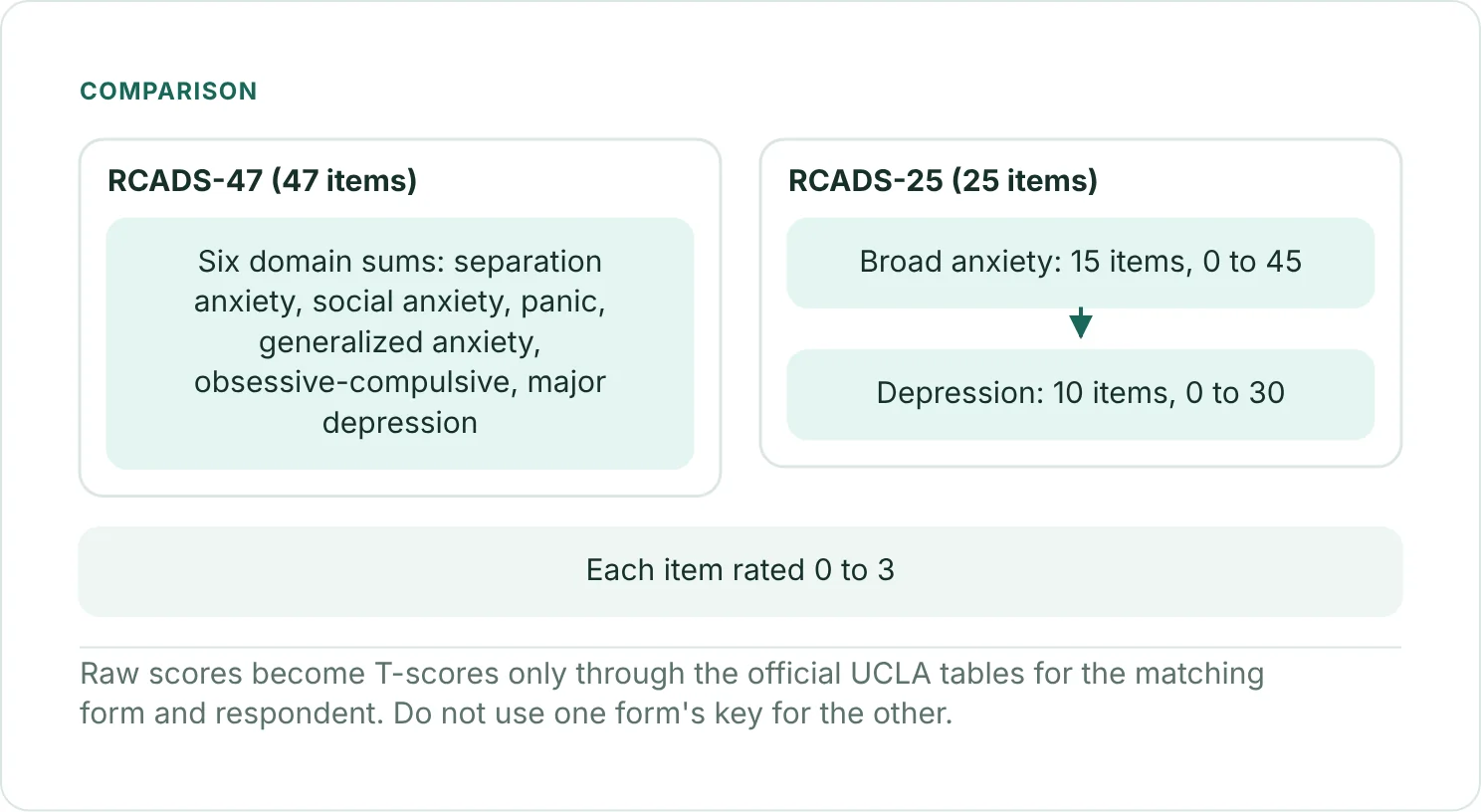
- RCADS-47: six domains covering separation anxiety, social anxiety, panic, generalized anxiety, obsessive-compulsive symptoms and major depression, each with its own raw sum.
- RCADS-25: a broad anxiety score from 15 items and a depression score from 10 items. It is not the same six-domain profile as the 47-item form.
- Responses: each item is rated 0 to 3 for how often the symptom occurs. Higher scores mean more frequent symptoms.
- Informants: youth and caregiver forms should not be pooled without allowing for informant differences.
- Keys: the official scoring materials set item membership and form-specific rules. Do not use another edition’s key.
The instrument itself is available from the official RCADS portal maintained by UCLA Child FIRST.
How to Score the RCADS
- Record the form length (47 or 25), respondent (youth or caregiver), language, country version and the scoring resource used.
- Check that every response is coded 0 to 3, then calculate domain sums from the official item groups for that form.
- Apply the official missing-item rules for the form. The UCLA scoring instructions allow limited prorating and set strict upper limits, so take the exact limits from the current official resource and report them.
- Convert raw scores to T-scores only with the official tables or the UCLA scoring tools for the right respondent, form and grade. Never derive a T-score from a raw score with a generic mean and standard deviation.
* Preferred: the official UCLA scoring syntax or tools for your form.
* For an already-scored export, check the expected fields:
DESCRIPTIVES VARIABLES=rcads_gad_t rcads_panic_t rcads_depression_t
 /STATISTICS=MEAN STDDEV MIN MAX.
* Field names are placeholders; match your export.# data: an export already scored with the official UCLA resources.
score_vars <- c("rcads_gad_t", "rcads_panic_t", "rcads_depression_t")
summary(data[intersect(score_vars, names(data))])Interpreting RCADS Scores
| Score band | Interpretation |
|---|---|
| Raw domain scores | Higher = more frequently reported symptoms; ranges differ by domain and form |
| Norm-based T-score | Interpret against the applicable normative distribution for the form and respondent |
| Any clinical cutoff | Use only if the official guidance or a validation study supports it for your respondent group |
Source: Chorpita et al. (2000); official UCLA Child FIRST scoring resources.
A higher domain score describes more reported symptoms in that domain and is not a diagnosis. Dimensional scores and change over time are legitimate outcomes, provided the same scoring version and normative convention are used at every wave. Having a T-score does not make different forms comparable.
Scoring RCADS-25 data with RCADS-47 keys, or applying norms to a non-matching form, produces numbers that look plausible and are methodologically wrong.
Psychometric Properties
| Property | Published finding | Source |
|---|---|---|
| Development | Child anxiety and depressive symptom factors examined | Chorpita et al. (2000) |
| Clinical sample | Psychometric properties examined in a clinical sample | Chorpita et al. (2005) |
| Short form | 25 items derived by bifactor-based item reduction in school and clinic samples | Ebesutani et al. (2012) |
| RCADS-25 depression reliability | Alpha of .80 in the clinic sample and .79 in the school sample | Ebesutani et al. (2012) |
| T-score norms | Depend on form and group; official tools supply the conversion | UCLA Child FIRST |
These are source-specific findings and cannot be assumed to hold as reliability or accuracy estimates in a new sample.
Using the RCADS in a Study
Choose the RCADS-47 when the study must separate specific anxiety domains, and the RCADS-25 when a shorter measure of broad anxious and depressive burden is enough. This is a design decision about the construct, not only about length. In intervention work, decide whether raw-score change or norm-referenced status is the primary estimand.
For repeated measures, keep a scoring-version field and apply one prespecified pipeline across waves. A mixed-effects model suits repeated records, and missingness should be examined by item, informant and visit. If only scored exports are available, name the official scoring method used instead of claiming the domains were recomputed independently.
Reporting the RCADS
Youth symptoms were measured with the [RCADS-47 or RCADS-25] [youth or caregiver] version (Chorpita et al., 2000; [Ebesutani et al., 2012, if the short form]). Responses were scored 0 to 3 following the UCLA Child FIRST guidance, with [domain scores] and [US reference T-scores, when applicable] calculated using [scoring tool and version]. Missing responses were handled using the published RCADS rules. The primary outcome was [specified domain].
References
Chorpita, B. F., Yim, L., Moffitt, C., Umemoto, L. A., & Francis, S. E. (2000). Assessment of symptoms of DSM-IV anxiety and depression in children: A revised child anxiety and depression scale. Behaviour Research and Therapy, 38(8), 835-855. https://doi.org/10.1016/S0005-7967(99)00130-8
Chorpita, B. F., Moffitt, C. E., & Gray, J. (2005). Psychometric properties of the Revised Child Anxiety and Depression Scale in a clinical sample. Behaviour Research and Therapy, 43(3), 309-322.
Ebesutani, C., Reise, S. P., Chorpita, B. F., Ale, C., Regan, J., Young, J., Higa-McMillan, C., & Weisz, J. R. (2012). The Revised Child Anxiety and Depression Scale-Short Version: Scale reduction via exploratory bifactor modeling of the broad anxiety factor. Psychological Assessment, 24(4), 833-845.
Frequently Asked Questions
Can I add all 47 items into one total score?
A raw sum is possible, but the measure is built around six domains and official composites, so choose and justify the outcome you analyze.
How do I calculate RCADS T-scores?
Use the official form- and respondent-specific tables or software. Do not invent a mean and standard deviation transformation.
What if one or two items are missing?
The official guidance permits limited domain-level prorating with strict upper limits. Apply the rule for your form and report it.
Are the RCADS-25 and RCADS-47 interchangeable?
No. Item content and domains differ, so state which form was administered.
NEXT STEP
Need RCADS Scores Set Up
or Checked?
OnlineSPSS is a statistical consultancy for researchers. Share your design and dataset, and a statistically trained Research Coordinator reviews it. The scope and one fixed project fee are confirmed before work begins.
No Commitment Required
Strictly Confidential
Fixed Project Fee
In-House PhD-Level Statisticians
Same-Day Response
Serving Researchers Since 2014