
Home / Resources / Psychological Measures / PANSS
PANSS:
Scoring and Interpretation
The Positive and Negative Syndrome Scale (PANSS) is a 30-item clinician rating of schizophrenia-related symptoms in three domains. PANSS scoring has a floor that surprises many analysts, because every item is rated from 1 and the raw total therefore starts at 30, so this guide covers the subscales, floor-adjusted totals, rating requirements, SPSS and R checks, and reporting wording.
What the PANSS Measures
The Positive and Negative Syndrome Scale is a clinician-rated assessment of schizophrenia-related symptoms. Its three original components capture positive symptoms, negative symptoms and general psychopathology. Unlike broad self-report distress questionnaires, it depends on a structured clinical assessment and rating judgment (Kay et al., 1987).
The PANSS is routinely used in treatment studies where psychosis symptoms are monitored over time. The original publication studied 101 people with schizophrenia and provided reliability and construct-validity evidence for its syndrome scales (Kay et al., 1987). Later research has examined alternative factor structures, so researchers should state which scale model, and not only the name PANSS, was analyzed.
Structure of the PANSS
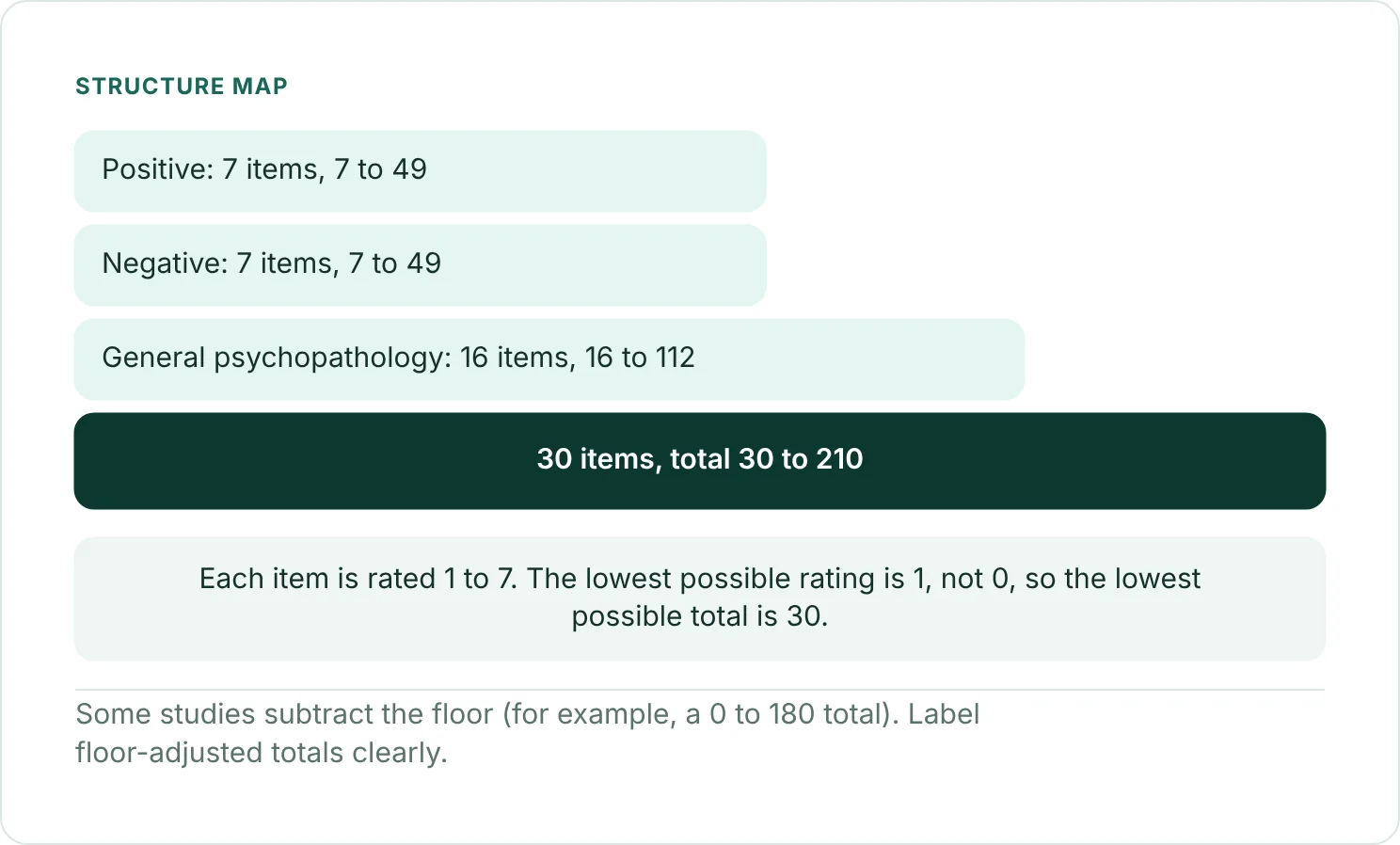
- Items: thirty clinician-rated symptoms, each on a 1 to 7 severity scale. Zero is not a permissible rating in the standard item scoring.
- Subscales: the original three domains comprise 7 positive, 7 negative and 16 general psychopathology items.
- Total: the standard summed total is 30 to 210, because each of the 30 items has a floor of 1.
- Floor adjustment: some studies subtract the floor (for example, a 0 to 180 total). This must be labeled clearly and never mixed with raw totals.
- Raters: training and consistency matter, because scores depend on clinical interviewing and observational judgment.
The instrument itself is available from the PANSS publications and from authorized professional assessment and training resources.
How to Score the PANSS
- Confirm that the items were administered and rated by trained personnel using the specified version and protocol.
- Check whether exported scores are original raw sums (minimum 30) or floor-adjusted scores (minimum zero).
- Use the professionally scored positive, negative, general and total variables, and verify that the total equals the sum of the three original subscales when those definitions apply.
- Do not use alternative factor scores without a declared factor model and an explicit item mapping.
* Illustrative check: subscale scores assumed computed under the original 3-scale model, raw totals.
COMPUTE panss_sum_check = panss_positive + panss_negative + panss_general.
COMPUTE panss_difference = panss_total - panss_sum_check.
DESCRIPTIVES VARIABLES=panss_positive panss_negative panss_general panss_total panss_difference
/STATISTICS=MIN MAX MEAN STDDEV.# data: one row per rating occasion; raw (not floor-adjusted) totals assumed.
stopifnot(all(is.na(data$panss_total) | (data$panss_total >= 30 & data$panss_total <= 210)))
expected <- data$panss_positive + data$panss_negative + data$panss_general
summary(data$panss_total - expected)Interpreting PANSS Scores
| Score | Interpretation |
|---|---|
| Positive, 7 to 49 | Higher values indicate greater rated positive symptom severity |
| Negative, 7 to 49 | Higher values indicate greater rated negative symptom severity |
| General, 16 to 112 | Higher values indicate more general psychopathology |
| Raw total, 30 to 210 | Higher values indicate greater overall symptom severity in the traditional scoring |
Source: Kay et al. (1987); ranges follow the 1 to 7 item coding.
For traditional totals, decreases may indicate improvement, but the meaning of a given change depends on baseline severity, the estimand and the score transformation. A 20-point reduction should not be described as a fixed percent improvement without stating the denominator, that is, the baseline score and whether the 30-point item floor was subtracted from it. Different PANSS factors may show different treatment patterns.
A raw total of 30 does not mean a patient has 30 points of illness above zero. It is the sum of the one-point floor on each item. Do not confuse raw totals with adjusted totals, and do not compare results from different definitions directly.
Psychometric Properties
| Property | Published finding | Source |
|---|---|---|
| Original development | Thirty-item design with positive, negative and general domains | Kay et al. (1987) |
| Reliability | The 1988 validation reported interrater coefficients in the .80 range in its studied setting | Kay et al. (1988) |
| Criterion evidence | Validation found correspondence with related symptom measures | Kay et al. (1988) |
| Factor models | Alternative factor solutions exist, so the analyzed model should be named | Later factor literature |
| Change assessment | Rater training and repeated-assessment procedures influence interpretation | Trial methodology |
These are source-specific findings and cannot be assumed to hold as reliability estimates in a new sample.
Using the PANSS in a Study
In a randomized trial, define the primary endpoint (total, positive, negative or a specified factor) and whether the score is raw or floor-adjusted. Use methods suited to repeated visits and missing outcomes. ANCOVA on the follow-up score, mixed models and longitudinal estimand approaches may each be useful, depending on the design and the available measurements.
Avoid treating every item or factor as an independent confirmatory endpoint. Examine site and rater effects, baseline severity and the consistency of interviews where a trial has several centers. State whether improvement was defined by absolute change, percentage change or a separate CGI-style response rating.
Reporting the PANSS
Psychosis-related symptoms were assessed with the Positive and Negative Syndrome Scale (PANSS; Kay et al., 1987), administered by [trained assessors] at [visits]. The original positive (7 items), negative (7 items) and general psychopathology (16 items) raw scores were summed, giving a total from 30 to 210. The primary outcome was [specified score] and was modeled using [planned analysis].
References
Kay, S. R., Fiszbein, A., & Opler, L. A. (1987). The Positive and Negative Syndrome Scale (PANSS) for schizophrenia. Schizophrenia Bulletin, 13(2), 261-276. https://doi.org/10.1093/schbul/13.2.261
Kay, S. R., Opler, L. A., & Lindenmayer, J.-P. (1988). Reliability and validity of the positive and negative syndrome scale for schizophrenics. Psychiatry Research, 23(1), 99-110. https://doi.org/10.1016/0165-1781(88)90038-8
Frequently Asked Questions
Why is the minimum PANSS total 30?
Each of the 30 items is rated from 1 to 7, so even the lowest possible ratings sum to 30.
Can I compare a 0 to 180 PANSS score with a 30 to 210 score?
Not without the explicit transformation, because the two have different zero points.
What is the difference between the three PANSS scales?
They summarize positive, negative and general symptoms and have different item counts and possible ranges.
Can an untrained rater administer the PANSS?
Defensible clinician-rated data need qualified assessment and the specified training and protocol.
NEXT STEP
Need PANSS Data Scored
or Checked?
OnlineSPSS is a statistical consultancy for researchers. Share your design and dataset, and a statistically trained Research Coordinator reviews it. The scope and one fixed project fee are confirmed before work begins.
No Commitment Required
Strictly Confidential
Fixed Project Fee
In-House PhD-Level Statisticians
Same-Day Response
Serving Researchers Since 2014