
Paired vs Independent Samples:
Identify the Correct Data Structure
Paired vs independent samples depends on whether each observation has a genuine counterpart in the design, such as the same person measured twice or an explicitly matched pair. Pairing comes from how the data were collected, never from equal group sizes. Paired data need within-pair methods, because treating pairs as independent misstates the precision.
In a paired dataset, each observation has a meaningful counterpart: for example, baseline and follow-up for the same patient, or two people linked by an explicit matching procedure. In an independent design, observations in one group have no one-to-one dependence on those in the other group. The distinction is a property of the study design, and it has to be settled before any test is chosen.
Recognize genuine pairing
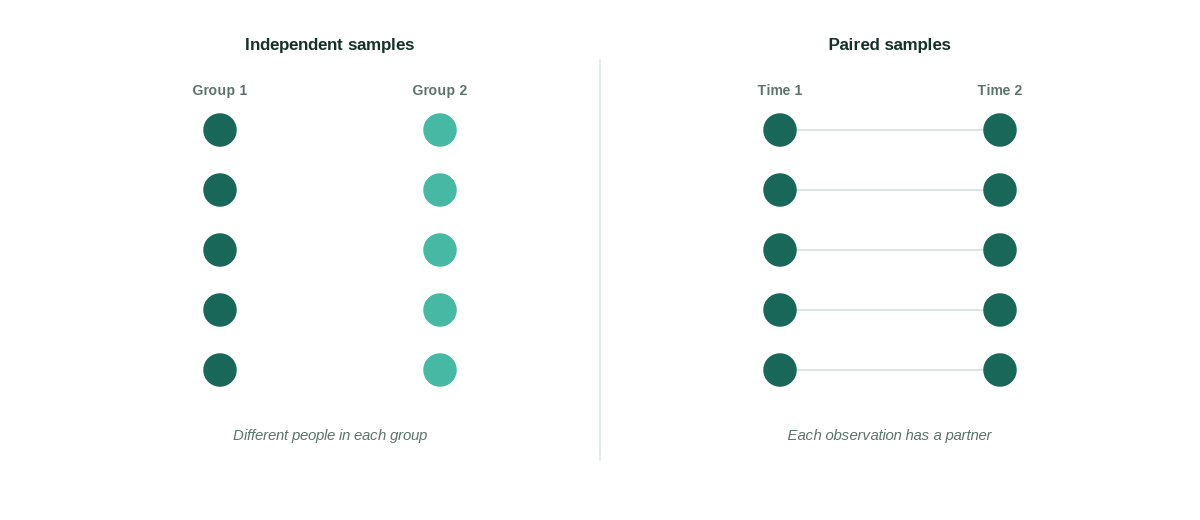
A before-after score for each participant is paired. Measurements from left and right eyes within the same patient are paired when the question concerns eye-level outcomes. A trial comparing separate people randomly assigned to groups is usually independent at the participant level, even if groups have equal sample sizes.
Equal sample sizes do not create pairing. Neither does sorting two columns by age. Pairing must arise from measurement or deliberate study design.
Paired vs independent samples: what changes in the analysis?
| Outcome and design | Typical analysis | Key feature |
|---|---|---|
| Continuous, two independent groups | Welch t-test | Between-person difference in means |
| Continuous, paired observations | Paired t-test | Mean of within-pair differences |
| Binary, independent groups | Chi-square or suitable model | Independent contingency table |
| Binary, paired outcomes | McNemar test | Discordant pairs matter |
| More than two repeated time points | Longitudinal model | Within-person correlation across times |
The relevant variance for a paired mean difference depends on the variability of within-person differences, which in turn reflects the correlation of the repeated measurements. Treating pairs as independent generally fails to use this information and can give misleading standard errors (Bland & Altman, 1994).
A hypothetical pairing example
Suppose 50 people have scores before and after an intervention. For each person, calculate after minus before, then summarize the 50 differences. This is not equivalent to treating the 50 baseline scores and 50 follow-up scores as 100 independent observations. The difference scores are the basic units for a simple paired mean test.
If an intervention and comparison group were each measured twice, the main comparison may be between their changes or an adjusted endpoint/longitudinal model; simply conducting a paired t-test within each group does not test whether treatment effects differ between groups.
Matching needs its own justification
In matched observational studies, researchers pair participants on characteristics such as age or clinic. Analysis may need to account for that matching. But matching does not eliminate residual confounding, and individual matching can vary in strength. The design and the target comparison still determine whether conditional models, paired contrasts or another analysis is appropriate (Kirkwood & Sterne, 2003).
Missing paired observations
If one observation in a pair is missing, a simple complete-pair t-test cannot use that pair’s difference. List how many complete pairs remain and assess why data are missing. Longitudinal models may use more incomplete profiles under assumptions, but can still be biased by missing data.
How to write Methods
A model sentence for the Methods section:
Because each participant provided one pre- and one post-measurement, change was evaluated within paired observations.
The paper should also state the measure, direction of change, sample size and uncertainty. This wording is not itself a claim that a before-after change was caused by the intervention.
Common mistakes
- Calling equal-sized independent groups “paired.”
- Running independent tests on repeated observations from the same person.
- Presenting within-group p-values as evidence of a between-group treatment difference.
- Ignoring matching or cluster dependence when computing standard errors.
- Omitting the number of complete pairs used in analysis.
Frequently asked questions
Does the same sample size make two groups paired?
No. Pairing arises from linked observations or a matching design, not from equal numbers.
Should I use paired t-tests to compare two randomized arms over time?
Within-arm paired tests alone do not test the between-arm treatment effect. Consider the treatment comparison and suitable adjusted or longitudinal model.
What happens if some pairs are incomplete?
Report missingness and the complete pairs; consider an appropriate repeated-data approach if assumptions justify it.
Quantitative Data AnalysisNot sure whether your data are paired or independent? A statistician checks how the observations were collected and matches the analysis to the design.
Quantitative Data Analysis
The Quantitative Data Analysis service is delivered by in-house PhD-level statisticians. Your project details and materials are reviewed by a statistically trained Research Coordinator, and the analytical work, deliverables and fixed project fee are confirmed before work begins. Research data and project details are handled confidentially.
References
- Bland, J. M., & Altman, D. G. (1994). Statistics notes: Correlation, regression, and repeated data. BMJ, 308(6933), 896. https://doi.org/10.1136/bmj.308.6933.896
- Kirkwood, B. R., & Sterne, J. A. C. (2003). Essential medical statistics (2nd ed.). Blackwell Science. https://www.wiley.com/en-us/essential-medical-statistics-2nd-edition-p-9780865428713
Last reviewed November 2026 by the OnlineSPSS Statistical Team. Worked examples use hypothetical values and are not client data.
NEXT STEP
Need this done for
your study?
Share your research in about a minute and receive a complimentary assessment the same day: scope, timeline and one fixed fee.
No Commitment Required
Strictly Confidential
Fixed Project Fee
In-House PhD-Level Statisticians
Same-Day Response
Serving Researchers Since 2014