
Home / Resources / Psychological Measures / MoCA
MoCA:
Scoring and Interpretation
The Montreal Cognitive Assessment (MoCA) is a brief cognitive screening test scored out of 30 points and developed to detect mild cognitive impairment. MoCA scoring is simple once the version is fixed, and the trouble comes from the education correction and from the cutoff of 26. Here the correction rule, the code and the limits of that threshold are set out in turn, and a model methods paragraph closes the guide.
What the MoCA Measures
Nasreddine et al. (2005) built the MoCA as a ten-minute tool for first-line physicians, aimed at patients who perform in the normal range on the Mini-Mental State Examination but may still have mild cognitive impairment. Its tasks sample attention, executive and visuospatial function, memory, language, abstraction and orientation, and points are awarded by performance on each task, not by agreement with statements.
A screen is not a diagnosis. In the original validation, a cutoff of 26 detected 90% of participants with mild cognitive impairment and 100% of those with mild Alzheimer’s disease, with specificity of 87% in the healthy controls (Nasreddine et al., 2005). A later population-based study of 2,653 adults found that 66% scored below 26, which shows that the threshold behaves differently outside the original clinic and control samples (Rossetti et al., 2011).
Structure of the MoCA
- Content: standardized cognitive tasks, not Likert items. No item is reverse scored, and the points for each task follow the instructions of the form administered.
- Total: the standard score runs from 0 to 30, and higher scores indicate better performance on the tasks.
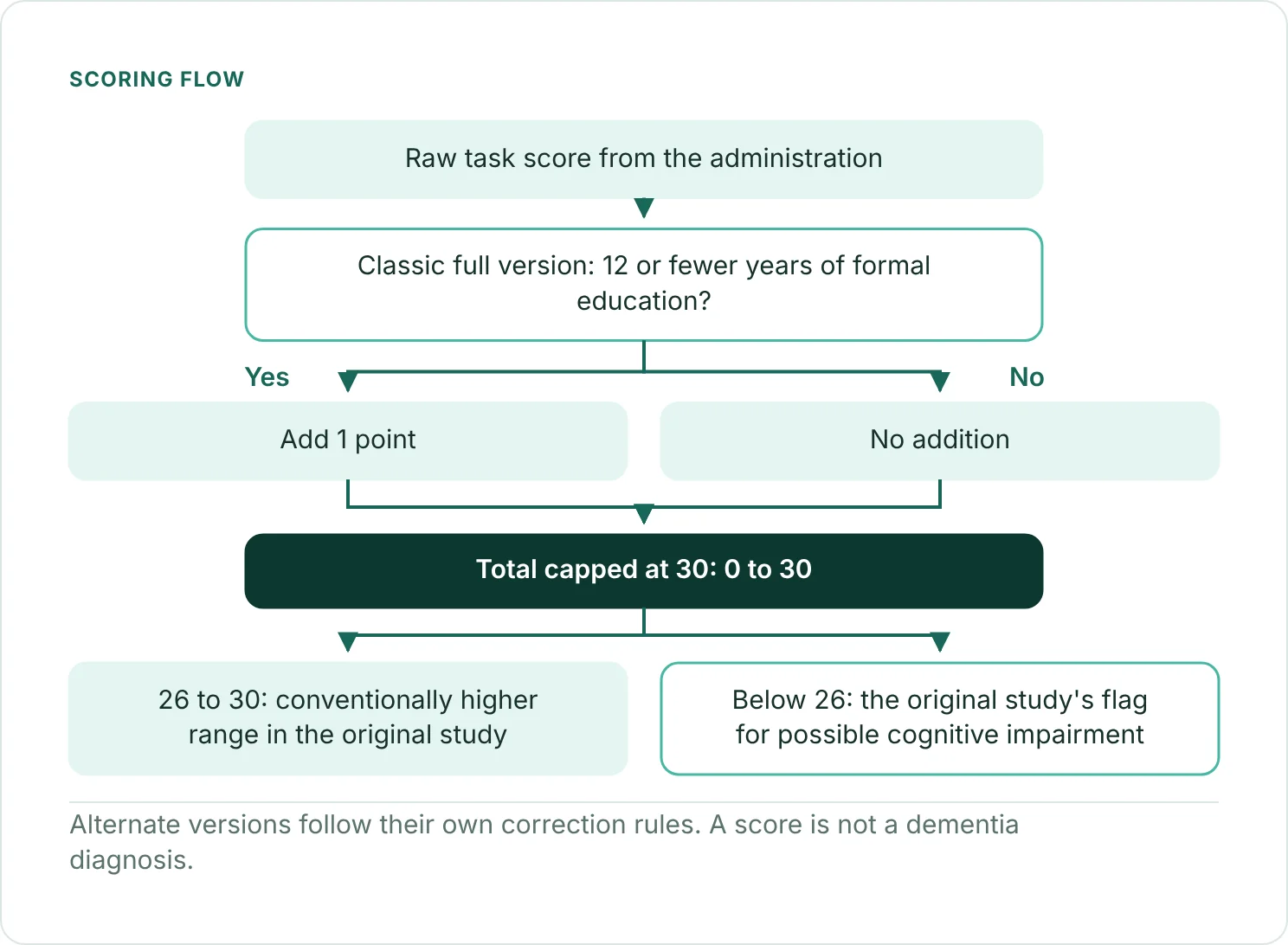
- Education correction: in the original form, one point is added when the person has 12 or fewer years of formal education, and the total is capped at 30 (Nasreddine et al., 2005). Other versions and adapted forms can follow different rules, so confirm the rule for the form you used.
- Cutoff: the original study treated 26 and above as the normal screening range and flagged scores below 26 (Nasreddine et al., 2005).
- Versions: later editions, alternate forms and forms adapted for people with visual impairment are not interchangeable with the original, and each has its own instructions.
- Translations: name the language version and cite validation evidence for it. If none exists, say so and describe how the version was adapted.
The form and its administration instructions come from the test developers (MoCA Cognition) for the version you use. This post covers scoring logic and analysis only and reproduces no test content.
How to Score the MoCA
- Record the exact version, the language, the date of administration and the person’s years of formal education before scoring.
- Obtain the raw task total from the administration, following the scoring instructions of that form. Do not rebuild it from a spreadsheet of partial entries.
- For the original full form, add one point when education is 12 years or fewer and cap the result at 30. For any other version, confirm the correction rule in its own instructions first.
- Handle a task that was not administered by the rule of the form and not by silently entering zero. The code below leaves the total missing when the raw score or education is missing.
- Decide in advance whether the below-26 flag will be used at all, and report the reason for using it.
* Illustrative syntax for the original full form: moca_raw is the raw total (0 to 30), education_years is formal schooling in years.
IF (NOT MISSING(moca_raw) AND NOT MISSING(education_years)) moca_total = MIN(30, moca_raw + (education_years <= 12)).
IF (NOT MISSING(moca_total)) moca_below26 = (moca_total < 26).
EXECUTE.
DESCRIPTIVES VARIABLES=moca_total /STATISTICS=MEAN STDDEV MIN MAX.# data: one row per person; moca_raw is the raw total (0 to 30), education_years is formal schooling in years.
stopifnot(all(is.na(data$moca_raw) | data$moca_raw %in% 0:30))
data$moca_total <- ifelse(
is.na(data$moca_raw) | is.na(data$education_years), NA_real_,
pmin(30, data$moca_raw + as.integer(data$education_years <= 12))
)
data$moca_below26 <- as.integer(data$moca_total < 26)Interpreting MoCA Scores
| Score band | Interpretation |
|---|---|
| 26 to 30 | The range the original study treated as normal screening performance, which is not a statement of normal cognition |
| 0 to 25 | Below the original cutoff: a flag for possible cognitive impairment that needs context |
| Cutoff of 26 in other samples | Accuracy and the best threshold depend on age, education, language and setting |
Source: Nasreddine et al. (2005); Rossetti et al. (2011). The cutoff of 26 comes from the original validation sample.
Higher totals indicate better performance on the screening tasks. In the original validation, a cutoff of 26 gave sensitivity of 90% for mild cognitive impairment and specificity of 87% (Nasreddine et al., 2005). Positive and negative predictive values depend on prevalence, so those figures cannot be carried to another population as they stand. In the population-based sample, the mean total was 23.4 (SD = 4.0) and 66% of participants fell below 26, and norms were derived by age and education (Rossetti et al., 2011).
A low total is not a diagnosis of dementia, and a high total does not exclude every cognitive condition. Interpret a score against the version used, the person’s age and education, and the assessment setting.
Psychometric Properties
| Property | Published finding | Source |
|---|---|---|
| Original validation | 94 patients with mild cognitive impairment, 93 with mild Alzheimer’s disease and 90 healthy controls | Nasreddine et al. (2005) |
| Accuracy at a cutoff of 26 | Sensitivity 90% for mild cognitive impairment and 100% for mild Alzheimer’s disease; specificity 87% | Nasreddine et al. (2005) |
| Population-based data | 2,653 adults, mean total 23.4 (SD = 4.0), 66% below 26; norms by age and education | Rossetti et al. (2011) |
| Reliability | No single coefficient is asserted; estimate it for your design, including any repeated testing | Study-specific |
These are source-specific results and cannot be assumed to hold as accuracy or reliability estimates in a new sample or version.
Using the MoCA in a Study
The total is bounded at 0 and 30, so check for ceiling effects before treating it as a continuous outcome, and report the distribution and not only the mean. For repeated assessments, use a model that respects the correlation within people, such as a mixed-effects model, and consider practice effects and attrition. The education correction is a coarse adjustment, so models of the total usually still include age and education as covariates where the question allows. One point does not carry the same meaning at every baseline level.
When the MoCA serves as an eligibility criterion, state what the threshold is for, because a cutoff can flag people for further assessment without establishing a condition. Report the version, the education rule and the threshold so that others can reproduce enrollment. If the question concerns accuracy against a diagnosis, the design is a diagnostic-accuracy study with a reference standard, and the analysis follows that design.
Reporting the MoCA
Cognitive screening used the [version and language] Montreal Cognitive Assessment (MoCA; Nasreddine et al., 2005). The total score ranges from 0 to 30, with higher scores indicating better performance, and one point was added for [participants with 12 or fewer years of formal education] as specified by [version instructions]. Scores were analyzed [continuously or using a prespecified threshold of XX], and missing tasks were handled by [method].
References
Nasreddine, Z. S., Phillips, N. A., Bédirian, V., Charbonneau, S., Whitehead, V., Collin, I., Cummings, J. L., & Chertkow, H. (2005). The Montreal Cognitive Assessment, MoCA: A brief screening tool for mild cognitive impairment. Journal of the American Geriatrics Society, 53(4), 695-699. https://doi.org/10.1111/j.1532-5415.2005.53221.x
Rossetti, H. C., Lacritz, L. H., Cullum, C. M., & Weiner, M. F. (2011). Normative data for the Montreal Cognitive Assessment (MoCA) in a population-based sample. Neurology, 77(13), 1272-1275. https://doi.org/10.1212/WNL.0b013e318230208a
Frequently Asked Questions
What is the range of the MoCA total score?
The standard total runs from 0 to 30 after the applicable correction, with higher scores indicating better performance.
Do I always add a point for education?
No. In the original form, one point is added for 12 or fewer years of formal education, capped at 30. Other versions can differ, so follow the instructions of the form you used.
Does a score below 26 mean dementia?
No. It is the screening flag from the original validation, and its accuracy varies by population. A clinician interprets the result in context.
Can I compare MoCA and MMSE totals directly?
No. The tests differ in content and metric, so any conversion needs its own validation evidence.
NEXT STEP
Need MoCA Data Scored
or Checked?
OnlineSPSS is a statistical consultancy for researchers. Share your design and dataset, and a statistically trained Research Coordinator reviews it. The scope and one fixed project fee are confirmed before work begins.
No Commitment Required
Strictly Confidential
Fixed Project Fee
In-House PhD-Level Statisticians
Same-Day Response
Serving Researchers Since 2014