
Home / Resources / Psychological Measures / MLQ
Meaning in Life Questionnaire:
Scoring and Interpretation
The Meaning in Life Questionnaire (MLQ) is a 10-item self-report measure with two five-item scales, Presence of Meaning and Search for Meaning. Meaning in Life Questionnaire scoring produces two separate sums and no total, so this guide explains the item 9 reversal, how to read the two scores side by side, the reliability and invariance questions that follow, SPSS and R code, and a model reporting paragraph.
What the MLQ Measures
Steger, Frazier, Oishi and Kaler (2006) built the MLQ around a distinction that a single score would hide: whether a person experiences life as meaningful, and whether that person is actively looking for meaning. The two are related but not opposites, so high Search does not imply low Presence.
The questionnaire is used in positive psychology, counseling, university and health research. Its two-dimensional design suits questions about well-being, stress and life transitions, where the researcher wants to know whether meaning is present, being sought, or both.
Structure of the MLQ
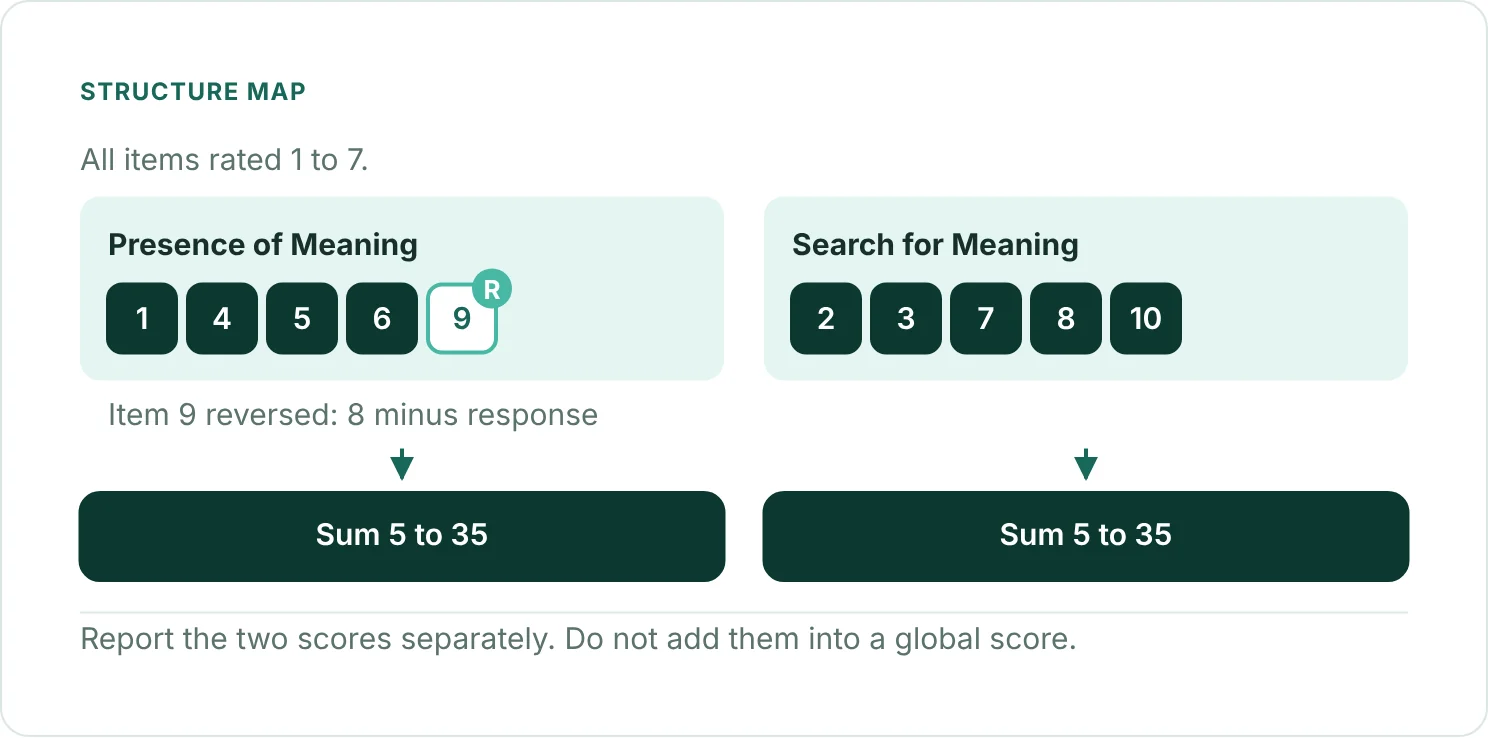
- Items: ten statements rated from 1 to 7.
- Presence of Meaning: items 1, 4, 5, 6 and 9, with item 9 reverse scored.
- Search for Meaning: items 2, 3, 7, 8 and 10, all scored in the stated direction.
- Total score: none. The two scales are reported separately, and adding them would blur the distinction the instrument was designed to make.
- Direction: after reversing item 9, higher scores mean more Presence or more Search.
- Versions and translations: confirm the language version and check its two-scale structure in your own data before relying on it.
The items and scoring are described in Steger et al. (2006). Confirm the item order of the version you administered.
How to Score the MLQ
- Confirm that mlq1 to mlq10 are coded 1 to 7 in the original item order.
- Reverse item 9 by subtracting the response from 8.
- Sum mlq1, mlq4, mlq5, mlq6 and the reversed mlq9 to obtain mlq_presence, which ranges from 5 to 35.
- Sum mlq2, mlq3, mlq7, mlq8 and mlq10 to obtain mlq_search, which ranges from 5 to 35.
- Treat a subscale as missing when one of its items is missing, unless the protocol states another rule. No developer-endorsed prorating rule was verified. Do not combine the two scales into a global score.
* Illustrative syntax: original MLQ item order, responses coded 1 to 7.
COMPUTE mlq9r = 8 - mlq9.
COMPUTE mlq_presence = SUM.5(mlq1, mlq4, mlq5, mlq6, mlq9r).
COMPUTE mlq_search = SUM.5(mlq2, mlq3, mlq7, mlq8, mlq10).
EXECUTE.# data: one row per respondent; items mlq1 to mlq10 coded 1 to 7.
cols <- paste0("mlq", 1:10)
stopifnot(all(vapply(data[cols], function(z) all(is.na(z) | z %in% 1:7), logical(1))))
pres <- c("mlq1", "mlq4", "mlq5", "mlq6", "mlq9")
seek <- c("mlq2", "mlq3", "mlq7", "mlq8", "mlq10")
data$mlq_presence <- ifelse(complete.cases(data[pres]),
data$mlq1 + data$mlq4 + data$mlq5 + data$mlq6 + (8 - data$mlq9), NA_real_)
data$mlq_search <- ifelse(complete.cases(data[seek]), rowSums(data[seek]), NA_real_)Interpreting MLQ Scores
| Score band | Interpretation |
|---|---|
| Presence, 5 to 35 | Higher = stronger experienced sense that life is meaningful |
| Search, 5 to 35 | Higher = more active effort to find or understand meaning |
| Clinical cutoff | None established |
Source: Steger et al. (2006); no clinical cutoff was verified.
Report the two scores separately, together with their correlation. A high Search score does not indicate distress, and it should not be treated as a reverse-coded Presence score. The bounds describe the possible range of each sum and are not risk bands.
These are research measurement scores, not individual clinical judgments. Interpret group differences and change within the study design, with confidence intervals, and do not read simultaneous questionnaire responses as evidence of temporal or causal order.
Psychometric Properties
| Property | Published finding | Source |
|---|---|---|
| Structure | Two distinct dimensions, Presence and Search | Steger et al. (2006) |
| Internal consistency | Reported separately for each scale in the original multi-study development | Steger et al. (2006) |
| Temporal stability | Examined in the original development | Steger et al. (2006) |
| Convergent evidence | Relationships with well-being and related meaning measures were examined | Steger et al. (2006) |
These are source-specific findings and cannot be assumed to hold as reliability or validity estimates in a new sample or language.
Using the MLQ in a Study
Because Presence and Search are different constructs, decide in advance which is the primary outcome and how each enters regression, mediation or longitudinal models. If both are predictors, examine their correlation, since collinearity can distort the individual estimates. Cross-sectional associations between the two scales and an outcome should not be described as one causing the other.
Report a reliability coefficient for each five-item scale from your own data, and do not compute a single coefficient across all ten items, which mixes two constructs. When comparing demographic or language groups, measurement invariance is worth testing before interpreting mean differences.
Reporting the MLQ
Meaning in life was measured with the 10-item Meaning in Life Questionnaire (MLQ; Steger et al., 2006). Presence of Meaning and Search for Meaning were each scored as the sum of five items rated from 1 to 7 (range = 5 to 35), with item 9 reversed for Presence, and higher scores indicating more of each dimension. The two scales were analyzed separately. Internal consistency in the present sample was [coefficient and value] for Presence and [coefficient and value] for Search.
References
Steger, M. F., Frazier, P., Oishi, S., & Kaler, M. (2006). The meaning in life questionnaire: Assessing the presence of and search for meaning in life. Journal of Counseling Psychology, 53(1), 80-93. https://doi.org/10.1037/0022-0167.53.1.80
Frequently Asked Questions
Which MLQ item is reverse scored?
Item 9 is reversed (8 minus the response) and contributes to Presence in the original item order.
Is there one MLQ total score?
No. The instrument yields two separate five-item scores, and adding them would obscure what each measures.
Does a high Search score mean low meaning?
Not necessarily. Search and Presence are related but distinct dimensions, so both should be reported.
Can I enter both MLQ scales in one model?
Yes, when the question calls for it, but check their correlation and state how each was specified.
NEXT STEP
Need MLQ Data Scored
or Checked?
OnlineSPSS is a statistical consultancy for researchers. Share your design and dataset, and a statistically trained Research Coordinator reviews it. The scope and one fixed project fee are confirmed before work begins.
No Commitment Required
Strictly Confidential
Fixed Project Fee
In-House PhD-Level Statisticians
Same-Day Response
Serving Researchers Since 2014