
Home / Resources / Psychological Measures / MBI
Maslach Burnout Inventory:
Scoring and Interpretation
The Maslach Burnout Inventory (MBI) is a family of self-report measures of work-related burnout, and the 22-item Human Services Survey (MBI-HSS) is its best-known form. Maslach Burnout Inventory scoring yields three separate subscale scores and no grand total, so this guide covers the subscale directions, the form-matching problem, the absence of a universal case definition, SPSS and R code for scored data, and a reporting paragraph.
What the Maslach Burnout Inventory Measures
Maslach and Jackson (1981) developed the inventory to describe burnout as experienced by people who work with others. The MBI-HSS reflects three dimensions, emotional exhaustion, depersonalization and reduced personal accomplishment, which were found to be correlated but conceptually distinct, not three interchangeable symptoms to be merged into one number.
It is widely used in healthcare, education and occupational research, for example to ask whether working conditions predict exhaustion or whether burnout dimensions change after an organizational intervention. The scores describe work-related experience. They are not a psychiatric diagnosis.
Structure of the MBI
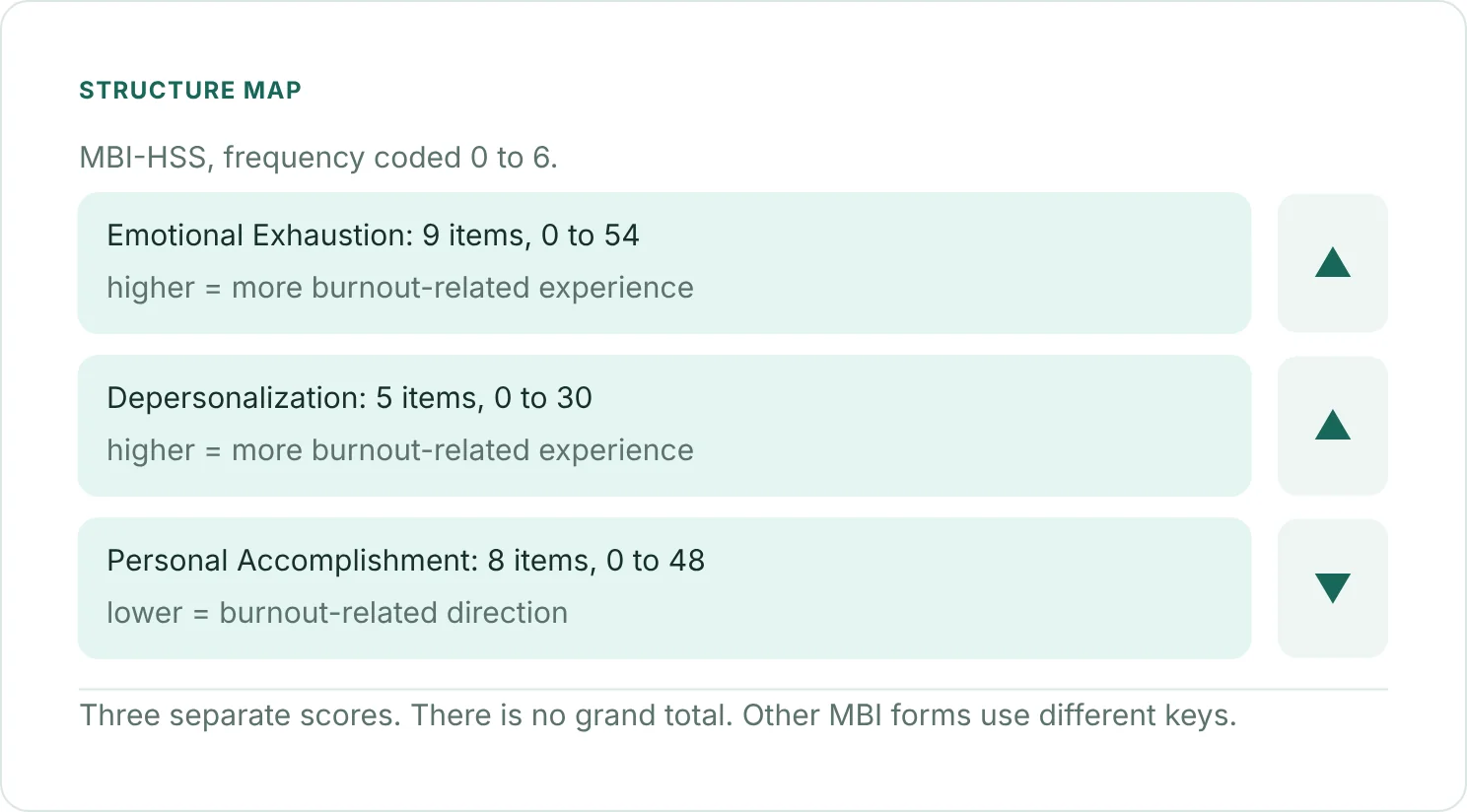
- Items: the MBI-HSS has 22 items across three subscales of 9, 5 and 8 items.
- Subscales: Emotional Exhaustion, Depersonalization and Personal Accomplishment, each scored on its own.
- Response scale: frequency, coded 0 to 6 in the standard MBI-HSS.
- Direction: higher Emotional Exhaustion and Depersonalization indicate more burnout-related experience, while lower Personal Accomplishment is the burnout-related direction.
- Total score: none. Three separate scores are reported.
- Other forms: the MBI-General Survey, the Educators Survey and other variants have different items and score structures. Do not apply HSS keys to them.
The MBI is published by Mind Garden, which provides the forms and scoring documentation for each version. Original development is described in Maslach and Jackson (1981).
How to Score the MBI
- Identify the exact MBI form administered, its response anchors and the scoring documentation the team is using.
- Use that form’s item-to-subscale map to obtain separate Emotional Exhaustion, Depersonalization and Personal Accomplishment scores, and do not create a grand total.
- For an MBI-HSS dataset, check that the subscale sums fall within their possible ranges of 0 to 54, 0 to 30 and 0 to 48.
- Handle missing responses by the form’s scoring rule. If none is available to you, mark the score incomplete and do not replace values silently. No developer-endorsed prorating rule was verified for this page.
- Analyze the three subscales separately, and describe any prespecified classification as study-defined with its source.
* Illustrative syntax: MBI-HSS subscale sums already computed from the form's own key.
DESCRIPTIVES VARIABLES=mbi_exhaustion mbi_depersonalization mbi_accomplishment
  /STATISTICS=MEAN STDDEV MIN MAX.
* Item-level scoring requires the key for the exact form, outside this example.# data: MBI-HSS subscale sums already computed from the correct form's key.
cols <- c("mbi_exhaustion", "mbi_depersonalization", "mbi_accomplishment")
summary(data[cols])
stopifnot(all(is.na(data$mbi_exhaustion) | (data$mbi_exhaustion >= 0 & data$mbi_exhaustion <= 54)))
stopifnot(all(is.na(data$mbi_depersonalization) | (data$mbi_depersonalization >= 0 & data$mbi_depersonalization <= 30)))
stopifnot(all(is.na(data$mbi_accomplishment) | (data$mbi_accomplishment >= 0 & data$mbi_accomplishment <= 48)))Interpreting MBI Scores
| Score band | Interpretation |
|---|---|
| Emotional Exhaustion, 0 to 54 | Higher = more frequent exhaustion |
| Depersonalization, 0 to 30 | Higher = more frequent depersonalization |
| Personal Accomplishment, 0 to 48 | Lower = less perceived professional effectiveness |
| Single burnout case definition | None universally accepted |
Source: Maslach and Jackson (1981); no universal case definition was verified.
Read each subscale in its own direction, and report the three together. Cutoff and dichotomization schemes differ across studies and purposes, so a threshold should be tied to the exact form, the occupational group and the stated research definition. Do not transfer a cutoff from another population.
MBI scores describe the construct the instrument defines and are not a clinical diagnosis. Interpret change and group differences within the study design, form, sampling frame and participant characteristics, and avoid causal wording for cross-sectional associations.
Psychometric Properties
| Property | Published finding | Source |
|---|---|---|
| Original domains | Three correlated but conceptually distinct dimensions | Maslach & Jackson (1981) |
| Reliability | Varies by population, language and administration; estimate it for each subscale in your own data | Study-specific |
| Factor structure | Check in your sample and language, especially for translated or non-HSS forms | Study-specific |
| Case classification | No single operational definition applies across settings | Not established universally |
These are source-specific findings and cannot be assumed to hold as reliability or validity estimates in a new sample, occupation or language.
Using the MBI in a Study
Name the occupational population and the form before comparing scores with other studies. In observational surveys, model each dimension separately with prespecified confounders, and remember that cross-sectional associations do not establish that working conditions cause burnout. In repeated assessments, evaluate change by subscale instead of relying on a dichotomous burned-out label.
Staff nested in teams, wards or sites violate independence, so a multilevel model is usually more appropriate than ordinary regression. Plan sample size from the target effect or precision for the primary outcome and not from the number of items, and consider missing data, multiplicity across three subscales and, for translated forms, dimensional equivalence.
Reporting the MBI
Work-related burnout was assessed with the [exact MBI form] (Maslach & Jackson, 1981). Scores were calculated for [named subscales] using the scoring documentation for that form, and each subscale was analyzed separately [continuously or as prespecified]. Higher Emotional Exhaustion and Depersonalization, and lower Personal Accomplishment, indicate more burnout-related experience. Missing responses were handled by [method]. Internal consistency in the present sample was [coefficient and value] for each subscale.
References
Maslach, C., & Jackson, S. E. (1981). The measurement of experienced burnout. Journal of Organizational Behavior, 2(2), 99-113. https://doi.org/10.1002/job.4030020205
Frequently Asked Questions
Can I add all 22 MBI-HSS items into one burnout score?
No. The standard approach reports three separate subscale scores, and a single total has no standard definition for this form.
Does a high MBI score diagnose a mental disorder?
No. The scores describe work-related experience and should not serve as a stand-alone diagnosis.
Is there a universal burnout cutoff on the MBI?
No. Any threshold belongs to the exact form, population and research definition it was set for.
Which variables do I analyze in SPSS?
The subscale scores computed with the key for your own form. Never score an MBI-HSS dataset with the key of another MBI version.
NEXT STEP
Need MBI Data Scored
or Checked?
OnlineSPSS is a statistical consultancy for researchers. Share your design and dataset, and a statistically trained Research Coordinator reviews it. The scope and one fixed project fee are confirmed before work begins.
No Commitment Required
Strictly Confidential
Fixed Project Fee
In-House PhD-Level Statisticians
Same-Day Response
Serving Researchers Since 2014