
Home / Resources / Psychological Measures / M-CHAT-R/F
M-CHAT-R/F:
Scoring and Interpretation
The Modified Checklist for Autism in Toddlers, Revised With Follow-Up (M-CHAT-R/F) is a two-stage, parent-report screen that flags toddlers who may benefit from a developmental evaluation. M-CHAT-R/F scoring is a keyed count, not a plain sum of yes answers, and the count routes each child to routine surveillance, structured follow-up or referral, so this guide covers the key, the thresholds, the two-stage logic, code that organizes screening data, and reporting wording.
What the M-CHAT-R/F Measures
The checklist was validated as a screening process for toddlers seen in primary care, where it asks caregivers about everyday behaviors relevant to early social communication and then follows up on the answers most likely to reflect misunderstanding or ordinary developmental variation (Robins et al., 2014). Its output is a screening classification that points to the need for evaluation. It is not a diagnostic interview and it does not grade the severity of autism spectrum disorder.
In the validation study, 16,071 toddlers were screened at 18- and 24-month well-child visits, and children who screened positive at both stages were evaluated. Among those who scored at least 3 on the initial checklist and at least 2 at follow-up, about 47.5% received an autism spectrum disorder diagnosis and about 94.6% had some developmental delay or concern (Robins et al., 2014). A positive screen therefore signals a need for developmental evaluation, and a negative screen does not override concerns raised by caregivers or clinicians.
Structure of the M-CHAT-R/F
- Items: twenty yes or no parent-report questions in the first stage. No item wording is reproduced here.
- Keying: most positions score a risk response for one answer, while positions 2, 5 and 12 score it for the other. A plain count of yes answers is therefore wrong.
- Follow-up: a structured interview revisits only the responses that scored as elevated likelihood. It is not a second ordinary sum.
- Subscales: none. The outputs are an initial count from 0 to 20 and a two-stage screening result.
- Age: the checklist is intended for toddlers of roughly 16 to 30 months. Record the child’s age in months at screening.
- Versions: the revised checklist with follow-up is not interchangeable with the original M-CHAT, and a translation needs its own source and evidence.
The instrument itself is available from the developers of the M-CHAT-R/F.
How to Score the M-CHAT-R/F
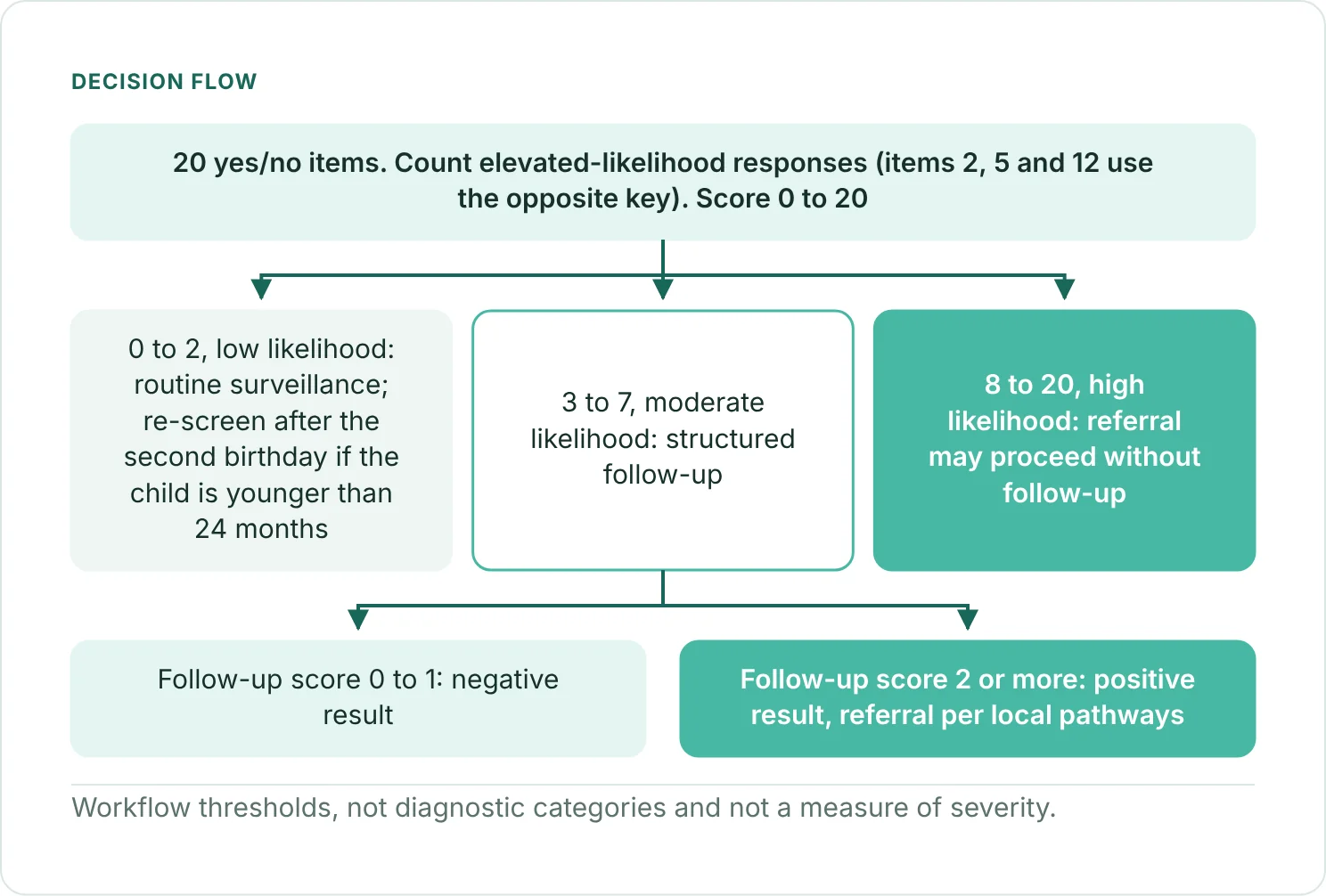
- Confirm that you are using the current M-CHAT-R/F form and its scoring algorithm, and code each response as 1 for an elevated-likelihood answer and 0 otherwise, remembering that items 2, 5 and 12 are keyed opposite to the rest.
- Count the elevated-likelihood responses to obtain the initial score, which ranges from 0 to 20.
- Apply the initial thresholds. A score of 0 to 2 is low likelihood, and the developers advise routine surveillance and re-screening after the second birthday when the child is younger than 24 months (M-CHAT, n.d.). A score of 3 to 7 is moderate likelihood and calls for the structured follow-up. A score of 8 to 20 is high likelihood, and referral may proceed without follow-up.
- After follow-up, a score of 2 or more is a positive screening result and 0 to 1 is negative. If follow-up was not done because the initial score was 8 or higher, do not record the child as follow-up negative.
- Store missing or indeterminate responses separately, never treat them as a reassuring answer, and handle them by the rule set in your protocol. The code below returns a missing score unless all 20 responses are present.
* Illustrative syntax: mchat1 to mchat20 are already coded 1 = elevated-likelihood response, 0 = other, using the keyed form.
COUNT mchat_risk_count = mchat1 TO mchat20 (1).
COMPUTE mchat_complete = (NVALID(mchat1 TO mchat20) = 20).
IF (mchat_complete = 0) mchat_risk_count = $SYSMIS.
RECODE mchat_risk_count (0 THRU 2=1) (3 THRU 7=2) (8 THRU 20=3) INTO mchat_band.
EXECUTE.# data: one row per screening; items mchat1 to mchat20 already coded 1 = elevated likelihood, 0 = other.
items <- paste0("mchat", 1:20)
stopifnot(all(items %in% names(data)))
valid <- rowSums(!is.na(data[items])) == 20
data$mchat_risk_count <- ifelse(valid, rowSums(data[items] == 1), NA_real_)
data$mchat_band <- cut(data$mchat_risk_count, breaks = c(-Inf, 2, 7, 20), labels = c("0-2", "3-7", "8-20"))Interpreting M-CHAT-R/F Scores
| Score band | Interpretation |
|---|---|
| Initial 0 to 2 | Low likelihood; routine surveillance |
| Initial 3 to 7 | Moderate likelihood; structured follow-up |
| Initial 8 to 20 | High likelihood; referral may proceed without follow-up |
| Follow-up 0 to 1 | Negative result after follow-up |
| Follow-up 2 or more | Positive result after follow-up; referral per local pathways |
Source: the three-level algorithm recommended and evaluated by Robins et al. (2014).
These are workflow thresholds, not diagnostic categories and not a measure of severity, so a one-point difference in the initial count is not an interval of autism likelihood. The predictive value of a positive screen depends on the population screened and on how the outcome was defined and ascertained, and the figures above come from a primary-care sample at 18- and 24-month visits.
Decisions about developmental evaluation should also reflect caregiver concerns and clinical judgment, whatever the questionnaire result. The code on this page organizes research data and does not determine what happens to an individual child.
Psychometric Properties
| Property | Published finding | Source |
|---|---|---|
| Validation sample | 16,071 toddlers screened at 18- and 24-month well-child visits | Robins et al. (2014) |
| Positive predictive value | About 47.5% for autism spectrum disorder in children scoring at least 3 initially and at least 2 at follow-up | Robins et al. (2014) |
| Any developmental concern | About 94.6% of the same group had delay or concern | Robins et al. (2014) |
| Sensitivity and specificity | Depend on how screen-negative children were ascertained; report them only against an explicit reference standard | Study-specific |
| Internal consistency | Not a central statistic for a keyed two-stage algorithm | Study-specific |
These are source-specific results and cannot be assumed to hold as accuracy estimates in a new sample, language or care setting.
Using the M-CHAT-R/F in a Study
Define the unit of analysis (the child), the initial score, whether follow-up was indicated and completed, and the two-stage positive-screen indicator before analysis. Report the numbers screened, eligible, missing, followed up, referred and evaluated, because a proportion of positive screens is not a proportion of diagnoses and incomplete diagnostic verification can bias apparent accuracy.
Use descriptive proportions with confidence intervals, or logistic models for a prespecified binary screen outcome. Report sensitivity and specificity only when the reference standard and the verification of screen-negative children are explicit. When a child is screened more than once, do not treat the repeated screens as independent. Plan sample size around the target estimate, such as the precision of a proportion or of a sensitivity, and not around a generic rule of thumb.
Reporting the M-CHAT-R/F
Caregivers completed the Modified Checklist for Autism in Toddlers, Revised With Follow-Up (M-CHAT-R/F; Robins et al., 2014) at [age range] months. Initial scores were the count of elevated-likelihood responses using the form’s key (range = 0 to 20). Children scoring 3 to 7 were offered the structured follow-up, and the two-stage algorithm determined screen-positive status. We report the initial score distribution, the proportion completing follow-up and the proportion screen positive, with developmental evaluations documented separately. No diagnosis was inferred from the screening result alone.
References
Robins, D. L., Casagrande, K., Barton, M., Chen, C.-M. A., Dumont-Mathieu, T., & Fein, D. (2014). Validation of the Modified Checklist for Autism in Toddlers, Revised With Follow-up (M-CHAT-R/F). Pediatrics, 133(1), 37-45. https://doi.org/10.1542/peds.2013-1813
M-CHAT. (n.d.). Modified Checklist for Autism in Toddlers, Revised With Follow-Up (M-CHAT-R/F) [Developer website].
Frequently Asked Questions
Is a positive M-CHAT-R/F result an autism diagnosis?
No. It indicates a need for developmental evaluation and, where relevant, early-intervention referral. Diagnosis rests on a broader clinical assessment.
Does every initial positive score need follow-up?
No. A score of 3 to 7 calls for the structured follow-up, while a score of 8 to 20 is high likelihood and referral may proceed without it.
Can I simply add up the yes answers?
No. Items 2, 5 and 12 carry the opposite key, so the keyed count is what produces the initial score.
Can the initial score be analyzed as a continuous outcome?
It can be described, but the screening result is the two-stage classification. A one-point difference is not an interval-scaled increment of severity.
NEXT STEP
Need M-CHAT-R/F Screening Data
Checked?
OnlineSPSS is a statistical consultancy for researchers. Share your design and dataset, and a statistically trained Research Coordinator reviews it. The scope and one fixed project fee are confirmed before work begins.
No Commitment Required
Strictly Confidential
Fixed Project Fee
In-House PhD-Level Statisticians
Same-Day Response
Serving Researchers Since 2014