
Home / Resources / Psychological Measures / LSAS
Liebowitz Social Anxiety Scale:
Scoring and Interpretation
The Liebowitz Social Anxiety Scale (LSAS) rates 24 social and performance situations twice, once for fear and once for avoidance. Liebowitz Social Anxiety Scale scoring therefore produces a fear total and an avoidance total (0 to 72 each) and a combined score (0 to 144), and this guide covers that structure, interpretation, SPSS and R code, psychometric evidence and reporting wording.
What the Liebowitz Social Anxiety Scale Measures
Liebowitz (1987) introduced the scale as a clinician-administered rating of social phobia, and its situations cover two kinds of demand: social interaction and performance in front of others. The paired ratings separate how anxious a situation makes the person from how far they avoid it, which is why the scale yields two dimension scores and not one (Heimberg et al., 1999).
The LSAS has been widely used in social anxiety treatment research. Its two dimensions are related, and factor-analytic work suggests that fear and avoidance are not always cleanly separable in clinical samples, so researchers should not assume that every proposed subgroup or factor score is equally stable (Heimberg et al., 1999).
Structure of the LSAS
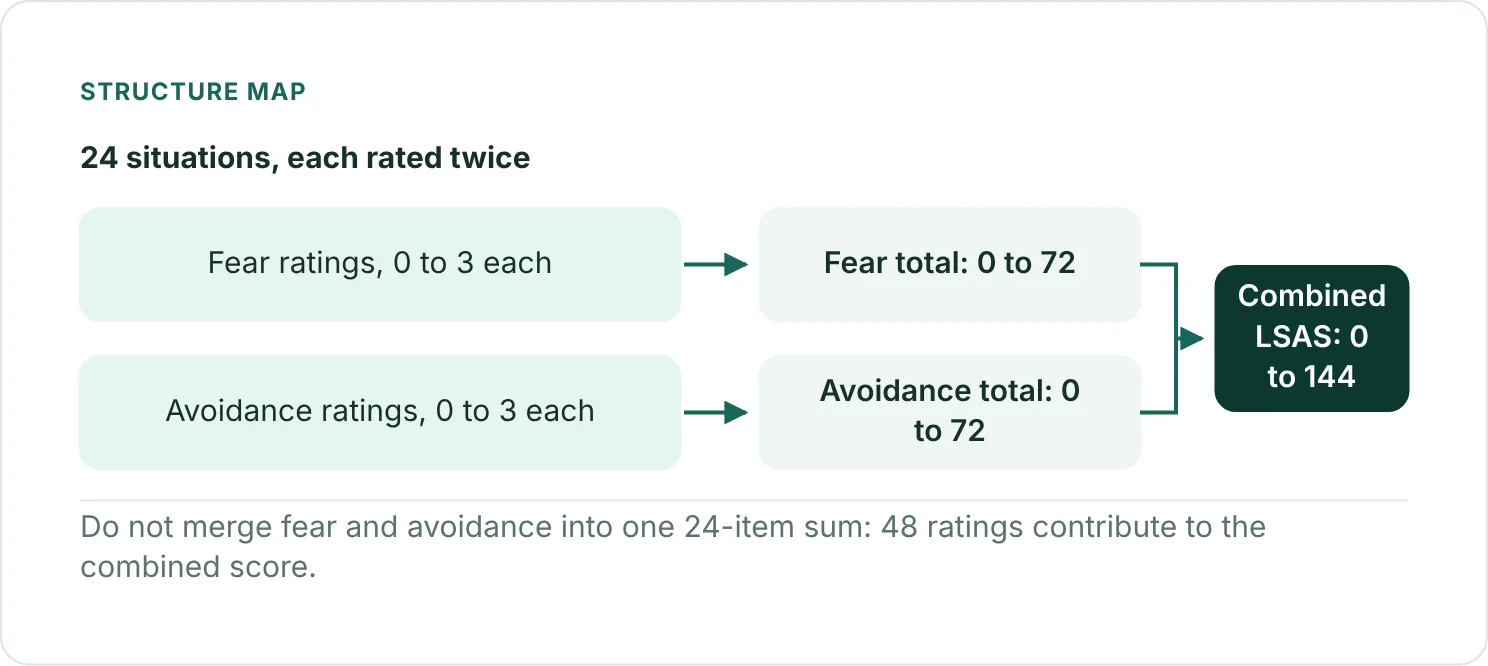
- Items: twenty-four situations, each rated twice, once for fear and once for avoidance, both on a 0 to 3 scale.
- Totals: the fear total and the avoidance total each range from 0 to 72, and the combined total ranges from 0 to 144.
- Subscales: interaction and performance scores are sometimes reported, but they require version-specific item mapping and should not be assumed.
- Direction: neither the fear nor the avoidance ratings are reverse scored.
- Versions: clinician-administered and self-report (LSAS-SR) forms exist. The version must be declared, and the recall period commonly refers to the preceding week.
- Translations: use a validated version for the intended population and name the language and its source. If no validated translation exists, say so and describe how the version was adapted.
The instrument itself is available from the original scientific publications or the specified LSAS publisher or clinical source.
How to Score the LSAS
- Verify that you hold 24 fear ratings (lsas_f1 to lsas_f24) and 24 avoidance ratings (lsas_a1 to lsas_a24), all from the same version of the scale.
- Sum each dimension separately to obtain lsas_fear and lsas_avoid, each ranging from 0 to 72.
- Add the two complete sums to obtain lsas_total, which ranges from 0 to 144. This is a sum of 48 ratings and not a 24-item sum.
- Apply a missing-response rule. The example requires every rating to be present. No developer-endorsed prorating rule was verified, so any alternative must be prespecified in the protocol and reported.
* Illustrative syntax: all 48 ratings already coded 0 to 3.
COMPUTE lsas_fear = SUM.24(lsas_f1 TO lsas_f24).
COMPUTE lsas_avoid = SUM.24(lsas_a1 TO lsas_a24).
IF (NOT MISSING(lsas_fear) AND NOT MISSING(lsas_avoid)) lsas_total = lsas_fear + lsas_avoid.
EXECUTE.# data: one row per respondent; fear items lsas_f1 to lsas_f24 and avoidance items lsas_a1 to lsas_a24 coded 0 to 3.
f <- paste0("lsas_f", 1:24)
a <- paste0("lsas_a", 1:24)
data$lsas_fear <- rowSums(data[f], na.rm = FALSE)
data$lsas_avoid <- rowSums(data[a], na.rm = FALSE)
data$lsas_total <- data$lsas_fear + data$lsas_avoidInterpreting LSAS Scores
| Score band | Interpretation |
|---|---|
| 0 to 144 | Continuous combined score; higher = more fear and avoidance |
| Fear or avoidance total (0 to 72) | Higher = more fear, or more avoidance, respectively |
| Screening thresholds | Use only with a published study, population and version |
Source: Heimberg et al. (1999) for validation; no universal diagnostic cutoff is assumed.
The combined score expresses social anxiety symptom severity and avoidance behavior. Some studies have evaluated thresholds for possible social anxiety disorder, but sensitivity and specificity depend on the sample, the diagnostic reference standard and whether the clinician or self-report version was used. The scale should not be the sole diagnostic assessment.
Do not merge fear and avoidance into one undifferentiated 24-item sum. Each situation has two ratings, so 48 numerical values contribute to the combined score. Totals from the clinician and self-report versions should not be treated as interchangeable.
Psychometric Properties
| Property | Published finding | Source |
|---|---|---|
| Internal consistency | Reported as excellent in a multicenter clinical sample of 382 participants | Heimberg et al. (1999) |
| Convergent validity | Correlated with other measures of social fear and avoidance | Heimberg et al. (1999) |
| Factor structure | Fear and avoidance may not be distinct factors in all clinical samples | Heimberg et al. (1999) |
| Treatment sensitivity | Sensitive to differences between pharmacologic treatments and to change | Heimberg et al. (1999) |
These are source-specific results and cannot be assumed to hold as reliability estimates in a new sample.
Using the LSAS in a Study
In a trial, prespecify whether the primary outcome is the combined LSAS or the fear and avoidance scores separately. Because repeated assessments on the same person are correlated, the treatment-change model should account for that dependence, for example with a mixed-effects model. If fear and avoidance are both analyzed, the two outcomes are correlated and the multiplicity should be handled in the analysis plan.
For validation work, evaluate the factor structure and reliability in the target population and not by borrowing them from a clinical sample, and do not treat the clinician and self-report variants as interchangeable. If you compare groups, such as language versions or clinical and community samples, test measurement invariance before interpreting differences in raw means.
Reporting the LSAS
Social anxiety severity was assessed with the Liebowitz Social Anxiety Scale (LSAS; Liebowitz, 1987; Heimberg et al., 1999), administered as the [clinician or self-report] version. Twenty-four fear ratings and twenty-four avoidance ratings (each 0 to 3) were summed to give separate fear and avoidance scores (range = 0 to 72 each) and a combined total (range = 0 to 144), with higher scores indicating greater social anxiety and avoidance. Cronbach’s alpha in the present sample was [α = XX]. Analyses used [planned method].
References
Heimberg, R. G., Horner, K. J., Juster, H. R., Safren, S. A., Brown, E. J., Schneier, F. R., & Liebowitz, M. R. (1999). Psychometric properties of the Liebowitz Social Anxiety Scale. Psychological Medicine, 29(1), 199-212. https://doi.org/10.1017/S0033291798007879
Liebowitz, M. R. (1987). Social phobia. Modern Problems of Pharmacopsychiatry, 22, 141-173. https://doi.org/10.1159/000414022
Frequently Asked Questions
Why are there 48 numeric ratings for 24 situations?
Every situation is rated once for fear and once for avoidance, and both sets contribute to the combined total of 0 to 144.
Is the LSAS only clinician administered?
A clinician version is historically established, and a self-report version has also been studied. State which one you used, because the versions should not be treated as interchangeable.
Can I report the fear and avoidance scores separately?
Yes, with a justified analysis plan. The two scores are correlated and may not be psychometrically independent, so interpret them with that in mind.
Does a high LSAS score diagnose social anxiety disorder?
No. Diagnosis requires an appropriate clinical assessment, and a high score is a severity indicator.
NEXT STEP
Need an LSAS Score Set Up
or Checked?
OnlineSPSS is a statistical consultancy for researchers. Share your design and dataset, and a statistically trained Research Coordinator reviews it. The scope and one fixed project fee are confirmed before work begins.
No Commitment Required
Strictly Confidential
Fixed Project Fee
In-House PhD-Level Statisticians
Same-Day Response
Serving Researchers Since 2014