
Home / Resources / Psychological Measures / IES-R
IES-R:
Scoring and Interpretation
The Impact of Event Scale-Revised (IES-R) is a 22-item self-report measure of distress tied to one named event over the past seven days. IES-R scoring gives a 0 to 88 total and three subscale means, so this guide covers the subscales, why the scale is not a DSM-5 diagnostic tool, the study-specific cutoff near 33, SPSS and R code, and reporting wording.
What the IES-R Measures
The Impact of Event Scale-Revised measures subjective distress linked to a specific traumatic or highly stressful event. It has intrusion, avoidance and hyperarousal symptom groups and a seven-day reference period. The 22-item revision extends the original 15-item Impact of Event Scale (Weiss & Marmar, 1997).
The IES-R is used in trauma, disaster, occupational-health and post-event psychological research. It is important to distinguish trauma-related distress from a DSM-5 diagnosis of posttraumatic stress disorder. The U.S. Department of Veterans Affairs National Center for PTSD notes that the IES-R reflects earlier diagnostic frameworks and was not updated to cover all DSM-5 symptom clusters.
Structure of the IES-R
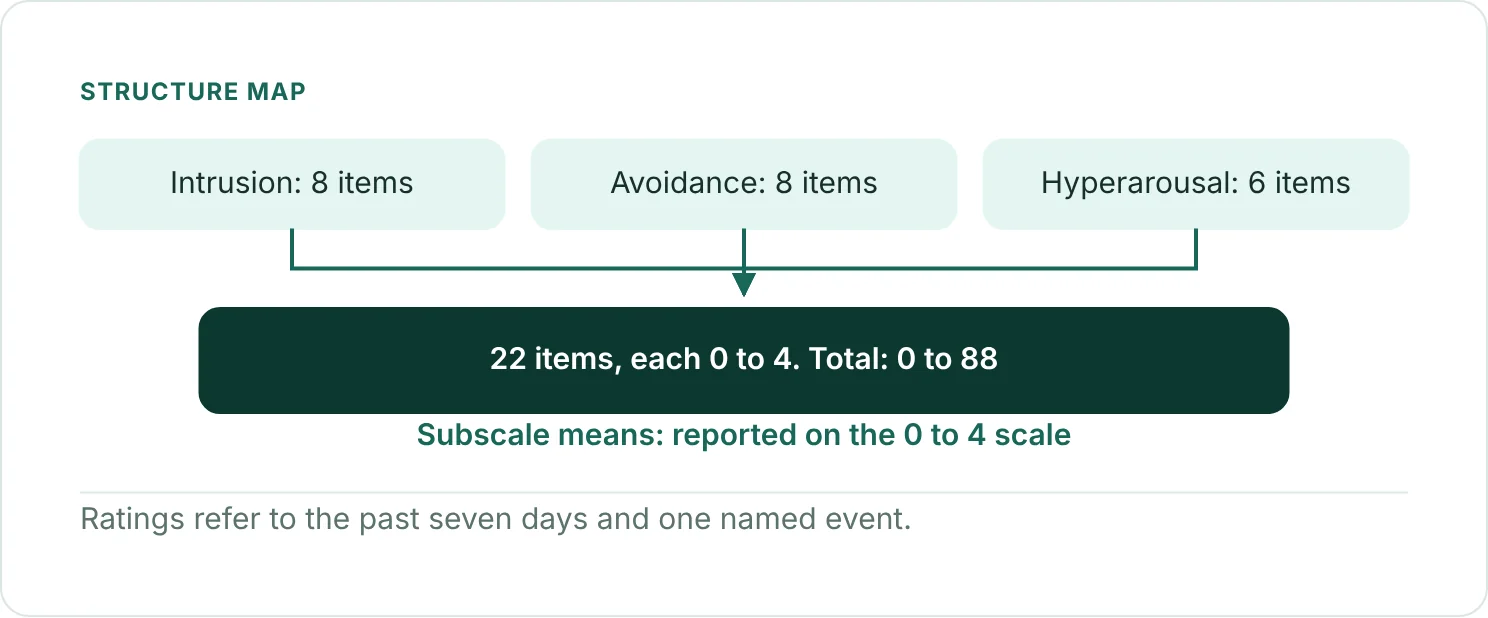
- Items: twenty-two self-report distress ratings tied to a participant-identified event, each scored from 0 to 4.
- Subscales: 8 intrusion, 8 avoidance and 6 hyperarousal items. The complete total spans 0 to 88.
- Subscale metric: the authors recommend subscale means, so that groups of different size sit on a common 0 to 4 scale.
- Versions: the 15-item original IES and the 22-item IES-R are not interchangeable.
- Scope: the scale does not cover the full DSM-5 symptom framework. The PCL-5 or the CAPS-5 suits a study whose main requirement is DSM-5 PTSD assessment.
The instrument itself is available from the U.S. Department of Veterans Affairs National Center for PTSD assessment information and from the authors’ published chapter.
How to Score the IES-R
- Confirm the participant’s reference event and the seven-day recall instruction, and check that all 22 responses are numeric from 0 to 4.
- Compute the 22-item total, which ranges from 0 to 88. The example below does so only for complete records.
- Compute intrusion, avoidance and hyperarousal means only with the verified IES-R subscale keys, and not by splitting the items into three consecutive blocks.
- Document the missing-response rule and the version used, and state whether results are sums or means.
* Illustrative syntax: items iesr1 to iesr22 coded 0 to 4, standard item order.
COMPUTE iesr_total = SUM.22(iesr1 TO iesr22).
EXECUTE.
* Subscale means need the verified item membership for each subscale.# data: one row per respondent; items iesr1 to iesr22 coded 0 to 4.
items <- paste0("iesr", 1:22)
stopifnot(all(vapply(data[items], function(x) all(is.na(x) | x %in% 0:4), logical(1))))
data$iesr_total <- rowSums(data[items], na.rm = FALSE)Interpreting IES-R Scores
| Score | Interpretation |
|---|---|
| 0 to 88 total | A higher total indicates more severe event-related distress |
| Subscale means | Each can be reported on the 0 to 4 scale using the relevant item key |
| PTSD classification | No universal IES-R score confirms PTSD |
Source: Weiss & Marmar (1997), Creamer et al. (2003) and the U.S. Department of Veterans Affairs National Center for PTSD.
The total expresses the burden of event-related subjective distress. In a study of Vietnam veterans, Creamer and colleagues (2003) found that a threshold near 33 performed well against their chosen PTSD assessment. That cutoff is a study-specific finding and not a stand-alone diagnostic rule for every population. If a paper uses a threshold, it should state the derivation population and the validation criterion.
The IES-R does not incorporate all DSM-5 PTSD criteria. Describing a positive IES-R screen as a DSM-5 diagnosis, or claiming that a threshold predicts current clinical status perfectly, is methodologically unsound.
Psychometric Properties
| Property | Published finding | Source |
|---|---|---|
| Revision | The IES-R expanded the original event-focused scale with hyperarousal content | Weiss & Marmar (1997) |
| Convergent validity | A correlation of .84 with the PTSD Checklist in veteran samples | Creamer et al. (2003) |
| Cutoff evaluation | A cutoff near 33 was examined in a veteran sample; the reference standard and population matter | Creamer et al. (2003) |
| Diagnostic scope | Based on earlier PTSD criteria, not a full DSM-5 assessment | U.S. Department of Veterans Affairs National Center for PTSD |
| Reliability | Published subscale internal-consistency estimates vary by sample | Creamer et al. (2003); other validations |
These are source-specific findings and cannot be assumed to hold as reliability estimates in a new sample.
Using the IES-R in a Study
In cross-sectional research, the total can serve as a dimensional distress outcome related to event type, exposure and social factors. Do not read causal effects from a cross-sectional association without a credible design. If several subscales are analyzed, state whether they were prespecified and address multiplicity, or present them as descriptive.
In longitudinal research, identify the index event and whether follow-up questionnaires continue to refer to the same event. Use methods suited to repeated measures and examine missing questionnaires, which may relate to trauma severity. When the research goal requires formal DSM-5 PTSD symptom status, choose a contemporary validated instrument designed for that purpose.
Reporting the IES-R
Event-related distress was assessed with the 22-item Impact of Event Scale-Revised (IES-R; Weiss & Marmar, 1997). Participants rated distress over the preceding seven days in relation to [event], with items scored 0 to 4 and summed to a total of 0 to 88. Higher totals represented greater event-related distress. The outcome was analyzed [continuously or with a justified threshold] and was not interpreted as a DSM-5 diagnosis.
References
Creamer, M., Bell, R., & Failla, S. (2003). Psychometric properties of the Impact of Event Scale-Revised. Behaviour Research and Therapy, 41(12), 1489-1496. https://doi.org/10.1016/j.brat.2003.07.010
Weiss, D. S., & Marmar, C. R. (1997). The Impact of Event Scale-Revised. In J. P. Wilson & T. M. Keane (Eds.), Assessing psychological trauma and PTSD (pp. 399-411). Guilford Press.
Frequently Asked Questions
Does the IES-R diagnose PTSD?
No. It measures post-event distress and does not implement the full DSM-5 diagnostic framework.
What is the IES-R total score range?
With all 22 items completed and each scored 0 to 4, the total ranges from 0 to 88.
Should I report subscale sums or means?
The authors recommend means, which place the different-size subscales on the same 0 to 4 metric.
Is 33 a universal cutoff for PTSD?
No. It was studied in a particular veteran sample and is not a universally validated decision rule.
NEXT STEP
Need IES-R Data Scored
or Checked?
OnlineSPSS is a statistical consultancy for researchers. Share your design and dataset, and a statistically trained Research Coordinator reviews it. The scope and one fixed project fee are confirmed before work begins.
No Commitment Required
Strictly Confidential
Fixed Project Fee
In-House PhD-Level Statisticians
Same-Day Response
Serving Researchers Since 2014