
How to Report Mediation Analysis Results
How to report mediation analysis comes down to describing the model and its paths, giving the indirect effect with a confidence interval (usually from resampling), and stating the design assumptions behind any causal wording. Cross-sectional data support an indirect association consistent with the proposed model, not a demonstrated causal sequence.

A mediation report requires more than saying that one variable “mediates” another. Readers need to see the hypothesized paths, the estimated indirect effect, the way its uncertainty was calculated, and the design assumptions supporting any causal language.
Describe the mediation model first
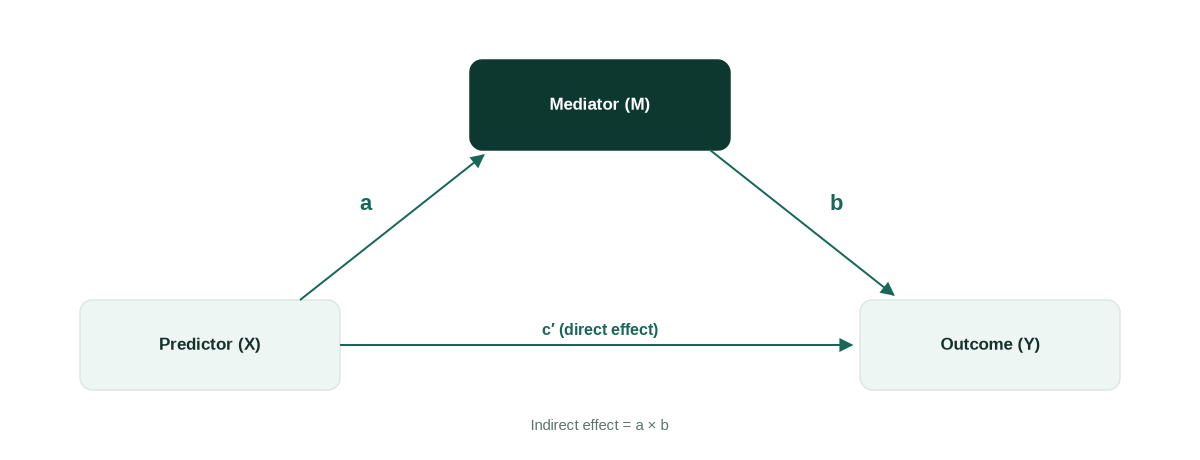
In a simple model, X is the predictor, M is the proposed mediator, and Y is the outcome. Path a connects X to M; path b connects M to Y after accounting for X. Their product (a × b) is the indirect-effect estimate in a common linear-model formulation. Path c′ describes the direct association after accounting for M. Multiple mediators require clear definitions for each specific indirect effect (Preacher & Hayes, 2008).
Draw or describe the model before interpreting coefficients. State whether X, M and Y were measured at separate time points or in one cross-sectional survey. Temporal order is important if you want to make a claim about how one factor produces change in another.
Report the indirect effect, not only the individual paths
The sampling distribution of a product of coefficients may be asymmetric. Resampling methods are widely used to estimate intervals for the indirect effect (Preacher & Hayes, 2008). Report the estimate, type of confidence interval and number of bootstrap samples, together with any correction or clustering scheme.
| Quantity | What it tells the reader |
|---|---|
| a | Association of X with M under the specified model |
| b | Association of M with Y conditional on X and other terms |
| a × b | Estimated indirect effect and its confidence interval |
| c′ | Direct effect under the specified model |
| Total effect | Overall X-Y association when defined for the chosen model |
Do not infer an indirect effect solely from two individually significant paths. Nor does a nonsignificant total effect automatically rule out a specific indirect pathway.
How to report mediation analysis in APA style
A mediation model estimated an indirect association between X and Y through M of 0.18 (bootstrap 95% CI [0.07, 0.32], 5,000 resamples). The direct-effect estimate was 0.10 (95% CI [−0.04, 0.24]). The observational, cross-sectional data do not establish the hypothesized causal sequence.
Hypothetical example, not published data.
A total, direct and indirect effect can be compared only when their definitions and estimation scales permit it. In nonlinear models, products and decompositions may differ from the simple linear case.
Multiple mediators and covariates
If mediators are fitted in parallel, identify all mediators and report each specific indirect estimate and its interval. Include covariates chosen for a substantive reason and describe any sensitivity analyses. A single “percentage mediated” can be unstable or confusing when effects have opposite signs or the total effect is close to zero, so do not use it as the only summary.
What does mediation not prove?
Mediation analysis can describe a hypothesized process but does not manufacture temporal information or remove unmeasured confounding. Cross-sectional mediation estimates can misrepresent longitudinal processes (Maxwell & Cole, 2007). Cross-sectional results should normally use cautious language such as “indirect association consistent with the proposed model.” A randomized X does not by itself eliminate confounding of M and Y; causal interpretations need additional identification assumptions (Imai et al., 2010). Report alternative explanations and the limits of causal interpretation.
Submission checklist
State the model, sample size, estimator, link functions, missing-data approach, paths, indirect-effect interval, bootstrap scheme, and assumptions. If you used a pre-specified theory, cite it; if you tested the mediation after viewing the data, label the analysis exploratory. These decisions are more informative than a statement that “PROCESS showed significant mediation.”
Frequently asked questions
Does mediation require a significant total effect?
No. Specific indirect associations can be estimated without a statistically significant total effect; interpretation still depends on the model and assumptions.
Should I report the indirect-effect p-value?
A confidence interval for the estimated indirect effect is often more informative than reporting only a p-value.
Can cross-sectional surveys establish mediation?
They can estimate a proposed indirect association, but generally cannot establish temporal or causal mediation by themselves.
Results Reporting & InterpretationNeed your mediation results reviewed before submission? A statistician can check the model specification, the indirect-effect interval and the causal wording against your design.
Results Reporting & Interpretation
Results Reporting & Interpretation at OnlineSPSS provides the agreed methodological, analytical and statistical reporting support for your study, carried out in-house by PhD-level statisticians. A statistically trained Research Coordinator reviews your request, and the analytical work, deliverables, timeline and one fixed project fee are confirmed before work begins. The research question, interpretation and conclusions remain with you.
References
- Imai, K., Keele, L., & Tingley, D. (2010). A general approach to causal mediation analysis. Psychological Methods, 15(4), 309–334. https://doi.org/10.1037/a0020761
- Maxwell, S. E., & Cole, D. A. (2007). Bias in cross-sectional analyses of longitudinal mediation. Psychological Methods, 12(1), 23–44. https://doi.org/10.1037/1082-989X.12.1.23
- Preacher, K. J., & Hayes, A. F. (2008). Asymptotic and resampling strategies for assessing and comparing indirect effects in multiple mediator models. Behavior Research Methods, 40(3), 879–891. https://doi.org/10.3758/BRM.40.3.879
Last reviewed November 2026 by the OnlineSPSS Statistical Team. Worked examples use hypothetical values and are not client data.
NEXT STEP
Need this done for
your study?
Share your research in about a minute and receive a complimentary assessment the same day: scope, timeline and one fixed fee.
No Commitment Required
Strictly Confidential
Fixed Project Fee
In-House PhD-Level Statisticians
Same-Day Response
Serving Researchers Since 2014