
Home / Resources / Psychological Measures / GHQ-12
GHQ-12:
Scoring and Interpretation
The 12-item General Health Questionnaire (GHQ-12) screens for recent psychological distress by asking how a person has felt compared with usual. GHQ-12 scoring has two common methods, binary (0 to 12) and Likert (0 to 36), and the method changes every downstream number, so both keys are shown side by side, with SPSS and R code, what the evidence says about reliability, and reporting wording.
What the GHQ-12 Measures
Goldberg (1972) introduced the General Health Questionnaire, and Goldberg and Williams (1988) describe the GHQ-12 as its shortest form, a screen for non-specific psychological distress in community and primary care settings. Each item asks whether a symptom or behavior has changed compared with the respondent’s usual state in recent weeks.
Because the frame is change from usual, a score reflects recent distress and not a stable trait or a specific disorder. Goldberg et al. (1997) evaluated the GHQ-12 against a structured diagnostic interview in a multi-center World Health Organization study of general health care and found it worked about as well as the 28-item version as a case detector. It is a screening instrument, not a diagnostic one.
Structure of the GHQ-12
- Items: twelve self-report items, each with four ordered response categories. Positively and negatively worded items have different response labels, but the categories are listed in order of increasing distress.
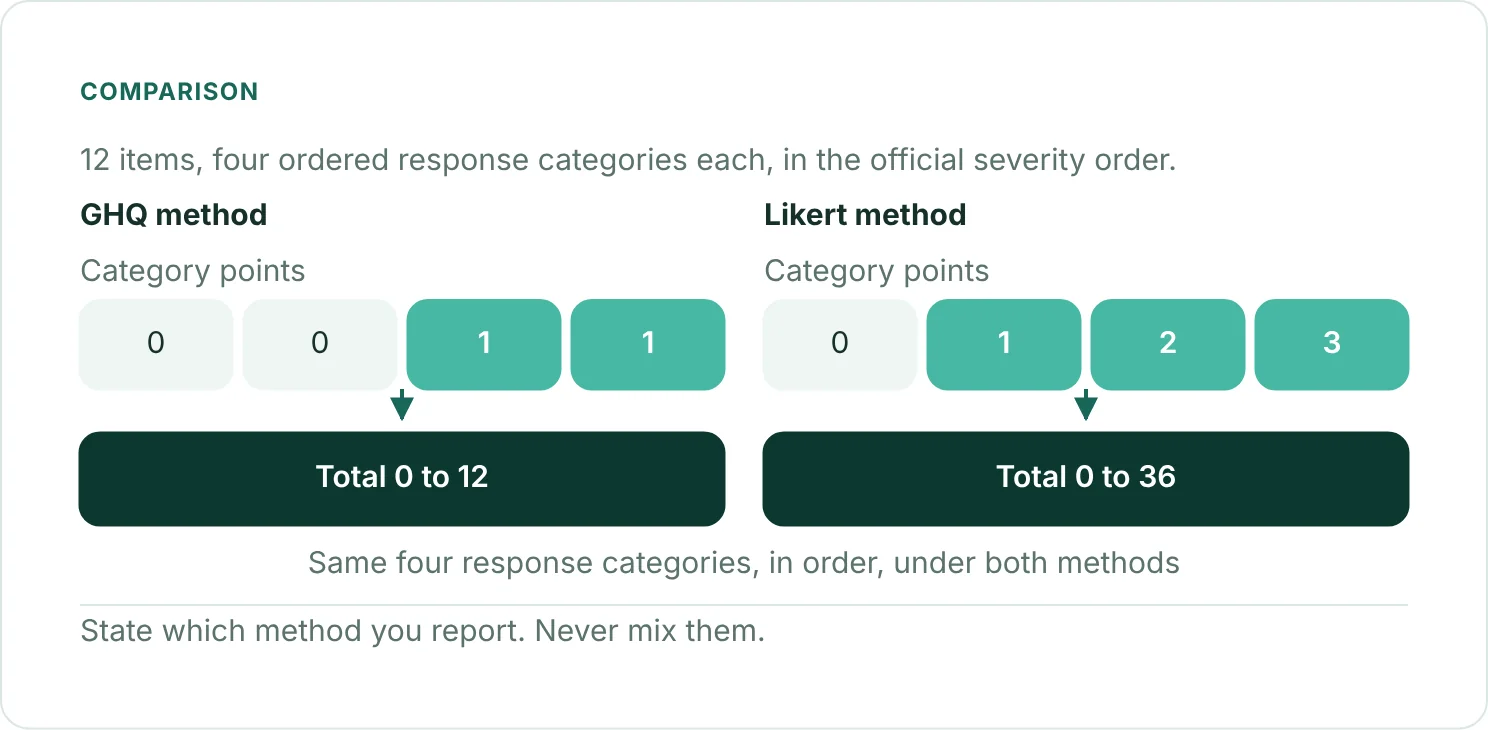
- Scoring methods: the GHQ (binary) method scores the categories 0, 0, 1, 1 for a total of 0 to 12, and the Likert method scores them 0, 1, 2, 3 for a total of 0 to 36. A further method, C-GHQ, exists and is not interchangeable with either.
- Subscales: no standard subscales. Factor structures have been proposed, but a single total is the usual outcome.
- Direction: higher scores mean more distress once responses are scored by category position.
- Versions: the GHQ-28, GHQ-30 and GHQ-60 are different instruments with their own scoring.
- Translations: name the language and the validation evidence for it, and confirm that the response categories keep the same order of distress. If none exists, say so and describe how the version was adapted.
The questionnaire and its scoring key are described in Goldberg and Williams (1988).
How to Score the GHQ-12
- Enter each response by the position of the category the respondent chose, from the least to the most distress, so that 0 to 3 increases with distress for every item. Verify this against the layout of your form.
- For the Likert method, sum the 12 items to obtain ghq_likert, which ranges from 0 to 36.
- For the GHQ method, recode the two lowest categories to 0 and the two highest to 1, then sum to obtain ghq_binary, which ranges from 0 to 12. State which method you report and never mix them.
- Apply a missing-item rule set by the protocol. No developer-endorsed prorating rule was verified, so the code below requires all 12 responses. Report how missing items were handled.
* Illustrative syntax: ghq1 to ghq12 hold category position coded 0 to 3 by increasing distress.
COMPUTE ghq_likert = SUM.12(ghq1 TO ghq12).
RECODE ghq1 TO ghq12 (0,1=0) (2,3=1) (ELSE=SYSMIS) INTO ghqb1 TO ghqb12.
COMPUTE ghq_binary = SUM.12(ghqb1 TO ghqb12).
EXECUTE.# data: one row per respondent; items ghq1 to ghq12 coded 0 to 3 by increasing distress.
items <- paste0("ghq", 1:12)
data$ghq_likert <- rowSums(data[items], na.rm = FALSE)
binary <- as.data.frame(lapply(data[items], function(x) as.integer(x >= 2)))
data$ghq_binary <- rowSums(binary, na.rm = FALSE)Interpreting GHQ-12 Scores
| Score band | Interpretation |
|---|---|
| 0 to 12 (binary) or 0 to 36 (Likert) | Continuous distress; higher = more distress |
| Screening cutoffs | Use only if a publication for your population and scoring method supports the value |
| Universal diagnostic threshold | None verified |
Source: Goldberg and Williams (1988); no universal diagnostic threshold was verified.
Higher totals indicate more recent psychological distress. Cutoffs for a positive screen depend on the scoring method, the population and the setting, so a value taken from one study does not transfer to another scoring method. The continuous score keeps more information and should be reported alongside any threshold.
A GHQ-positive result is not a psychiatric diagnosis. Cross-cultural and cross-language comparisons need evidence of measurement equivalence before group differences are interpreted.
Psychometric Properties
| Property | Published finding | Source |
|---|---|---|
| Screening validity | In a multi-center WHO study, the GHQ-12 performed about as well as the GHQ-28 as a case detector against a structured interview, and complex scoring added no advantage over simpler methods | Goldberg et al. (1997) |
| Dimensionality | In a national survey sample, a one-dimensional model with response bias on negatively worded items fitted best | Hankins (2008) |
| Reliability | Cronbach’s alpha overstated reliability when response bias was modeled, and the gap differed by scoring method | Hankins (2008) |
| Cross-population validity | Check language and group equivalence before transferring thresholds | Version-specific research |
These are source-specific findings and cannot be assumed to hold as reliability or accuracy estimates in a new sample.
Using the GHQ-12 in a Study
Fix the scoring method before analysis and carry it through the whole study. The binary score is a count with a narrow range and many ties, so a linear model on it needs inspection, and a model for bounded counts or ordinal data may fit better. The Likert total is closer to continuous but is still bounded at 0 and 36. If a threshold is used for prevalence, report the continuous results as well.
Because response bias on the negatively worded items has been reported, alpha alone may flatter reliability, and an omega-type estimate from a latent model is a useful complement. Where groups differ in language or culture, test measurement invariance before comparing means. Sample size should be planned around the primary contrast or model, not the number of items.
Related guides: Reliability Analysis (Cronbach’s Alpha) · Measurement Invariance · ROC Curve Analysis · Health Psychology
Reporting the GHQ-12
Psychological distress was measured with the 12-item General Health Questionnaire (GHQ-12; Goldberg & Williams, 1988). Responses were scored using the [binary (0, 0, 1, 1) or Likert (0, 1, 2, 3)] method and summed to a total score (range = [0 to 12 or 0 to 36]), with higher scores indicating greater distress. Missing responses were handled by [method]. Internal consistency in the present sample was [alpha or omega = XX, 95% CI XX to XX]. The statistical model was [model] with [covariates].
References
Goldberg, D. P. (1972). The detection of psychiatric illness by questionnaire (Maudsley Monograph No. 21). Oxford University Press.
Goldberg, D. P., Gater, R., Sartorius, N., Üstün, T. B., Piccinelli, M., Gureje, O., & Rutter, C. (1997). The validity of two versions of the GHQ in the WHO study of mental illness in general health care. Psychological Medicine, 27(1), 191-197. https://doi.org/10.1017/S0033291796004242
Goldberg, D. P., & Williams, P. (1988). A user’s guide to the General Health Questionnaire. NFER-Nelson.
Hankins, M. (2008). The reliability of the twelve-item General Health Questionnaire (GHQ-12) under realistic assumptions. BMC Public Health, 8, Article 355. https://doi.org/10.1186/1471-2458-8-355
Frequently Asked Questions
What is the difference between GHQ binary and Likert scoring?
The binary method scores the four categories 0, 0, 1, 1 (total 0 to 12) and the Likert method scores them 0, 1, 2, 3 (total 0 to 36). State which you used and never mix them.
Does a high GHQ-12 score mean someone has a mental disorder?
No. It screens for recent distress and is not a diagnosis. A clinical assessment is needed for any diagnostic conclusion.
Can I apply a cutoff from another GHQ-12 study?
Only if the scoring method, population and setting match. Thresholds are method-specific, so cite the source of any value you use.
How should I handle a missing item?
A missing item can shift the binary and Likert totals by different amounts, so set one rule before scoring and apply it identically under both methods. Report how many respondents it affected.
NEXT STEP
Need GHQ-12 Data Scored
or Checked?
OnlineSPSS is a statistical consultancy for researchers. Share your design and dataset, and a statistically trained Research Coordinator reviews it. The scope and one fixed project fee are confirmed before work begins.
No Commitment Required
Strictly Confidential
Fixed Project Fee
In-House PhD-Level Statisticians
Same-Day Response
Serving Researchers Since 2014