
Home / Resources / Psychological Measures / GDS-15
GDS-15:
Scoring and Interpretation
The Geriatric Depression Scale short form (GDS-15) is a 15-item yes or no screen for depressive symptoms in older adults. GDS-15 scoring turns on mixed keying, because five items score a point for No and ten for Yes, so this guide sets out the recoding, the 0 to 15 total, the screening threshold of 5 with its published accuracy, SPSS and R code, and reporting wording.
What the GDS-15 Measures
Sheikh and Yesavage (1986) derived the GDS-15 as a short form of the earlier 30-item GDS. The yes or no format was meant as an accessible alternative to assessments that lean heavily on somatic features, which are hard to separate from physical illness in aging populations.
The GDS-15 is common in geriatric clinical and research settings, including primary care and long-term care, but its accuracy varies across environments and presentations. A systematic review and meta-analysis reported pooled sensitivity of .89 and specificity of .77 at a cutoff of 5, while cautioning that thresholds are reported inconsistently across studies (Pocklington et al., 2016).
Structure of the GDS-15
- Items: fifteen dichotomous self-report items. Each is keyed so that a depression-indicating response earns one point.
- Keying: the keyed direction varies by item. In the commonly distributed Stanford form, items 1, 5, 7, 11 and 13 are depression-indicating for No, and the other ten for Yes. Do not code all Yes answers as one.
- Subscales: none required. The standard score is a single 0 to 15 sum.
- Transformation: none. The standard screening total needs no T-score or other conversion.
- Versions: the original GDS-30 and other brief versions are not interchangeable with the GDS-15, and recall follows the form’s own instructions.
- Translations: use a validated version for the intended population and name the language and its source. If no validated translation exists, say so and describe how the version was adapted.
The instrument itself is available from the Stanford GDS resource (Yesavage) and the instrument source.
How to Score the GDS-15
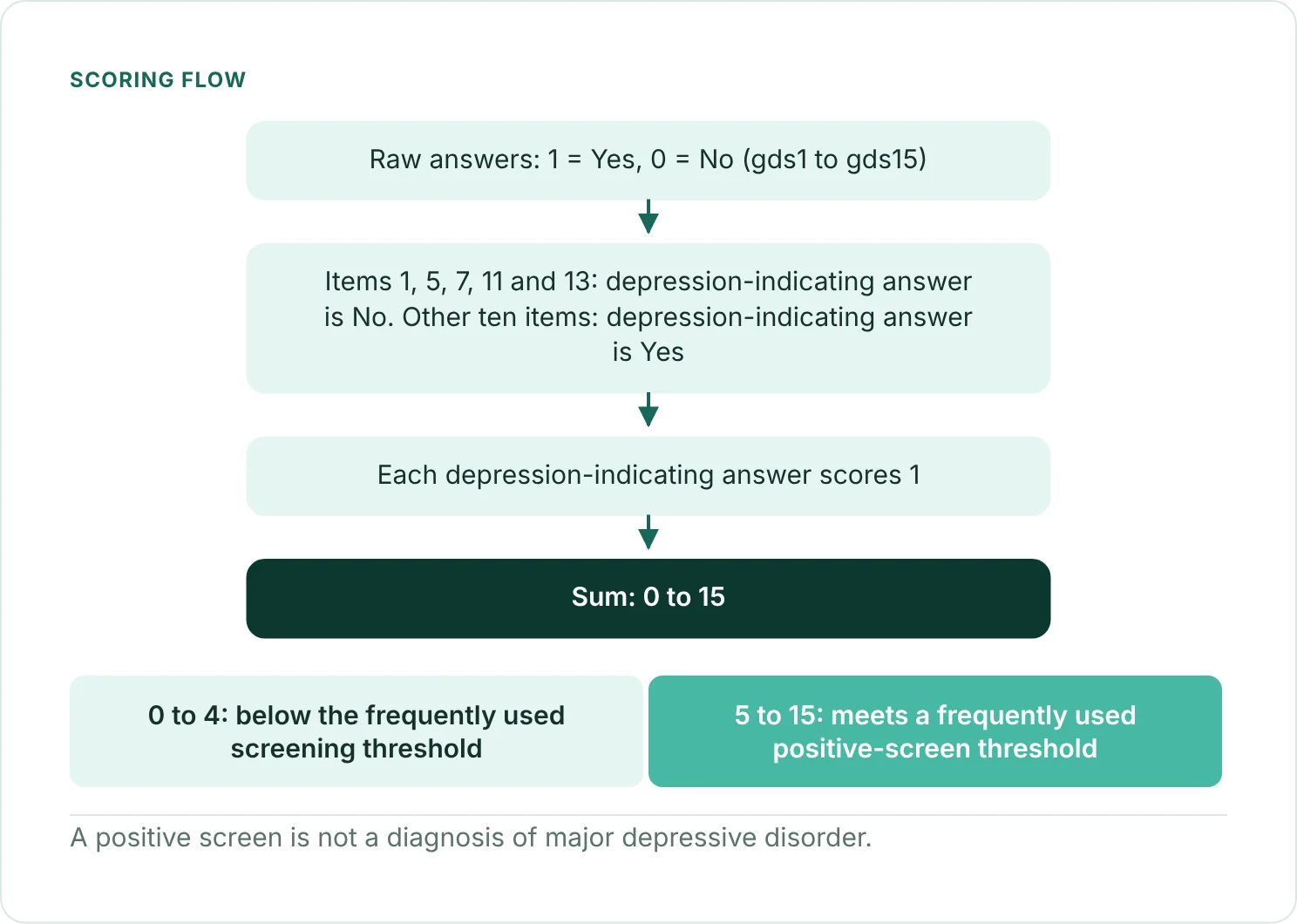
- Enter raw responses as 1 = Yes and 0 = No in gds1 to gds15, and verify the exact published 15-item ordering of your form.
- In the commonly distributed Stanford form, items 1, 5, 7, 11 and 13 are keyed for No and the other ten for Yes. Confirm this against your own questionnaire.
- Reverse the five No-keyed items (1 minus the response) so every variable shows 1 for a depression-indicating answer, then sum all 15 to obtain gds15_total, which ranges from 0 to 15.
- Apply a missing-item rule. The example requires all 15 responses. No developer-endorsed prorating rule was verified, so any other rule must be prespecified, justified and reported in the methods section.
* Illustrative syntax: raw entries Yes = 1, No = 0, standard 15-item ordering.
RECODE gds1 gds5 gds7 gds11 gds13 (0=1) (1=0) INTO gdsk1 gdsk5 gdsk7 gdsk11 gdsk13.
COMPUTE gds15_total = SUM.15(gdsk1, gds2, gds3, gds4, gdsk5, gds6, gdsk7, gds8, gds9, gds10, gdsk11, gds12, gdsk13, gds14, gds15).
EXECUTE.# data: one row per respondent; items gds1 to gds15 coded Yes = 1, No = 0.
raw <- data[paste0("gds", 1:15)]
keyed <- raw
rev_items <- c(1, 5, 7, 11, 13)
keyed[rev_items] <- lapply(raw[rev_items], function(x) ifelse(is.na(x), NA, 1 - x))
data$gds15_total <- rowSums(keyed, na.rm = FALSE)Interpreting GDS-15 Scores
| Score band | Interpretation |
|---|---|
| 0 to 4 | Below the frequently used screening threshold |
| 5 to 15 | Meets a frequently used positive-screen threshold |
Source: Pocklington et al. (2016), who evaluated a threshold of 5 in pooled screening studies; settings vary.
Higher totals indicate more depression-indicating responses. A total of 5 or more is a commonly studied positive screen and not confirmation of major depressive disorder. Pocklington et al. (2016) reported sensitivity of .89 (95% CI .80 to .94) and specificity of .77 (95% CI .65 to .86) at this threshold across studies.
Screening performance may differ in long-term care, in dementia, and where the respondent cannot give a reliable self-report. A clinician should interpret a positive screen, and a threshold of 5 should not be assumed to be the optimal classification point in every population.
Psychometric Properties
| Property | Published finding | Source |
|---|---|---|
| Original short form | Fifteen-item version developed from the longer GDS | Sheikh & Yesavage (1986) |
| Screening accuracy | At a threshold of 5, pooled sensitivity .89 and specificity .77 across eligible studies | Pocklington et al. (2016) |
| Generalizability | Accuracy and optimal cutoffs vary by care setting and sample | Pocklington et al. (2016) |
| Reliability | No single coefficient is asserted; estimate internal consistency in your own sample | Study-specific |
These are source-specific results and cannot be assumed to hold as reliability or accuracy estimates in a new sample.
Using the GDS-15 in a Study
Report the continuous 0 to 15 total and, where clinically justified, the proportion at or above a prespecified screening threshold. When change over time is the question, use a model for repeated observations, such as a mixed-effects model, and check for floor and ceiling effects, because the total is bounded at 0 and 15. Dichotomizing discards information, so prespecify any cutoff and give its source and the population it was validated in.
When measurement quality is part of the research purpose, estimate internal consistency with a coefficient suited to binary items, such as KR-20 or an ordinal-based alternative, and compute it only after the five No-keyed items are recoded, since a wrongly keyed item depresses the estimate. For screening-accuracy questions, the analysis is a diagnostic-accuracy design against a reference standard and not a scale-reliability one.
Reporting the GDS-15
Depressive symptoms in older adults were assessed with the 15-item Geriatric Depression Scale (GDS-15; Sheikh & Yesavage, 1986). Each depression-indicating answer received one point (range = 0 to 15), with higher totals indicating more symptoms. Scores were analyzed [continuously or using a prespecified cutoff of 5], and missing responses were handled by [method]. Internal consistency in the present sample was [KR-20 = XX]. Screening results were not treated as diagnostic classifications.
References
Pocklington, C., Gilbody, S., Manea, L., & McMillan, D. (2016). The diagnostic accuracy of brief versions of the Geriatric Depression Scale: A systematic review and meta-analysis. International Journal of Geriatric Psychiatry, 31(8), 837-857. https://doi.org/10.1002/gps.4407
Sheikh, J. I., & Yesavage, J. A. (1986). Geriatric Depression Scale (GDS): Recent evidence and development of a shorter version. Clinical Gerontologist, 5(1-2), 165-173. https://doi.org/10.1300/J018v05n01_09
Frequently Asked Questions
Which GDS-15 answers earn one point?
The keyed response varies by item. In the standard Stanford form, No scores one point on items 1, 5, 7, 11 and 13, and Yes scores one point on the remaining ten.
Does a score of 5 prove depression?
No. It is a positive screen at a commonly evaluated cutoff, and confirmatory clinical assessment is needed.
Can I use the GDS-15 with adults of any age?
It was developed for older adults. Use in substantially younger samples needs justification and validation evidence.
Can I substitute GDS-30 cutoff values?
No. The versions have different item counts and score ranges, so cutoffs do not transfer.
NEXT STEP
Need a GDS-15 Score Set Up
or Checked?
OnlineSPSS is a statistical consultancy for researchers. Share your design and dataset, and a statistically trained Research Coordinator reviews it. The scope and one fixed project fee are confirmed before work begins.
No Commitment Required
Strictly Confidential
Fixed Project Fee
In-House PhD-Level Statisticians
Same-Day Response
Serving Researchers Since 2014