
Home / Resources / Psychological Measures / FTND
FTND:
Scoring and Interpretation
The Fagerström Test for Nicotine Dependence (FTND) is a six-item index of cigarette-related dependence behaviors. FTND scoring is a weighted 0 to 10 sum, because two items carry up to 3 points and four carry up to 1, so this guide covers the point weights, interpretation without a universal cutoff, the limits of the test for vaping, SPSS and R code, and reporting wording.
What the FTND Measures
Heatherton and colleagues (1991) built the FTND as a revision of the earlier Fagerström Tolerance Questionnaire. They compared its items with biochemical measures of smoking intensity in 254 smokers and dropped two items that showed no relationship to any such measure. The remaining items center on how soon after waking a person smokes and how many cigarettes they smoke daily.
The FTND is used in tobacco treatment and smoking-cessation research as a baseline descriptor, a moderator or an outcome. It is not a biomarker of nicotine intake and it does not establish a psychiatric diagnosis. It was developed around cigarettes, so applying it unchanged to vaping or heated tobacco is a change of construct that needs its own validation and not just a relabeling of the questions.
Structure of the FTND
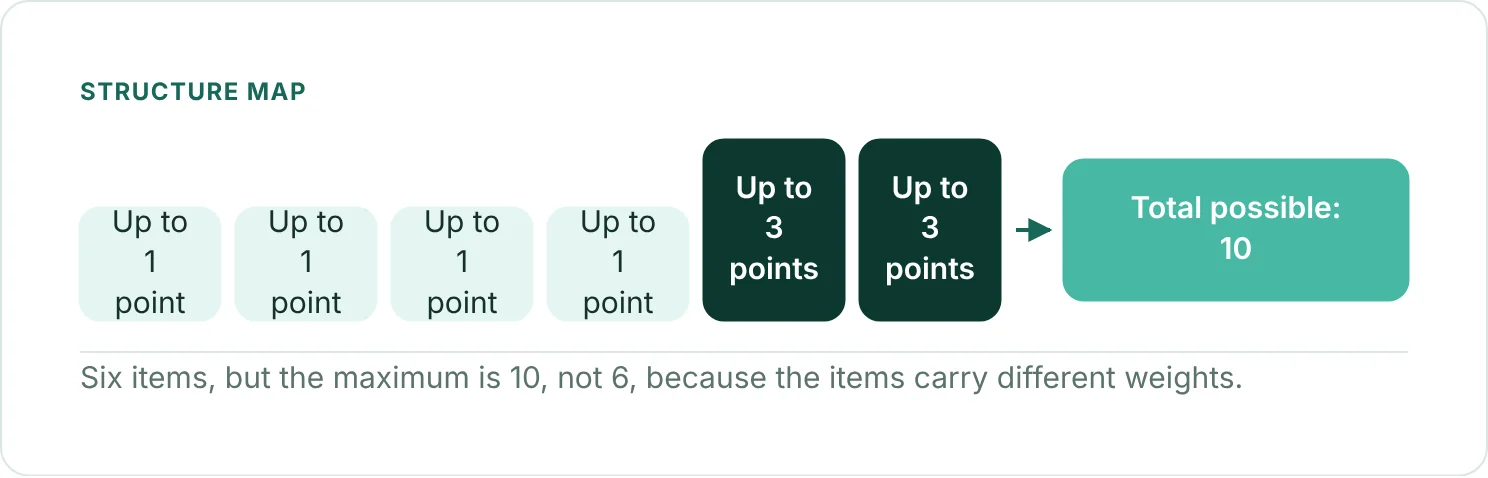
- Items: six, with unequal weights. Time to first cigarette and number of cigarettes per day contribute up to 3 points each, and the other four items up to 1 point each.
- Total: the maximum is 10, not 6, because of those weights. A sum of raw response codes is therefore not the FTND score.
- Subscales: none in the standard form. The score is a single total.
- Direction: higher scores mean stronger cigarette-related dependence indicators.
- Versions: the FTND is not the original eight-item Fagerström Tolerance Questionnaire, and the two have different lengths and score ranges.
- Translations: use a validated version for the intended population and name the language and its source. Any translation must preserve the point values and the reference to cigarette smoking.
The instrument itself is available from Heatherton et al. (1991) and the NIDA Clinical Trials Network instrument library.
How to Score the FTND
- Confirm that the dataset holds the standard FTND point value for each item, not the raw response-category codes.
- Check that the two weighted items range from 0 to 3 and that the other four range from 0 to 1.
- Sum the six point values to obtain ftnd_total, which ranges from 0 to 10.
- Apply a missing-item rule set by the protocol. The code below requires all six items. No developer-endorsed prorating rule was verified, so any other rule must be prespecified, justified and reported.
* Illustrative syntax: ftnd1 to ftnd6 already hold the standard point values.
COMPUTE ftnd_total = SUM.6(ftnd1 TO ftnd6).
EXECUTE.# data: one row per respondent; items ftnd1 to ftnd6 hold point values, not category codes.
items <- paste0("ftnd", 1:6)
data$ftnd_total <- rowSums(data[items], na.rm = FALSE)
stopifnot(all(is.na(data$ftnd_total) | data$ftnd_total %in% 0:10))Interpreting FTND Scores
| Score band | Interpretation |
|---|---|
| 0 to 10 | Continuous index; higher = stronger cigarette-related dependence indicators |
| Severity labels | Use only if a publication for your population and version supports the bands |
| Universal diagnostic threshold | None verified |
Source: Heatherton et al. (1991); no universal severity or diagnostic cutoff was verified.
Higher totals indicate stronger dependence indicators on the questionnaire metric. The total is often most informative as a continuous score, subject to its distribution, and any severity labels should be cited with their source and target population. A score does not determine whether an individual will succeed in quitting.
The FTND was developed for cigarettes. Its 0 to 10 score does not transfer directly to vaping or other products without validation, and it does not replace verification of use or abstinence.
Psychometric Properties
| Property | Published finding | Source |
|---|---|---|
| Revision rationale | Two items of the earlier questionnaire showed no relationship to biochemical measures in 254 smokers and were removed | Heatherton et al. (1991) |
| Item weighting | Rescoring time to first cigarette and cigarettes per day improved the scale | Heatherton et al. (1991) |
| Reliability | Varies across populations; no single coefficient is asserted | Study-specific |
| Versions | The FTND and its predecessor differ in length and scoring range | Heatherton et al. (1991) |
These are source-specific findings and cannot be assumed to hold as reliability or validity estimates in a new sample or for non-cigarette products.
Using the FTND in a Study
Use a baseline FTND score as a covariate or effect modifier only when that role is prespecified. In cessation trials, define the endpoint separately, for example biochemically confirmed abstinence at a stated time, and model it with a method suited to a binary outcome. Report smoking status, product type and assessment timing, because a repeated FTND is interpretable only for participants whose cigarette-use items remain meaningful.
Inspect the distribution for floor effects, especially when many participants have stopped smoking. Do not code non-smokers as zero without stating a defensible rule. The commonest scoring error is a naive sum of raw response categories, so check whether the data hold raw responses or point values before computing any total.
Related guides: Logistic Regression · Relative Risk & Odds Ratios · Reliability Analysis (Cronbach’s Alpha) · Public Health
Reporting the FTND
Nicotine dependence was assessed with the six-item Fagerström Test for Nicotine Dependence (FTND; Heatherton et al., 1991). Responses were scored with their standard point values and summed to a total (range = 0 to 10), with higher scores indicating stronger cigarette-related dependence. The analysis used [total score or defined categories], and participants who did not currently smoke cigarettes were handled by [rule]. Missing responses were handled by [method].
References
Heatherton, T. F., Kozlowski, L. T., Frecker, R. C., & Fagerström, K.-O. (1991). The Fagerström Test for Nicotine Dependence: A revision of the Fagerström Tolerance Questionnaire. British Journal of Addiction, 86(9), 1119-1127. https://doi.org/10.1111/j.1360-0443.1991.tb01879.x
National Institute on Drug Abuse, Clinical Trials Network. (n.d.). Fagerström Test for Nicotine Dependence (FTND) [Instrument record]. NIDA CTN Clinical Trials Network Library.
Frequently Asked Questions
Why does the FTND range from 0 to 10 with only six items?
Two items contribute up to 3 points each and the other four up to 1 point each, so the maximum is 10.
Can the FTND measure vaping dependence?
Not automatically. The items were built around cigarettes, so any use with e-cigarettes needs separate validation.
Is the FTND a nicotine biomarker?
No. It records smoking behaviors and dependence indicators and does not measure nicotine intake directly.
Can I analyze the FTND as a continuous score?
Often yes, depending on the research question and the distribution. Any categories need a cited source and a stated population.
NEXT STEP
Need an FTND Score Set Up
or Checked?
OnlineSPSS is a statistical consultancy for researchers. Share your design and dataset, and a statistically trained Research Coordinator reviews it. The scope and one fixed project fee are confirmed before work begins.
No Commitment Required
Strictly Confidential
Fixed Project Fee
In-House PhD-Level Statisticians
Same-Day Response
Serving Researchers Since 2014