
Home / Resources / Psychological Measures / EDE-Q
EDE-Q:
Scoring and Interpretation
The Eating Disorder Examination Questionnaire (EDE-Q) is a self-report measure of eating-disorder-related attitudes and behaviors over the past 28 days. EDE-Q scoring means averaging four 0 to 6 subscale scores into a global mean while handling behavior-frequency items separately, so this guide covers that structure, the factor-structure debate, SPSS and R code, and reporting wording.
What the EDE-Q Measures
Fairburn and Beglin (1994) derived the EDE-Q from the Eating Disorder Examination clinical interview as a self-report form. Researchers use it to describe concerns about eating, weight and shape, dietary restraint, and how often particular behaviors occurred during the reference period.
The global attitudinal score is not a count of behaviors and it is not a diagnosis, and the questionnaire’s behavior-frequency items are kept apart from it. The four conventional subscales have also been questioned. A systematic review of 60 factor-analytic studies concluded that the originally proposed four-factor structure had little empirical support, with shape and weight concern items often merging into one factor (Jenkins & Rienecke, 2022).
Structure of the EDE-Q
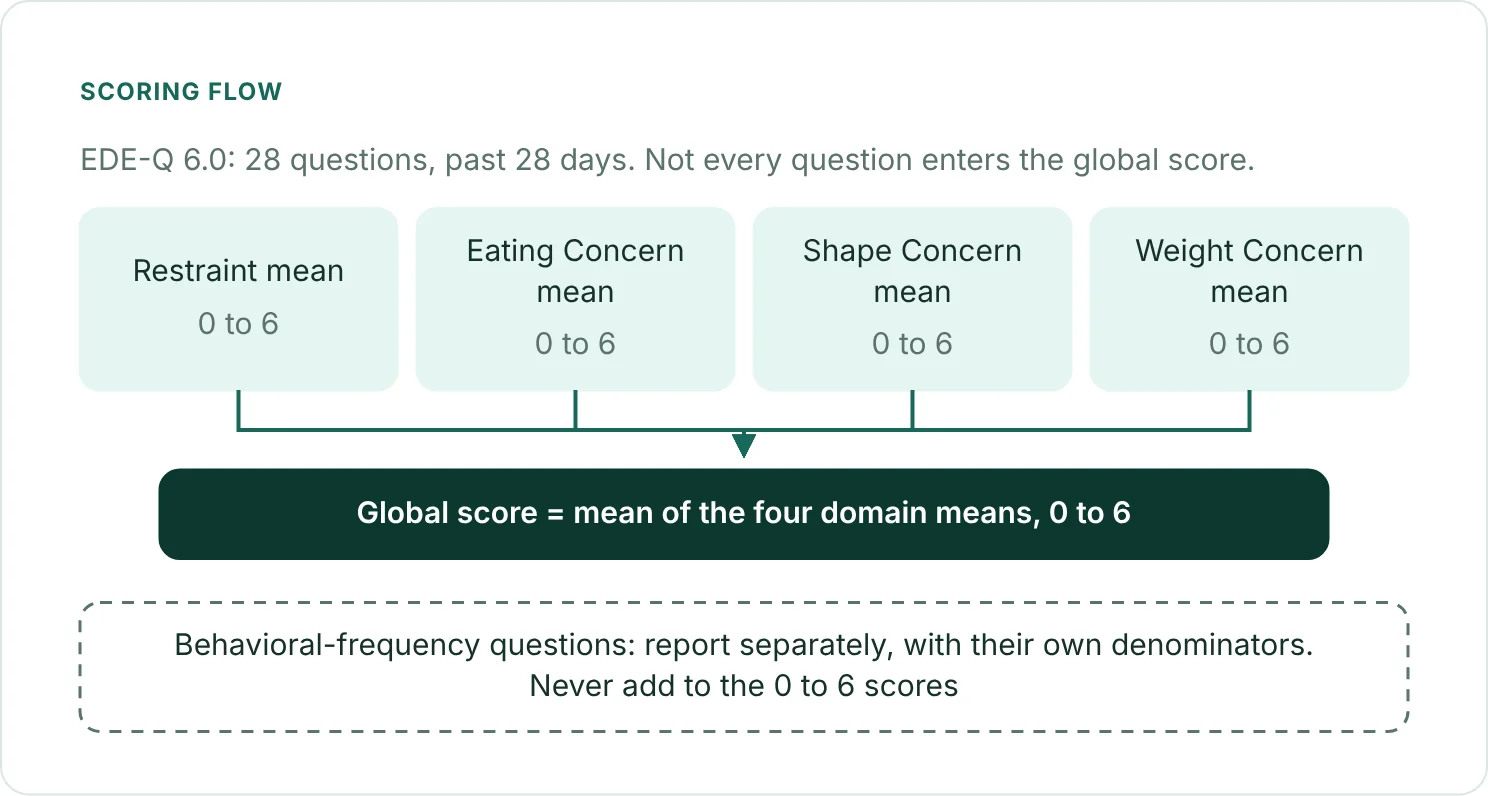
- Items: version 6.0 has 28 questions with a 28-day reference period. Not every question enters the global score.
- Subscales: restraint, eating concern, shape concern and weight concern, each scored 0 to 6 as a mean of its items. Item counts differ by subscale, so assemble them only with the key for your edition.
- Global score: the mean of the four subscale means, also on a 0 to 6 scale.
- Behavior items: frequency questions such as how often a behavior occurred need their own summaries. Never add them to the 0 to 6 attitudinal scores.
- Versions: earlier editions and shorter forms exist and are not interchangeable with version 6.0. A study that uses an alternative structure or a brief form should cite the validation it relies on.
- Translations: use a validated version for the intended population and name the language and its source. If no validated translation exists, say so and describe how the version was adapted.
The instrument itself is available from Fairburn (2008) and the questionnaire author’s materials.
How to Score the EDE-Q
- Identify the exact EDE-Q form, edition and item numbering, and do not apply a key written for a different edition.
- Compute the four subscale means from their items using the key for your edition and a documented missing-data rule.
- Take the mean of the four subscale means to obtain the global score, which ranges from 0 to 6, when all four are valid.
- Analyze and report the behavior-frequency items separately, each with its own denominator.
- The code below starts from four correctly computed subscale means. It does not rebuild them from item keys.
* Illustrative syntax: the four subscale means already hold values from 0 to 6.
COMPUTE edeq_global = MEAN.4(ede_restraint, ede_eating, ede_shape, ede_weight).
EXECUTE.
* Behavior-frequency items are analyzed separately.# data: one row per respondent; the four subscale means are already computed (0 to 6).
d <- c("ede_restraint", "ede_eating", "ede_shape", "ede_weight")
stopifnot(all(vapply(data[d], function(x) all(is.na(x) | (x >= 0 & x <= 6)), logical(1))))
data$edeq_global <- rowMeans(data[d], na.rm = FALSE)Interpreting EDE-Q Scores
| Score band | Interpretation |
|---|---|
| 0 to 6 global mean | Higher = more reported eating-disorder-related attitudes on the conventional metric |
| Four 0 to 6 subscale means | Historical dimensions; the four-factor structure is not universally supported |
| Behavior-frequency items | Report separately; never add to the global mean |
| Universal diagnostic cutoff | None verified |
Source: Fairburn & Beglin (1994); Fairburn (2008); Jenkins & Rienecke (2022).
A difference in the global score can reflect a change in attitudinal severity, but how much change matters depends on the population, the intervention and supporting research. The four subscales are convenient descriptors, and they should not be presented as independent latent factors in every group. Name the version, the scoring key and the factor interpretation in the report.
The global score leaves out the behavior-frequency items. Missing data, altered item sets and different subscale models can make scores non-comparable, and a score does not establish a clinical diagnosis.
Psychometric Properties
| Property | Published finding | Source |
|---|---|---|
| Origin | A self-report questionnaire derived from the Eating Disorder Examination interview | Fairburn & Beglin (1994) |
| Conventional scoring | Four subscale means, with their mean as the global score | Fairburn (2008) |
| Factor structure | Across 60 studies, the four-factor model had little empirical support and a seven-item version looked promising | Jenkins & Rienecke (2022) |
| Behavior reports | Self-reported frequencies may differ from interview-based estimates | Fairburn & Beglin (1994) |
| Reliability | Report internal consistency for the score you actually use | Study-specific |
These are source-specific findings and cannot be assumed to hold as reliability or validity estimates in a new sample or edition.
Using the EDE-Q in a Study
Treat the global score as a continuous outcome only if that is the prespecified construct. When hypotheses concern particular subscales, justify them separately and account for multiplicity. Intervention studies usually call for a baseline-adjusted model or a mixed-effects model for repeated assessments. If you retain the four-factor model, explain why it is defensible in your population given the systematic-review evidence.
Keep behavior-frequency variables distinct from attitudinal means. Frequencies with many zeros or a long right tail are better handled by a count model or a two-part approach than by a standard linear model. Let the research question choose the analysis, not the menu of the software.
Reporting the EDE-Q
Eating-related psychopathology was assessed with the Eating Disorder Examination Questionnaire (EDE-Q, version 6.0; Fairburn & Beglin, 1994; Fairburn, 2008). Four subscale means were computed with the edition-specific key, and their mean gave the global score (range = 0 to 6), with higher scores indicating greater reported eating-disorder-related attitudes. Behavior-frequency items were analyzed separately. The outcome was [score], and missing responses were handled by [method].
References
Fairburn, C. G. (2008). Cognitive behavior therapy and eating disorders. Guilford Press.
Fairburn, C. G., & Beglin, S. J. (1994). Assessment of eating disorders: Interview or self-report questionnaire? International Journal of Eating Disorders, 16(4), 363-370.
Jenkins, P. E., & Rienecke, R. D. (2022). Structural validity of the Eating Disorder Examination-Questionnaire: A systematic review. International Journal of Eating Disorders, 55(8), 1012-1030. https://doi.org/10.1002/eat.23721
Frequently Asked Questions
How do I calculate the EDE-Q global score?
Compute the four subscale means with the key for your edition, then take their mean, and document the missing-data rule.
Should I sum all 28 answers?
No. The behavior-frequency items are not part of the conventional global score and need separate summaries.
Are the four subscales confirmed in every sample?
No. A systematic review found little empirical support for the original four-factor structure, so justify the structure you use.
Is an EDE-Q score a diagnosis?
No. It is a questionnaire measure and does not replace a clinical evaluation.
NEXT STEP
Need EDE-Q Data Scored
or Checked?
OnlineSPSS is a statistical consultancy for researchers. Share your design and dataset, and a statistically trained Research Coordinator reviews it. The scope and one fixed project fee are confirmed before work begins.
No Commitment Required
Strictly Confidential
Fixed Project Fee
In-House PhD-Level Statisticians
Same-Day Response
Serving Researchers Since 2014