
Home / Resources / Psychological Measures / EAT-26
EAT-26:
Scoring and Interpretation
The Eating Attitudes Test (EAT-26) is a 26-item self-report screen for eating-related concerns. EAT-26 scoring turns on a response key and one reversed item, because the six response options convert to 0 to 3 points and item 26 runs in the opposite direction, so this guide sets out the key, the 0 to 78 total, the screening criterion of 20, SPSS and R code, and reporting wording.
What the EAT-26 Measures
Garner and colleagues (1982) derived the 26-item form from the earlier 40-item version and studied its psychometric features and clinical correlates. Its function is to flag attitudes and behaviors that may warrant a fuller assessment, not to diagnose an eating disorder.
Its brevity suits population and university research, but the scoring needs attention. Raw responses are not scored 1 through 6, and the final item runs in the opposite direction, so a sum of ordinary Likert codes gives a wrong total for every participant. Any additional behavioral questions on the form are separate from the total.
Structure of the EAT-26
- Items: 26, each answered on a six-option frequency scale that is converted to 0, 1, 2 or 3 points.
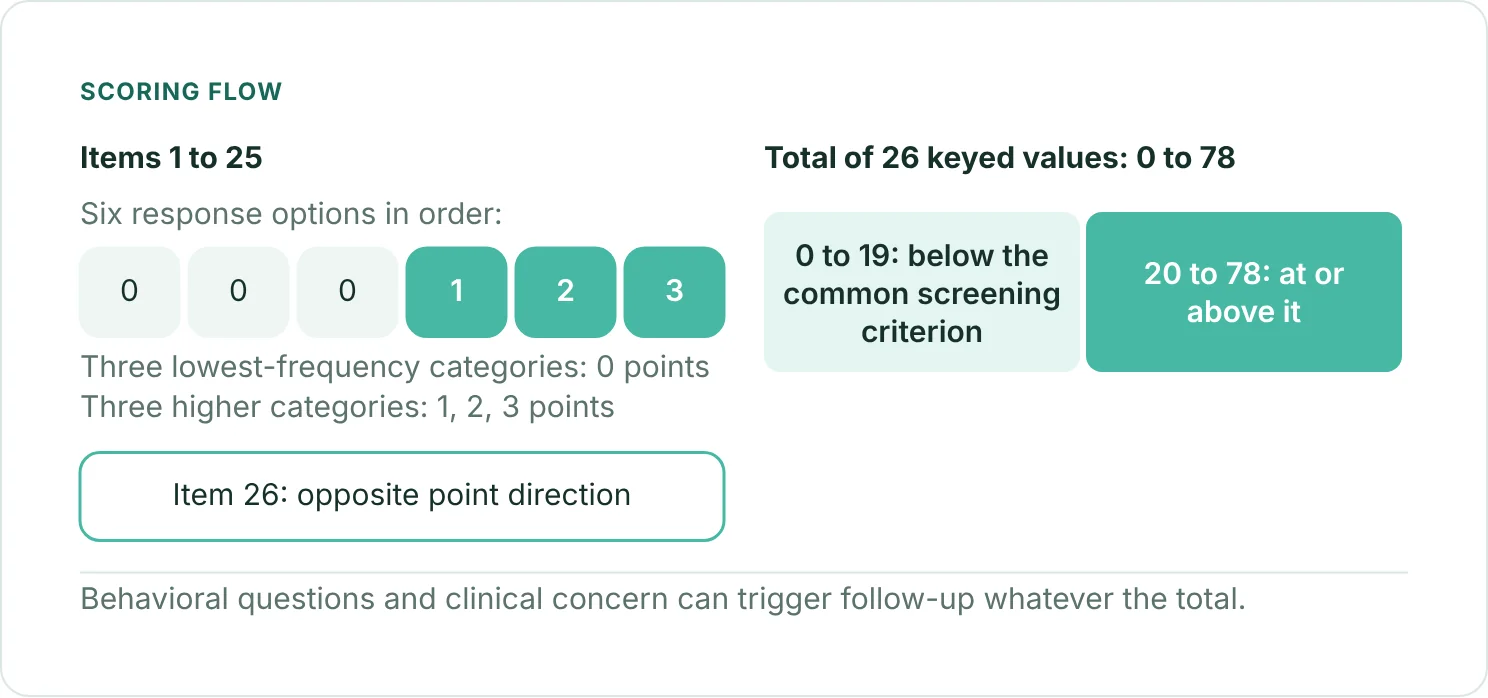
- Keying: for items 1 to 25, Always scores 3, Usually 2, Often 1, and the other three options 0. Item 26 is scored in the opposite direction, with Never scoring 3.
- Subscales: three content groupings (diet, bulimia and food preoccupation, oral control) are often cited, but the total is the standard screening result and the groupings should not be assumed to be validated factors in every population.
- Total: the sum of the 26 keyed values, from 0 to 78. Behavioral questions are not added to it.
- Versions: the 40-item original and the 26-item form differ in length and scoring and are not interchangeable.
- Translations: use a validated version for the intended population and name the language and its source. Record the screening criterion applied.
The instrument itself is available from the official EAT-26 website and Garner et al. (1982).
How to Score the EAT-26
- Confirm the form and the six response labels and their order.
- Convert items 1 to 25 to points: Always 3, Usually 2, Often 1, and the three lowest-frequency options 0.
- Score item 26 in the opposite direction, following the official scoring page.
- Sum the 26 keyed values to obtain eat26_total, which ranges from 0 to 78, and flag a total of 20 or more if a screening indicator is needed. The code below requires all 26 items. No developer-endorsed prorating rule was verified, so any other missing-item rule must be prespecified and reported.
* Illustrative syntax: eat1 to eat26 already hold keyed points 0 to 3, item 26 reversed.
COMPUTE eat26_total = SUM.26(eat1 TO eat26).
COMPUTE eat26_screen20 = (eat26_total >= 20).
IF MISSING(eat26_total) eat26_screen20 = $SYSMIS.
EXECUTE.# data: one row per respondent; items eat1 to eat26 already keyed 0 to 3, item 26 reversed.
items <- paste0("eat", 1:26)
stopifnot(all(vapply(data[items], function(x) all(is.na(x) | x %in% 0:3), logical(1))))
data$eat26_total <- rowSums(data[items], na.rm = FALSE)
data$eat26_screen20 <- ifelse(is.na(data$eat26_total), NA, data$eat26_total >= 20)Interpreting EAT-26 Scores
| Score band | Interpretation |
|---|---|
| 0 to 19 | Below the common screening criterion; does not rule out clinical concern |
| 20 to 78 | At or above the common screening criterion; further assessment may be warranted |
| Diagnosis | Not available from the questionnaire total |
Source: Garner et al. (1982); the official scoring page.
Higher totals reflect more disordered-eating attitudes on the questionnaire metric. A total of 20 or more is the commonly used screening criterion, and it can have different predictive properties in adolescents, men, clinical samples and other cultures. The behavioral questions and clinical concern should prompt follow-up whatever the total.
The EAT-26 is not a stand-alone diagnostic instrument. A positive screen is not evidence of anorexia nervosa or bulimia nervosa, and a score under 20 does not exclude them.
Psychometric Properties
| Property | Published finding | Source |
|---|---|---|
| Development | The 26-item form was derived from the 40-item version and studied with clinical and comparison samples | Garner et al. (1982) |
| Screening criterion | 20 is a screening convention and not a diagnostic confirmation | Garner et al. (1982); official scoring page |
| Subscales | Historical content groupings need caution when applied to other groups | Garner et al. (1982) |
| Response coding | Item 26 is scored in the opposite direction | Official scoring page |
| Contemporary validity | Check evidence for your sex, age, cultural and recruitment context | Population-specific |
These are source-specific findings and cannot be assumed to hold as accuracy or reliability estimates in a new sample.
Using the EAT-26 in a Study
In an observational survey, analyze the total as a numeric index where that is justified, and report the screen-positive proportion with a confidence interval. If the aim is predictive accuracy, compare the score with an appropriate clinical reference interview and report sensitivity and specificity with their uncertainty. Choose any cutoff in advance, and consider a receiver operating characteristic analysis rather than assuming that 20 is optimal in your sample.
In a trial, state whether the endpoint is change in score, screen-positive status or clinician-assigned diagnosis, since these are different outcomes. A pre-post study without a control group cannot show that a change was caused by the intervention. Before any total is computed, check the raw coding and item 26, because a keying error here affects every participant.
Reporting the EAT-26
Eating-related concerns were assessed with the 26-item Eating Attitudes Test (EAT-26; Garner et al., 1982). Responses were converted to their prescribed 0 to 3 values, with the final item scored in the opposite direction, and summed to a total (range = 0 to 78), with higher scores indicating greater eating-related concerns. A total of [prespecified criterion] or more indicated a positive screen and not a diagnosis. Missing responses were handled by [method].
References
EAT-26. (n.d.). Scoring [Web page]. EAT-26 official website.
Garner, D. M., Olmsted, M. P., Bohr, Y., & Garfinkel, P. E. (1982). The Eating Attitudes Test: Psychometric features and clinical correlates. Psychological Medicine, 12(4), 871-878. https://doi.org/10.1017/S0033291700049163
Frequently Asked Questions
What is the EAT-26 total score range?
0 to 78 after the official scoring key is applied to all 26 responses.
What is the commonly used EAT-26 screening criterion?
A total of 20 or more, noting that a lower total does not rule out clinical concern.
Is the last item scored differently?
Yes. Item 26 runs in the opposite direction, with Never scoring 3, so follow the official key.
Can the EAT-26 diagnose an eating disorder?
No. A diagnosis requires a clinical evaluation and other information.
NEXT STEP
Need EAT-26 Data Scored
or Checked?
OnlineSPSS is a statistical consultancy for researchers. Share your design and dataset, and a statistically trained Research Coordinator reviews it. The scope and one fixed project fee are confirmed before work begins.
No Commitment Required
Strictly Confidential
Fixed Project Fee
In-House PhD-Level Statisticians
Same-Day Response
Serving Researchers Since 2014