
Home / Resources / Psychological Measures / DERS
DERS:
Scoring and Interpretation
The Difficulties in Emotion Regulation Scale (DERS) is a 36-item self-report measure of emotion regulation difficulties across six dimensions. DERS scoring depends on a reversal map for 11 items and an item key for each subscale, and the interpretation has its own wrinkle in the Awareness items, which behave less consistently than the rest. This guide gives the key, the code and a model paragraph for reporting.
What the DERS Measures
Gratz and Roemer (2004) developed the DERS to assess emotion regulation difficulties in a multidimensional way. The 36-item form separates nonacceptance of emotional responses, difficulty engaging in goal-directed behavior, impulse control difficulties, lack of emotional awareness, limited access to regulation strategies and lack of emotional clarity.
The six dimensions guard against the simple conclusion that someone regulates emotion well or poorly. A person may recognize emotions accurately and still struggle to keep working toward goals when upset. Such patterns matter in clinical psychology, trauma research and intervention evaluation.
Structure of the DERS
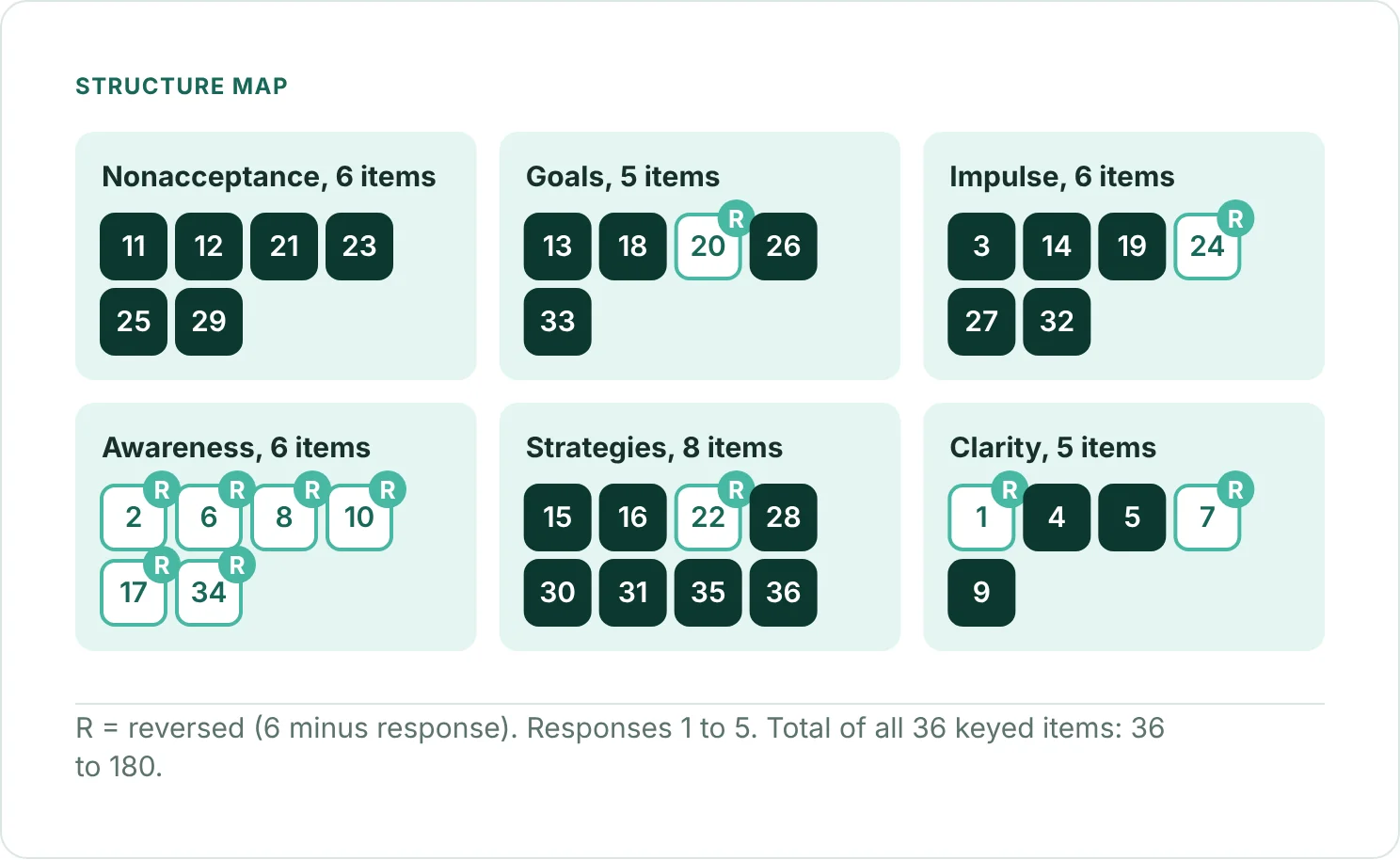
- Items: thirty-six statements rated from 1 (almost never) to 5 (almost always).
- Subscales: Nonacceptance (11, 12, 21, 23, 25, 29), Goals (13, 18, 20, 26, 33), Impulse (3, 14, 19, 24, 27, 32), Awareness (2, 6, 8, 10, 17, 34), Strategies (15, 16, 22, 28, 30, 31, 35, 36) and Clarity (1, 4, 5, 7, 9).
- Direction: eleven items are reverse-scored (1, 2, 6, 7, 8, 10, 17, 20, 22, 24, 34). After keying, higher scores mean greater difficulty.
- Total: the sum of all 36 keyed items, from 36 to 180. Subscale sums depend on the number of items in each.
- Versions: short forms such as the DERS-18 have their own item keys and score ranges and must not reuse the 36-item map. Translations should name the language and its source.
Gratz and Roemer (2004) describe the scale. Report the exact version you administered, with its item wording and instructions, in the methods.
How to Score the DERS
- Check that the items are in the original 36-item order and that every response is an integer from 1 to 5.
- Reverse items 1, 2, 6, 7, 8, 10, 17, 20, 22, 24 and 34 by subtracting each response from 6.
- Sum the keyed items within each subscale using the item map above, and sum all 36 keyed items for the total, which ranges from 36 to 180.
- Apply a missing-item rule set by the protocol. No developer-endorsed prorating rule was verified, so the code below requires every item of a score. Report how incomplete responses were handled.
* Illustrative syntax: ders1 to ders36 coded 1 to 5 in the original item order.
COMPUTE ders1r = 6 - ders1.
COMPUTE ders2r = 6 - ders2.
COMPUTE ders6r = 6 - ders6.
COMPUTE ders7r = 6 - ders7.
COMPUTE ders8r = 6 - ders8.
COMPUTE ders10r = 6 - ders10.
COMPUTE ders17r = 6 - ders17.
COMPUTE ders20r = 6 - ders20.
COMPUTE ders22r = 6 - ders22.
COMPUTE ders24r = 6 - ders24.
COMPUTE ders34r = 6 - ders34.
COMPUTE ders_nonaccept = SUM.6(ders11, ders12, ders21, ders23, ders25, ders29).
COMPUTE ders_goals = SUM.5(ders13, ders18, ders20r, ders26, ders33).
COMPUTE ders_impulse = SUM.6(ders3, ders14, ders19, ders24r, ders27, ders32).
COMPUTE ders_awareness = SUM.6(ders2r, ders6r, ders8r, ders10r, ders17r, ders34r).
COMPUTE ders_strategies = SUM.8(ders15, ders16, ders22r, ders28, ders30, ders31, ders35, ders36).
COMPUTE ders_clarity = SUM.5(ders1r, ders4, ders5, ders7r, ders9).
COMPUTE ders_total = SUM.6(ders_nonaccept, ders_goals, ders_impulse, ders_awareness, ders_strategies, ders_clarity).
EXECUTE.# data: one row per respondent; items ders1 to ders36 coded 1 to 5.
x <- data[paste0("ders", 1:36)]
stopifnot(all(vapply(x, function(z) all(is.na(z) | z %in% 1:5), logical(1))))
rev_items <- c(1, 2, 6, 7, 8, 10, 17, 20, 22, 24, 34)
x[rev_items] <- lapply(x[rev_items], function(z) 6 - z)
score <- function(k) ifelse(complete.cases(x[k]), rowSums(x[k]), NA_real_)
keys <- list(
nonaccept = c(11, 12, 21, 23, 25, 29),
goals = c(13, 18, 20, 26, 33),
impulse = c(3, 14, 19, 24, 27, 32),
awareness = c(2, 6, 8, 10, 17, 34),
strategies = c(15, 16, 22, 28, 30, 31, 35, 36),
clarity = c(1, 4, 5, 7, 9)
)
for (nm in names(keys)) data[[paste0("ders_", nm)]] <- score(keys[[nm]])
data$ders_total <- score(1:36)Interpreting DERS Scores
| Score band | Interpretation |
|---|---|
| 36 to 180 | Total after keying; higher = greater difficulty regulating emotion |
| Subscale ranges | Nonacceptance 6 to 30, Goals 5 to 25, Impulse 6 to 30, Awareness 6 to 30, Strategies 8 to 40, Clarity 5 to 25 |
| Diagnostic threshold | None; the DERS is a dimensional measure |
Source: Gratz and Roemer (2004); no universal diagnostic threshold was verified.
Higher scores indicate greater self-reported difficulty regulating emotion. The scale is designed for dimensional measurement, so avoid presenting a cut point as diagnostic unless a publication for your population and version supports it. Discuss subscales where theory makes them important, and state whether the Awareness items behaved consistently in your sample.
In adults with emotional disorders, internal consistency was strong for every original subscale except Awareness (Hallion et al., 2018). Inspect the local structure before relying on an Awareness subscale score or on a total that includes those items.
Psychometric Properties
| Property | Published finding | Source |
|---|---|---|
| Original development | A six-dimension structure and initial validation in a university sample | Gratz and Roemer (2004) |
| Awareness subscale | Weaker internal consistency than the other subscales in adults with emotional disorders | Hallion et al. (2018) |
| Short form | A brief 18-item version was validated in five samples and has its own key | Victor and Klonsky (2016) |
| Reliability in new samples | Estimate internal consistency for each intended score in your own data | Study-specific |
These are source-specific findings and cannot be assumed to hold as reliability or validity estimates in a new sample.
Using the DERS in a Study
Decide in advance whether the total or particular subscales address the primary hypothesis. If several subscales are analyzed, plan multiplicity control or label the analyses as exploratory. In intervention research, repeated DERS scores can be modeled with a mixed-effects model that accounts for within-person dependence.
When the scale is translated or used in a very different population, examine the measurement model and test invariance before comparing groups. Estimate reliability for each score you report, and consider whether the Awareness subscale should be reported at all in your sample. Plan sample size from the primary contrast and not from the 36 items.
Reporting the DERS
Difficulties in emotion regulation were assessed with the 36-item Difficulties in Emotion Regulation Scale (DERS; Gratz & Roemer, 2004). Eleven items were reverse coded according to the original key, and items were summed to a total (range = 36 to 180) and to six subscale scores, with higher scores indicating greater difficulty. The subscales analyzed were [names]. Responses with missing items were handled by [method]. Internal consistency in this sample was [alpha or omega for each score].
References
Gratz, K. L., & Roemer, L. (2004). Multidimensional assessment of emotion regulation and dysregulation: Development, factor structure, and initial validation of the Difficulties in Emotion Regulation Scale. Journal of Psychopathology and Behavioral Assessment, 26(1), 41-54. https://doi.org/10.1023/B:JOBA.0000007455.08539.94
Hallion, L. S., Steinman, S. A., Tolin, D. F., & Diefenbach, G. J. (2018). Psychometric properties of the Difficulties in Emotion Regulation Scale (DERS) and its short forms in adults with emotional disorders. Frontiers in Psychology, 9, Article 539. https://doi.org/10.3389/fpsyg.2018.00539
Victor, S. E., & Klonsky, E. D. (2016). Validation of a brief version of the Difficulties in Emotion Regulation Scale (DERS-18) in five samples. Journal of Psychopathology and Behavioral Assessment, 38(4), 582-589. https://doi.org/10.1007/s10862-016-9547-9
Frequently Asked Questions
How many DERS items are reverse scored?
Eleven in the original 36-item form (items 1, 2, 6, 7, 8, 10, 17, 20, 22, 24 and 34). Short forms have their own keys and the map does not transfer.
Is the DERS total from 36 to 180?
Yes, for the complete 36-item version after keying. The possible range is 36 to 180 only when every item is answered.
Can I report all six subscales?
Yes, using the original item map, but report reliability for each subscale in your sample and check the Awareness items in particular.
Is there a diagnostic DERS cutoff?
The DERS is a dimensional measure. Use a cut point only if a publication for your population and version supports it.
NEXT STEP
Need DERS Data Scored
or Checked?
OnlineSPSS is a statistical consultancy for researchers. Share your design and dataset, and a statistically trained Research Coordinator reviews it. The scope and one fixed project fee are confirmed before work begins.
No Commitment Required
Strictly Confidential
Fixed Project Fee
In-House PhD-Level Statisticians
Same-Day Response
Serving Researchers Since 2014