
Home / Resources / Psychological Measures / CTQ
CTQ-SF:
Scoring and Interpretation
The Childhood Trauma Questionnaire Short Form (CTQ-SF) is a 28-item self-report measure of retrospective exposure to childhood maltreatment. CTQ scoring depends on a keyed profile of five domains and a separate three-item validity indicator, so this guide sets out the structure, the 5 to 25 domain scores, SPSS and R code, what a score cannot establish, and a model reporting paragraph.
What the CTQ Measures
The CTQ-SF measures retrospective self-reported exposure to childhood maltreatment. Its five domains reflect types of abuse and neglect, not present-day psychiatric symptoms. In the validation study, Bernstein and colleagues (2003) derived a 28-item brief form, 25 clinical items and three response-style indicators, from an earlier 70-item questionnaire.
Researchers use it in psychiatric, epidemiologic, developmental and health-outcome studies to describe reported childhood adversity and relate it to later outcomes. Retrospective reports cannot establish the timing, severity or independent confirmation of events, so the construct measured should be kept distinct from externally verified maltreatment history.
Structure of the CTQ-SF
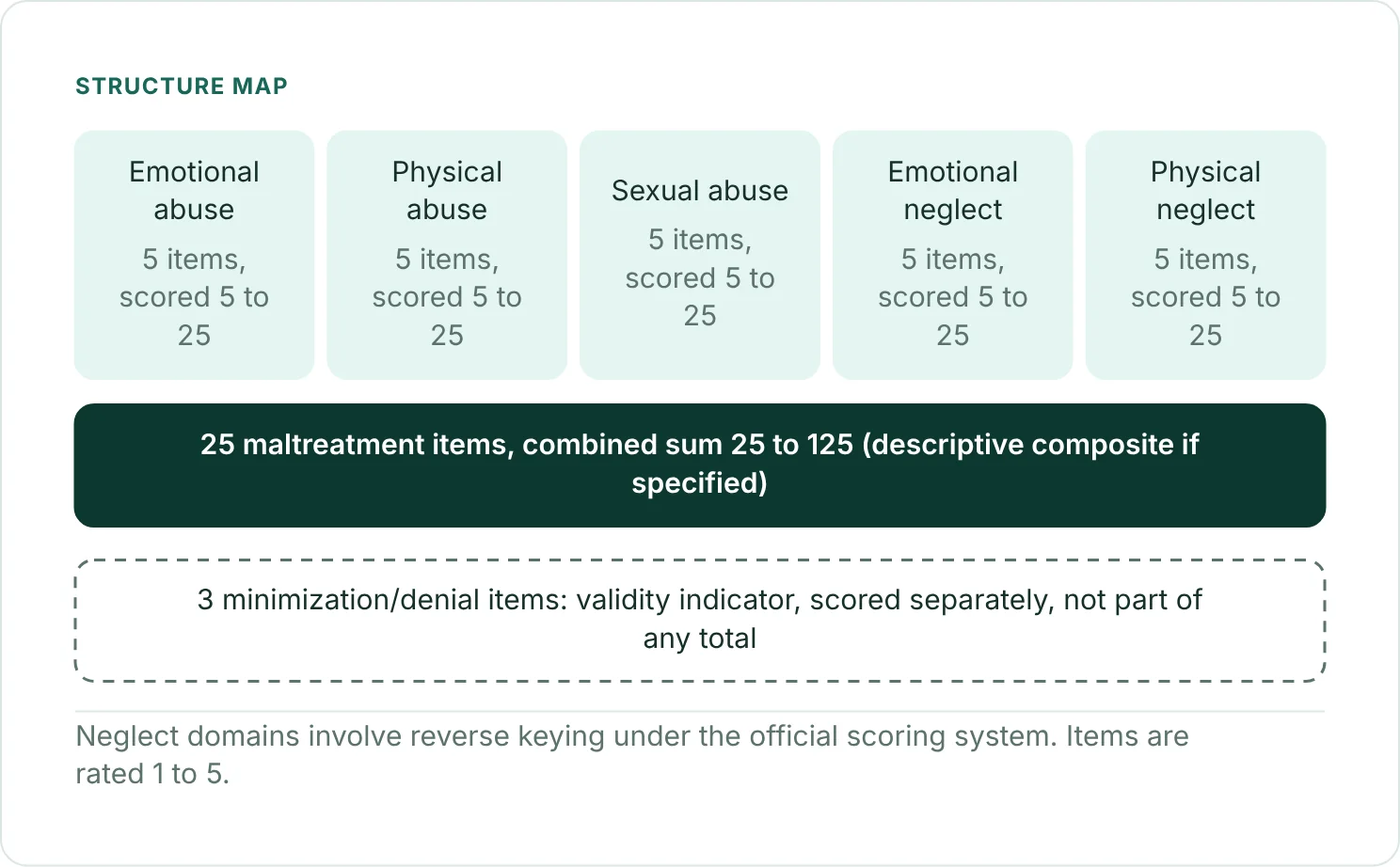
- Items: 28 in total. Twenty-five clinical items form five domains of five items each, rated from 1 to 5: emotional abuse, physical abuse, sexual abuse, emotional neglect and physical neglect.
- Validity items: three minimization and denial items are a separate indicator of possible response style. They are not a sixth trauma domain.
- Direction: some items are reverse-keyed under the official scoring key, so raw item responses must not simply be summed. Higher domain scores mean more self-reported exposure.
- Versions: the 28-item short form differs from the original 70-item CTQ and needs its own validation citation.
- Cutoffs: any domain-specific severity thresholds should be attributed to a documented manual or validation study and described as classification conventions.
- Translations: use a validated version for the intended population and name the language and its source. If no validated translation exists, say so and describe how the version was adapted.
The instrument itself is available from the publisher of the CTQ manual (Bernstein & Fink, 1998) and is described in Bernstein et al. (2003).
How to Score the CTQ-SF
- Verify that the dataset contains the 28-item short form and the expected 1 to 5 response coding.
- Apply the authorized scoring key, including reverse coding, before computing any domain.
- Sum each set of five keyed maltreatment items to obtain a domain score from 5 to 25.
- Evaluate the three validity items separately under their specified algorithm and keep them out of every severity total.
- Apply a missing-item rule set by the protocol. No developer-endorsed prorating rule was verified, so the code below requires complete domain scores. Because one unanswered item changes a five-item domain, report how missing responses were handled.
* Illustrative syntax: ctq_ea, ctq_pa, ctq_sa, ctq_en and ctq_pn are already-keyed domain scores (5 to 25), not raw items.
* Reverse coding and the validity-item check happen before this stage.
IF NMISS(ctq_ea, ctq_pa, ctq_sa, ctq_en, ctq_pn) = 0 ctq_clinical_sum = SUM(ctq_ea, ctq_pa, ctq_sa, ctq_en, ctq_pn).
EXECUTE.# data: one row per respondent; keyed domain scores, not raw items.
domains <- c("ctq_ea", "ctq_pa", "ctq_sa", "ctq_en", "ctq_pn")
stopifnot(all(vapply(data[domains], function(x) all(is.na(x) | (x >= 5 & x <= 25)), logical(1))))
data$ctq_clinical_sum <- rowSums(data[domains], na.rm = FALSE)
# Never include the three validity items in the clinical sum.Interpreting CTQ-SF Scores
| Score or category | Interpretation |
|---|---|
| 5 to 25 per domain | Higher means more self-reported exposure within that subtype |
| 25 to 125 combined sum | A descriptive composite if specified; it does not replace the five-domain profile |
| Three validity items | Interpret separately; not a psychological outcome scale |
| Severity categories | Use only source-specific domain cutoffs, with the source and sample stated |
Source: Bernstein & Fink (1998); Bernstein et al. (2003).
A five-domain profile is usually more informative than collapsing every maltreatment type into one score. Any grouping into none, low, moderate or severe should be tied to explicit manual definitions and presented as classification of reported experience, not as documentation of childhood events. The score range alone does not say which threshold suits a study.
Questions about childhood trauma can cause distress, so data collection needs a participant safety and confidentiality plan. The CTQ-SF does not independently verify abuse or neglect, and a high score is not a current diagnosis.
Psychometric Properties
| Property | Published finding | Source |
|---|---|---|
| Development | A 28-item version was derived from the 70-item parent form, with five clinical factors and three separate validity items | Bernstein et al. (2003) |
| Validation samples | The source study evaluated four distinct samples | Bernstein et al. (2003) |
| Age range | The original validation included adolescent as well as adult samples; generalization should be studied, not assumed | Bernstein et al. (2003) |
| Reliability | Estimate internal consistency separately for each of the five domains in your sample; a composite alpha is not equivalent | Study-specific |
| Response style | Minimization and denial items should not be used to exclude participants without a prespecified rule | Bernstein & Fink (1998) |
These are source-specific findings for a given population and version. They cannot be assumed to hold as reliability or accuracy estimates in a new sample.
Using the CTQ-SF in a Study
CTQ domains can enter explanatory models as continuous exposures once confounding and model assumptions are considered. Five correlated subscales can create multicollinearity, so use the subtypes that the research question calls for, or a justified composite, rather than picking the strongest association after seeing the data. For a binary outcome such as a clinical diagnosis, the usual route is logistic regression.
Because internal consistency should be estimated for each domain, report reliability separately and state how missing items were handled. Retrospective self-report captures recalled exposure, not an adjudicated timeline. If a translated form is being developed, evaluate measurement equivalence before comparing group means.
Reporting the CTQ-SF
Childhood maltreatment exposure was measured with the 28-item Childhood Trauma Questionnaire Short Form (CTQ-SF; Bernstein et al., 2003). After applying the instrument-specific item key, five domain scores were calculated (range = 5 to 25 each), with higher scores indicating more self-reported exposure. The three minimization and denial items were [handling according to the prespecified protocol]. Domains were analyzed [continuously or in prespecified categories], missing responses were handled by [method], and internal consistency in this sample was [estimates].
References
Bernstein, D. P., & Fink, L. (1998). Childhood Trauma Questionnaire: A retrospective self-report manual. Psychological Corporation.
Bernstein, D. P., Stein, J. A., Newcomb, M. D., Walker, E., Pogge, D., Ahluvalia, T., Stokes, J., Handelsman, L., Medrano, M., Desmond, D., & Zule, W. (2003). Development and validation of a brief screening version of the Childhood Trauma Questionnaire. Child Abuse & Neglect, 27(2), 169-190. https://doi.org/10.1016/S0145-2134(02)00541-0
Frequently Asked Questions
Can I calculate the CTQ-SF total by summing all 28 answers?
No. Only 25 items form the five maltreatment domains, and the three validity items are scored separately.
What is the range of a CTQ-SF domain score?
Each five-item domain ranges from 5 to 25 once the responses have been keyed and are complete.
Does a high CTQ score verify abuse?
No. It reflects retrospective, self-reported exposure and not independently verified records.
Should I model each domain separately?
That depends on the hypothesis and the correlations among domains. Justify the chosen predictors and avoid unplanned multiplicity.
NEXT STEP
Need CTQ Data Scored
or Checked?
OnlineSPSS is a statistical consultancy for researchers. Share your design and dataset, and a statistically trained Research Coordinator reviews it. The scope and one fixed project fee are confirmed before work begins.
No Commitment Required
Strictly Confidential
Fixed Project Fee
In-House PhD-Level Statisticians
Same-Day Response
Serving Researchers Since 2014