
Home / Resources / Psychological Measures / CORE-OM
CORE-OM:
Scoring and Interpretation
The Clinical Outcomes in Routine Evaluation Outcome Measure (CORE-OM) is a 34-item self-report measure of distress, functioning, well-being and risk over the past week. CORE-OM scoring reverses eight positively worded items, takes a mean of at least 31 valid items and multiplies it by 10, so the sections below explain the 0 to 4 and 0 to 40 metrics, the missing-item rule, the UK cutoff, and how to code and report the score in SPSS and R.
What the CORE-OM Measures
The CORE-OM evaluates overall psychological distress and functioning during the preceding week. Its four domains address subjective well-being, presenting symptoms, everyday functioning and risk. It was developed for routine psychotherapy outcome monitoring and not for diagnosing a single disorder (Evans et al., 2002).
It suits longitudinal service datasets in which outcomes are assessed before, during and after care. The developers do not treat the domains as cleanly independent factors, while the risk items occupy a distinct clinical area. One overall score can therefore serve treatment-outcome analysis, and the risk items need separate clinical handling.
Structure of the CORE-OM
- Items: thirty-four, each rated 0 to 4 for the past seven days.
- Domains: well-being (4 items), problems or symptoms (12), functioning (12) and risk (6). A 28-item non-risk score is also used.
- Direction: eight positively worded items are reverse scored so that higher always means more difficulty.
- Metric: the 0 to 4 item mean multiplied by 10 gives the commonly reported 0 to 40 clinical score. A 0 to 136 raw sum is not the preferred outcome metric.
- Related forms: the CORE-10 and CORE-LD are distinct instruments, and their scores should not be pooled with the CORE-OM.
The instrument itself is available from CORE System Trust with its official CORE-OM information and scoring guidance.
How to Score the CORE-OM
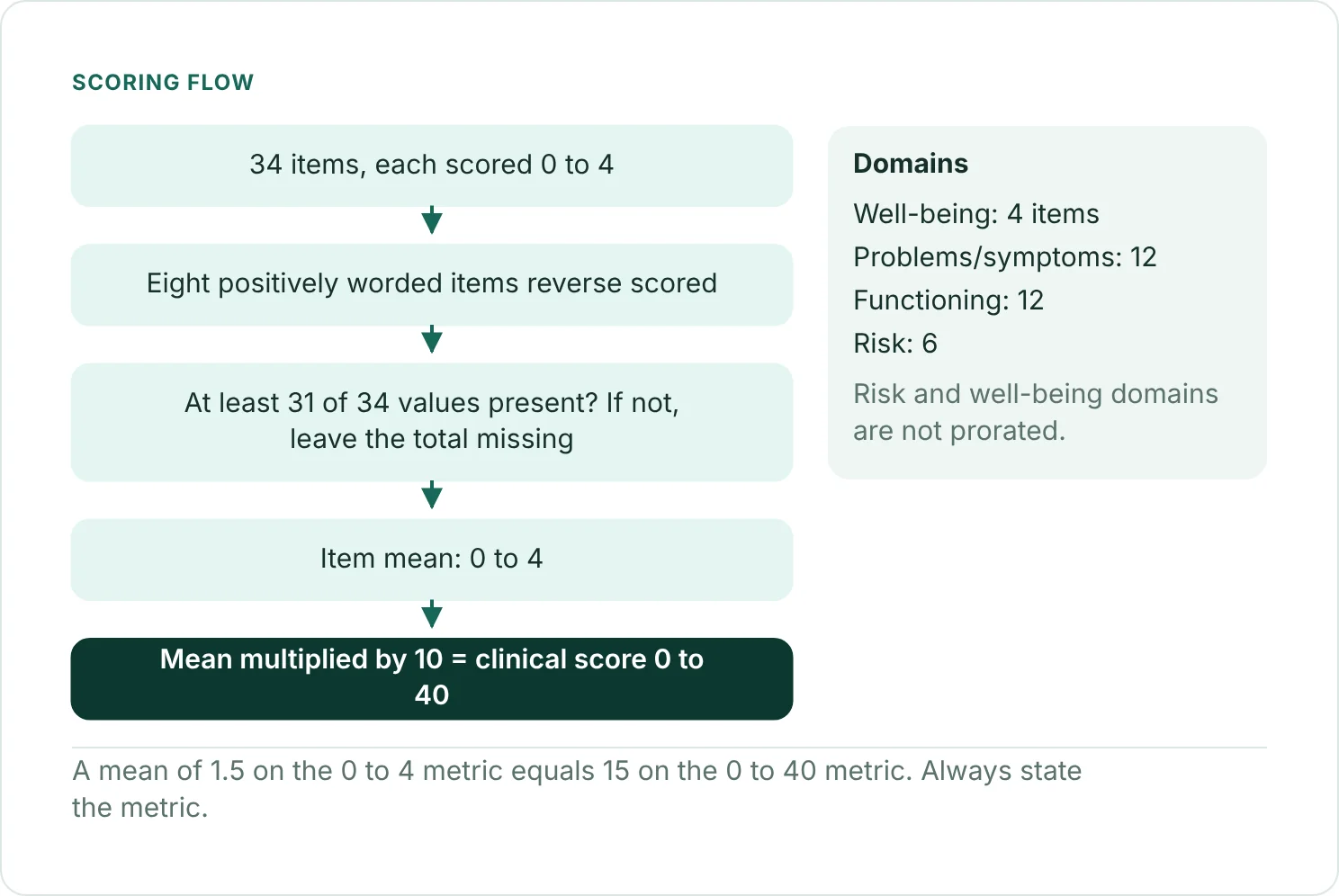
- Confirm that corek1 to corek34 are already keyed, including all eight reverse-worded items, with every score between 0 and 4.
- Count the valid items. For the overall score, the CORE team recommends computing the mean when at least 31 of 34 values are present.
- Multiply the keyed item mean by 10 to obtain core_clinical_0to40, and leave the score missing when fewer than 31 responses are present.
- Compute the non-risk and domain scores only with the validated membership keys. The CORE guidance advises against prorating the shorter well-being and risk domains.
* Illustrative syntax: corek1 to corek34 are already KEYED 0 to 4 scores, not raw items.
COMPUTE core_0to4 = MEAN.31(corek1 TO corek34).
COMPUTE core_clinical_0to40 = 10 * core_0to4.
EXECUTE.# data: keyed items corek1 to corek34 (reverse coding already done).
keyed <- data[paste0("corek", 1:34)]
valid <- rowSums(!is.na(keyed))
score <- rowMeans(keyed, na.rm = TRUE)
score[valid < 31] <- NA_real_
data$core_clinical_0to40 <- 10 * scoreInterpreting CORE-OM Scores
| Score band | Interpretation |
|---|---|
| 0 to 4 | Mean item distress score; larger means more distress |
| 0 to 40 | The same metric multiplied by 10, the clinical score |
| Clinical cutoff | Population specific; Connell et al. (2007) discuss 10 on the 0 to 40 scale in a UK sample |
Source: Evans et al. (2002); Connell et al. (2007); CORE System Trust guidance.
The CORE-OM is a continuous outcome and also a basis for judging clinically important change. Report the metric every time, since 1.5 on the 0 to 4 scale is the same result as 15 on the 0 to 40 scale. Connell et al. (2007) evaluated a cutoff of 10 on the 0 to 40 metric in a UK general population, and it should not be presented as a universal clinical rule for other countries.
Risk responses should never be dismissed because the overall mean is low. The risk items can flag safety-relevant content that warrants established clinical follow-up, whatever the study averages show.
Psychometric Properties
| Property | Published finding | Source |
|---|---|---|
| Original psychometrics | Evaluated in clinical and nonclinical samples, with evidence supporting outcome monitoring | Evans et al. (2002) |
| Structure | Domains not intended as perfectly independent latent factors | CORE System Trust |
| Cutoff evaluation | A UK general-population comparison derived a clinical cutoff near 10 on the 0 to 40 score | Connell et al. (2007) |
| Missing responses | No more than three missing items recommended for prorating the total | CORE System Trust |
These are source-specific findings and cannot be assumed to hold as reliability or accuracy estimates in a new sample.
Using the CORE-OM in a Study
In psychotherapy or service evaluation, analyze baseline-adjusted outcomes or repeated scores with methods that fit the design. When participants attend different numbers of sessions, a longitudinal model can allow for irregular measurement occasions. Prespecify the primary domain or total score instead of choosing a favorable outcome after seeing results.
Say whether risk is monitored as a separate outcome or a screening signal, and record missing-item counts and any prorating, especially at later visits where missingness may relate to treatment or symptom burden. When interpreting change, keep statistical significance, reliable change and clinical significance distinct, and cite the measurement properties used for each.
Reporting the CORE-OM
Psychological distress was assessed with the 34-item Clinical Outcomes in Routine Evaluation Outcome Measure (CORE-OM; Evans et al., 2002). Positively worded items were reverse keyed, and the mean of at least 31 completed items was multiplied by 10 to give a clinical score (range = 0 to 40), with higher values indicating greater distress. The primary analysis used [model], and risk responses were addressed under [safety protocol].
References
Connell, J., Barkham, M., Stiles, W. B., Twigg, E., Singleton, N., Evans, O., & Miles, J. N. V. (2007). Distribution of CORE-OM scores in a general population, clinical cut-off points and comparison with the CIS-R. The British Journal of Psychiatry, 190, 69-74. https://doi.org/10.1192/bjp.bp.105.017657
Evans, C., Connell, J., Barkham, M., Margison, F., McGrath, G., Mellor-Clark, J., & Audin, K. (2002). Towards a standardised brief outcome measure: Psychometric properties and utility of the CORE-OM. The British Journal of Psychiatry, 180(1), 51-60. https://doi.org/10.1192/bjp.180.1.51
Frequently Asked Questions
Is the CORE-OM total 0 to 136 or 0 to 40?
An item sum can reach 136, but the developers recommend the mean item score (0 to 4) or the clinical score (0 to 40).
How many missing items are allowed?
The developers recommend computing the overall mean when at least 31 of 34 items are present. Domain rules are stricter.
Is the CORE-OM a diagnosis?
No. It is a broad outcome measure of distress, functioning, well-being and risk.
Can I use the UK clinical cutoff in a US study?
Not automatically. State the reference population and show that it is relevant to your sample.
NEXT STEP
Need CORE-OM Data Scored
or Checked?
OnlineSPSS is a statistical consultancy for researchers. Share your design and dataset, and a statistically trained Research Coordinator reviews it. The scope and one fixed project fee are confirmed before work begins.
No Commitment Required
Strictly Confidential
Fixed Project Fee
In-House PhD-Level Statisticians
Same-Day Response
Serving Researchers Since 2014