
Home / Resources / Psychological Measures / CGI-S and CGI-I
CGI-S and CGI-I:
Scoring and Interpretation
The Clinical Global Impressions scales are single-item clinician judgments of overall illness severity (CGI-S) and of change from baseline (CGI-I). CGI-S CGI-I scoring involves no summing at all, so this guide covers what the two 7-point scales each mean, why their anchors must never be mixed, ordinal analysis choices, SPSS and R checks, and reporting wording.
What the CGI-S and CGI-I Measure
The Clinical Global Impressions scales are compact clinician-rated judgments of overall illness status and change. CGI-Severity (CGI-S) describes how unwell a patient is at the assessment visit, whereas CGI-Improvement (CGI-I) describes how the current condition compares with the study baseline. Their brevity makes them familiar in psychiatric clinical trials and outcome monitoring (Guy, 1976; Busner & Targum, 2007). Correct CGI-S CGI-I scoring is therefore a matter of keeping the two ratings separate and analyzing each as an ordered outcome.
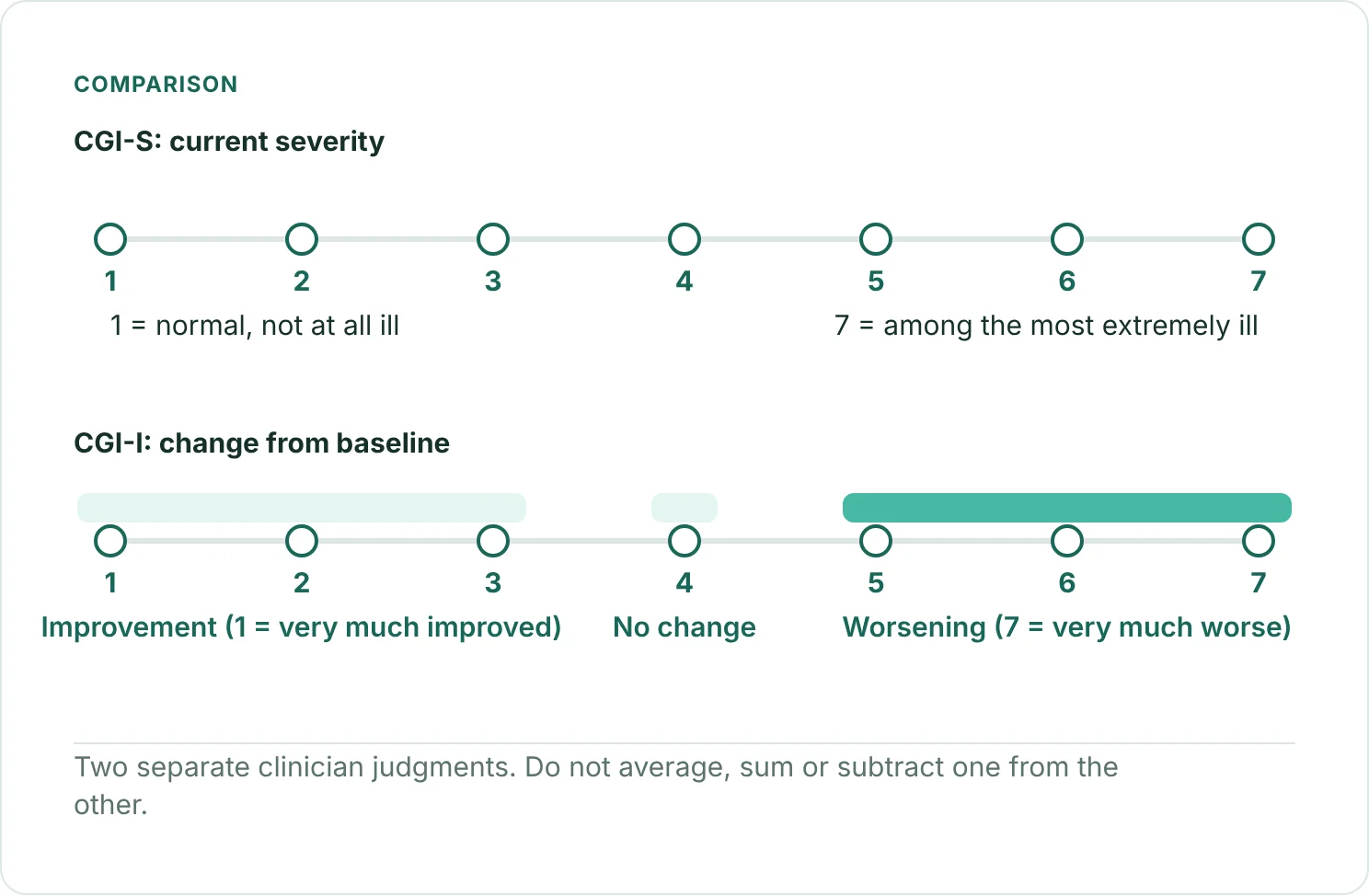
Despite their similar names, the two scales answer different research questions. A CGI-S of 4 does not describe no change; it describes a severity category. On CGI-I, 4 denotes no change, while lower numbers represent improvement and higher numbers worsening. Confusing these values can reverse the apparent direction of a treatment effect (Busner & Targum, 2007).
Structure of the CGI-S and CGI-I
- CGI-S: one clinician severity rating in seven ordered categories, from 1 (normal, not at all ill) to 7 (among the most extremely ill).
- CGI-I: one clinician improvement rating relative to baseline, from 1 (very much improved) through 4 (no change) to 7 (very much worse).
- Scoring logic: both are global judgments and not sums of symptom items, so there is no reverse-scoring key and no total.
- Baseline: a stable baseline definition and clear rater instructions are essential when interpreting CGI-I.
- Variants: disorder-specific CGI adaptations exist, and one should not automatically be scored as the generic Guy (1976) form.
The instrument itself is available from Guy (1976), the ECDEU Assessment Manual, and from published methodological descriptions.
How to Score the CGI-S and CGI-I
- Identify which field holds CGI-S and which holds CGI-I, and store the rater and visit for each rating.
- Verify that every value is an integer from 1 to 7, and document any not-assessed or missing code used in the case-report form.
- For CGI-I, use the prespecified baseline as the comparison point. Do not derive CGI-I by subtracting baseline CGI-S from follow-up CGI-S.
- Analyze each rating as an ordered outcome. If a study dichotomizes improvement, prespecify and justify the responder definition.
* Illustrative syntax: CGI-S and CGI-I are ordinal ratings, not summed scales.
FREQUENCIES VARIABLES=cgi_s cgi_i
 /ORDER=ANALYSIS.
* Audit out-of-range values and special missing codes first.# data: one row per rating occasion; cgi_s and cgi_i coded 1 to 7.
stopifnot(all(is.na(data$cgi_s) | data$cgi_s %in% 1:7))
stopifnot(all(is.na(data$cgi_i) | data$cgi_i %in% 1:7))
table(data$cgi_s, useNA = "ifany")
table(data$cgi_i, useNA = "ifany")Interpreting CGI-S and CGI-I Ratings
| Rating | Interpretation |
|---|---|
| CGI-S, 1 to 7 | From no current illness to very severe illness |
| CGI-I, 1 to 3 | Improvement categories relative to baseline |
| CGI-I, 4 | No change relative to baseline |
| CGI-I, 5 to 7 | Worsening categories relative to baseline |
Source: Guy (1976); Busner & Targum (2007).
CGI-I is an improvement judgment and not an observed difference in a specific symptom scale. A clinician can base the rating on several aspects of illness, so a CGI-I result does not equal a percentage change in another outcome. Trials should state whether response is defined by CGI-I category, symptom reduction or a composite, and should not change that definition after the results are seen.
CGI-S and CGI-I have distinct anchors and should not be averaged, summed or interchanged. Clinician raters may apply the categories differently, so calibration and rater effects matter.
Psychometric Properties
| Property | Published finding | Source |
|---|---|---|
| Historical definition | Standard ratings introduced through the ECDEU psychopharmacology assessment manual | Guy (1976) |
| Research utility | Widely used as complementary global outcomes in psychiatric research | Busner & Targum (2007) |
| Rater dependence | Ratings rely on clinical judgment and need consistent assessment standards | Busner & Targum (2007) |
| Interrater agreement | Ratings can differ by assessment perspective and rater; no single coefficient is asserted here | Study-specific |
| Measurement level | Ordered single items, so Cronbach’s alpha does not apply | Instrument structure |
These are source-specific findings and cannot be assumed to hold as reliability estimates in a new sample.
Using the CGI-S and CGI-I in a Study
CGI-S can serve as a baseline severity descriptor, an adjustment variable or a longitudinal outcome. CGI-I is most naturally an outcome after baseline. An ordinal regression, a proportional-odds model where its assumptions hold, or a prespecified responder analysis may be appropriate. Treat the ratings as continuous only with explicit justification.
Record rater identity, visit timing, blinding, population and treatment exposure. Where several raters score the same patient, rater agreement is a measurement-quality question, and an agreement statistic suited to ordinal ratings is more relevant than an internal-consistency coefficient. In blinded trials, take care that the rater’s expectation of treatment does not become an undocumented part of the change assessment.
Reporting the CGI-S and CGI-I
Overall illness status was rated with the Clinical Global Impressions-Severity (CGI-S) scale and change from baseline with the Clinical Global Impressions-Improvement (CGI-I) scale (Guy, 1976; Busner & Targum, 2007). Both use seven ordered categories, but their anchors are distinct. CGI-I was assessed relative to [baseline definition] by [blinded or trained raters], and outcomes were analyzed using [prespecified ordinal or responder method].
References
Busner, J., & Targum, S. D. (2007). The Clinical Global Impressions Scale: Applying a research tool in clinical practice. Psychiatry (Edgmont), 4(7), 28-37.
Guy, W. (Ed.). (1976). ECDEU assessment manual for psychopharmacology (rev. ed.; DHEW Publication No. ADM 76-338). U.S. Department of Health, Education, and Welfare.
Frequently Asked Questions
Is CGI-I calculated as follow-up CGI-S minus baseline CGI-S?
No. CGI-I is an independent clinician global rating of improvement or worsening.
Does a CGI-I of 4 mean moderately ill?
No. On CGI-I, 4 means no change. The two scales have different anchors.
Can I calculate Cronbach's alpha for CGI-S?
No. CGI-S is a single item, so a multi-item internal-consistency coefficient does not apply.
Should CGI ratings be analyzed with a t-test?
The ratings are ordinal. Choose an approach that fits the outcome distribution, the design and the prespecified estimand.
NEXT STEP
Need CGI Ratings Analyzed
or Checked?
OnlineSPSS is a statistical consultancy for researchers. Share your design and dataset, and a statistically trained Research Coordinator reviews it. The scope and one fixed project fee are confirmed before work begins.
No Commitment Required
Strictly Confidential
Fixed Project Fee
In-House PhD-Level Statisticians
Same-Day Response
Serving Researchers Since 2014