
Home / Resources / Psychological Measures / CBI
Copenhagen Burnout Inventory:
Scoring and Interpretation
The Copenhagen Burnout Inventory (CBI) is a 19-item self-report measure of exhaustion in three contexts: personal life, work and work with clients. Copenhagen Burnout Inventory scoring converts ordered responses to a 0 to 100 metric and reports a mean for each domain, so this guide covers that conversion, the single reversed work item, domain applicability, the missing-item decision, SPSS and R code, and APA wording.
What the Copenhagen Burnout Inventory Measures
Kristensen, Borritz, Villadsen and Christensen (2005) developed the CBI in the PUMA study to separate general exhaustion from exhaustion that people attribute to their work and to their contact with clients. Each domain asks about fatigue and exhaustion, differing in the source the respondent is asked to consider.
The distinction matters in studies of healthcare staff, teachers and social care workers. Work-related burnout can be higher than personal burnout, and that pattern is lost if the domains are collapsed. The scores describe reported exhaustion. They do not diagnose a clinical condition.
Structure of the CBI
- Items: 19 in the original three-domain form.
- Domains: Personal Burnout (6 items), Work-Related Burnout (7 items) and Client-Related Burnout (6 items).
- Response scale: five ordered categories, converted to 0, 25, 50, 75 or 100. The anchors are frequency or degree depending on item wording.
- Reversed item: one positively worded item in the work-related domain (work item 4 in the original domain order) is reversed.
- Reported score: the mean within each domain, not a sum of 19 raw codes.
- Applicability: the client-related domain is meaningful only for jobs with client contact, and a translated or sector-adapted version should be checked for the same structure.
The inventory and its development are described in Kristensen et al. (2005). Check the item order and anchors of the version you administered.
How to Score the CBI
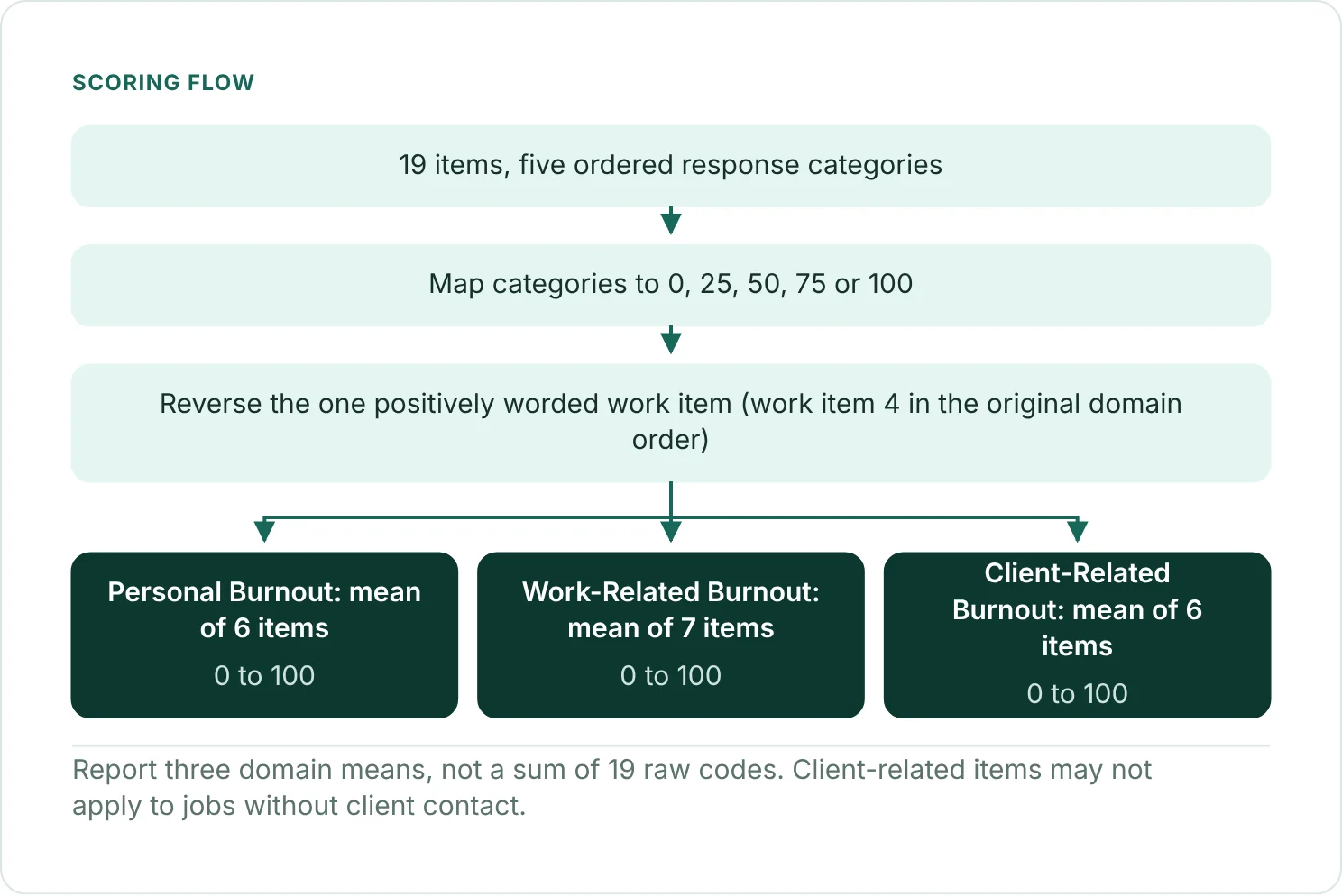
- Check the form and whether each item uses frequency or degree anchors, then convert the five categories to 100, 75, 50, 25 and 0, from the highest frequency or degree to the lowest, for every item.
- Reverse the one positively worded work item by subtracting its converted value from 100.
- Average the six personal, seven work-related and six client-related items separately to obtain three domain means from 0 to 100.
- The code below requires every item in a domain. This is a deliberately conservative rule, and no developer-endorsed missing-item policy was verified, so any alternative must be prespecified and reported.
- Report the three means with the number of complete cases per domain, and do not replace missing answers with zeros.
* Illustrative syntax: cbi_pb1 to cbi_pb6, cbi_wb1 to cbi_wb7, cbi_cb1 to cbi_cb6 already coded 0 to 100.
COMPUTE cbi_wb4_key = 100 - cbi_wb4.
COMPUTE cbi_personal = MEAN.6(cbi_pb1, cbi_pb2, cbi_pb3, cbi_pb4, cbi_pb5, cbi_pb6).
COMPUTE cbi_work = MEAN.7(cbi_wb1, cbi_wb2, cbi_wb3, cbi_wb4_key, cbi_wb5, cbi_wb6, cbi_wb7).
COMPUTE cbi_client = MEAN.6(cbi_cb1, cbi_cb2, cbi_cb3, cbi_cb4, cbi_cb5, cbi_cb6).
EXECUTE.# data: one row per respondent; items already coded 0, 25, 50, 75 or 100.
pb <- paste0("cbi_pb", 1:6); wb <- paste0("cbi_wb", 1:7); cb <- paste0("cbi_cb", 1:6)
scored <- data[c(pb, wb, cb)]
stopifnot(all(vapply(scored, function(x) all(is.na(x) | x %in% c(0, 25, 50, 75, 100)), logical(1))))
scored$cbi_wb4 <- 100 - scored$cbi_wb4
complete_mean <- function(x) ifelse(complete.cases(x), rowMeans(x), NA_real_)
data$cbi_personal <- complete_mean(scored[pb])
data$cbi_work <- complete_mean(scored[wb])
data$cbi_client <- complete_mean(scored[cb])Interpreting CBI Scores
| Score band | Interpretation |
|---|---|
| 0 to 100, each domain mean | Higher = greater reported exhaustion in that domain |
| Midpoint of 50 | Midpoint of the metric, not a diagnostic boundary |
| Universal burnout cutoff | None established |
Source: Kristensen et al. (2005); no universal cutoff was verified.
Each domain is read in its own right, and the 0 to 100 metric makes the means easy to describe. Studies sometimes apply ad hoc high-burnout cut points, but these do not transfer automatically between occupations or languages. If a classification is used, describe it as study-defined and cite where it came from.
CBI scores describe reported exhaustion and are not a clinical diagnosis. Interpret change and group differences within the study design, version and sample, and avoid causal wording for cross-sectional associations.
Psychometric Properties
| Property | Published finding | Source |
|---|---|---|
| Original validation | Reliability and construct validity were examined across the three domains in the PUMA study | Kristensen et al. (2005) |
| Domain structure | Personal, work-related and client-related exhaustion were designed to answer different questions | Kristensen et al. (2005) |
| Reliability | Varies by sample and language; estimate it for each domain in your own data | Study-specific |
| Cutoff | No single validated diagnostic threshold across workplaces was established | Not established universally |
These are source-specific findings and cannot be assumed to hold as reliability or validity estimates in a new sample, occupation or language.
Using the CBI in a Study
Analyze the three domains as separate continuous outcomes. Where workers are followed over time, a linear mixed model handles repeated measures, and where staff are clustered in hospitals or teams, a multilevel structure is needed. Before comparing professions, confirm that the client-related domain means the same thing across roles, and decide whether testing three domains calls for a prespecified multiplicity strategy.
Plan the sample size from the effect or precision of the primary domain, not from the item count. Domain means are bounded at 0 and 100 and often skewed, so inspect residuals and consider a model suited to the distribution. Compute reliability separately for each domain, and treat jobs without client contact as having no client-related score instead of imputing one.
Reporting the CBI
Burnout was assessed with the 19-item Copenhagen Burnout Inventory (Kristensen et al., 2005). Responses were converted to a 0 to 100 metric, the positively worded work item was reversed, and means were calculated separately for personal, work-related and client-related burnout (range = 0 to 100), with higher scores indicating greater exhaustion. Missing responses were handled by [method]. Internal consistency in the present sample was [coefficient and value] for each domain.
References
Kristensen, T. S., Borritz, M., Villadsen, E., & Christensen, K. B. (2005). The Copenhagen Burnout Inventory: A new tool for the assessment of burnout. Work & Stress, 19(3), 192-207. https://doi.org/10.1080/02678370500297720
Frequently Asked Questions
Is the CBI scored as one 19-item sum?
No. The original design reports three domain means on a 0 to 100 metric, and a raw sum of 19 codes is not the standard score.
How is the reversed work item coded?
After conversion to the 0 to 100 metric, subtract the value from 100 for work item 4 in the original domain order.
Does a score of 50 mean someone has burnout?
No. It is the midpoint of the metric and not a diagnostic boundary, and no universal cutoff has been established.
Can I score client-related burnout for employees without clients?
Only if the domain is meaningful for the job and was administered. Otherwise report it as not applicable.
NEXT STEP
Need CBI Data Scored
or Checked?
OnlineSPSS is a statistical consultancy for researchers. Share your design and dataset, and a statistically trained Research Coordinator reviews it. The scope and one fixed project fee are confirmed before work begins.
No Commitment Required
Strictly Confidential
Fixed Project Fee
In-House PhD-Level Statisticians
Same-Day Response
Serving Researchers Since 2014