
Home / Resources / Psychological Measures / CBCL/ASEBA
CBCL/ASEBA:
Scoring and Interpretation
The Child Behavior Checklist (CBCL) is a caregiver-report measure of children's emotional and behavioral problems and adaptive functioning, part of the Achenbach System of Empirically Based Assessment (ASEBA). CBCL scoring is not a sum you compute yourself, because standardized T-scores come from official ASEBA scoring, so the sections below explain what to import from official scoring, how to read broadband and syndrome profiles, and which score to analyze in SPSS or R.
What the CBCL Measures
The school-age form, the CBCL/6-18, turns a caregiver’s ratings into empirically derived syndrome scales, broader Internalizing and Externalizing scores and a Total Problems score, alongside competence and adaptive-functioning scales (Achenbach & Rescorla, 2001). Problem items ask about behavior now or within the past six months.
The CBCL is more than one symptom count. Raw ratings are organized into a profile and read through age- and sex-referenced T-scores, and a school-age form cannot be assumed comparable with the preschool form or with other informant forms. A study of parent ratings for 58,051 children aged 6 to 18 across 30 societies tested the eight-syndrome structure, which shows the instrument’s research reach and why cross-cultural measurement still needs attention (Ivanova et al., 2007).
Structure of the CBCL
- Items: the CBCL/6-18 holds competence items plus problem items numbered 1 to 113, some with lettered sub-items, each rated 0, 1 or 2 by a caregiver.
- Scales: eight syndrome scales, the broadband Internalizing, Externalizing and Total Problems scores, and DSM-oriented scales are reported in the standardized profile.
- Versions: the CBCL/1½-5, the CBCL/6-18, the Teacher’s Report Form and the Youth Self-Report differ in content and norms and are not interchangeable.
- Transformation: raw scores are converted to T-scores through designated ASEBA norms and scoring rules. No simple item key reproduces an official profile.
- Translations: ASEBA provides translations and multicultural norms. Name the form, language and norm group used.
The instrument itself is available from ASEBA’s official forms, manuals and scoring profiles.
How to Score the CBCL
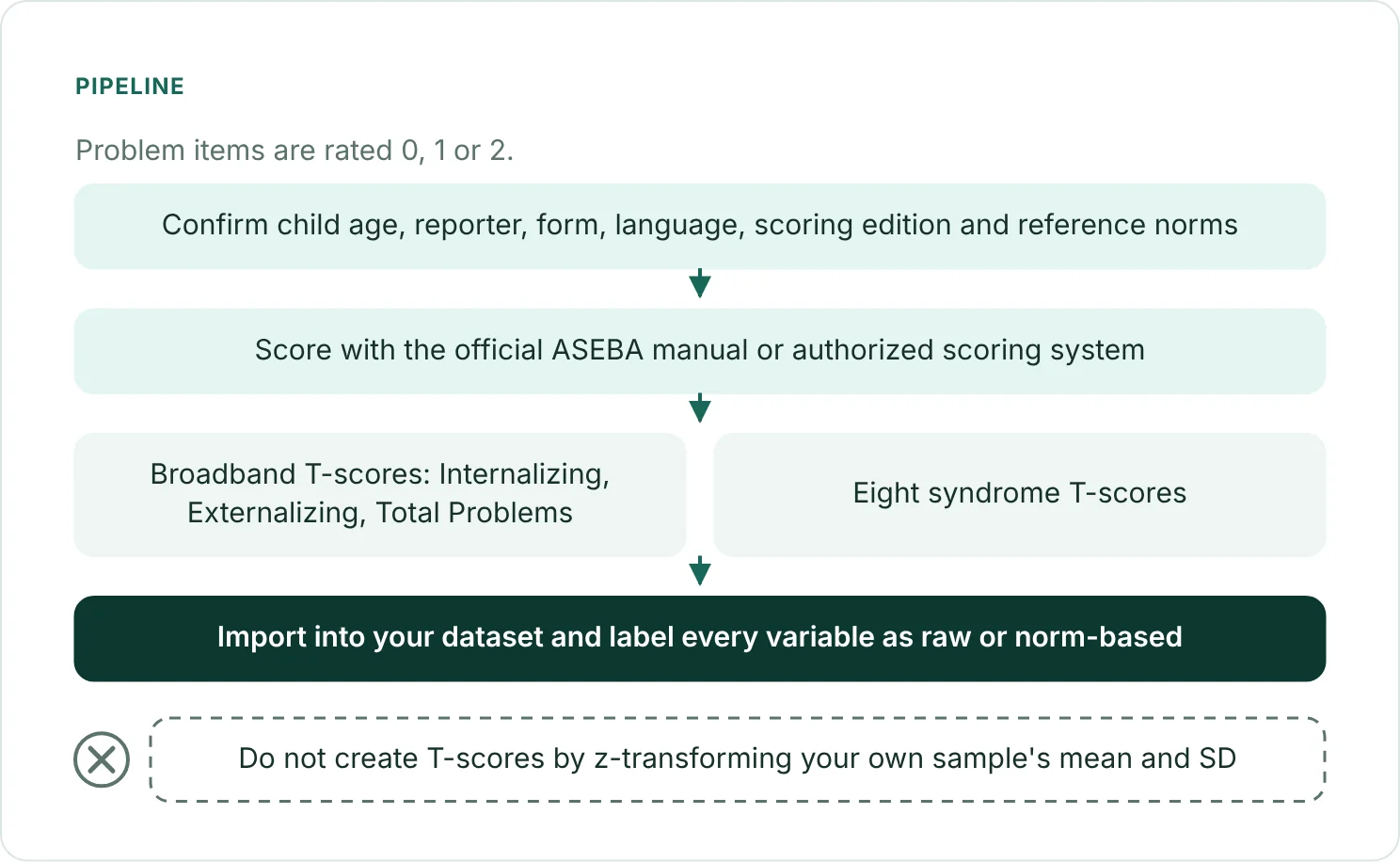
- Confirm the child’s age, the reporter, the CBCL form, the language, the scoring edition and the reference norms.
- Score the original form with the official ASEBA manual or an authorized ASEBA scoring system.
- Import the broadband, syndrome and any DSM-oriented T-scores, and label each variable as raw or norm-based.
- Do not create T-scores by z-transforming your own sample’s mean and standard deviation. That produces a sample-relative score, not the norm-referenced one.
- Record nonresponse, out-of-range ages and incomplete profiles as the official manual directs, and report how they were handled.
* Illustrative syntax: T-scores were generated by official ASEBA scoring.
DESCRIPTIVES VARIABLES=cbcl_internalizing_T cbcl_externalizing_T cbcl_total_problems_T
/STATISTICS=MEAN STDDEV MIN MAX.# data: one row per child; T-scores imported from official ASEBA scoring.
vars <- c("cbcl_internalizing_T", "cbcl_externalizing_T", "cbcl_total_problems_T")
stopifnot(all(vars %in% names(data)))
summary(data[vars])Interpreting CBCL Scores
| Output | Interpretation |
|---|---|
| Internalizing and Externalizing T-scores | Norm-referenced summaries of internalizing and externalizing problems |
| Total Problems T-score | Norm-referenced global summary of caregiver-reported problems |
| Eight syndrome T-scores | Domain-specific profile indicators, read with their own scale rules |
| Borderline and clinical ranges | Take them from the ASEBA manual for the scale and reference group, not from one universal T-score threshold |
Source: Achenbach and Rescorla (2001) school-age manual; no single T-score cutoff applies to all scales.
An elevated T-score communicates a higher standing relative to the intended norm group and is not a psychiatric diagnosis. Broadband and syndrome scales can follow different classification rules, so cite the scoring reference you actually used. Because the data come from caregivers, the respondent, the child’s age and the setting matter as much as the number.
Do not score the CBCL/6-18 with a preschool item list or a checklist copied from elsewhere. T-score labels do not replace standardized norms or a clinician’s evaluation.
Psychometric Properties
| Property | Published finding | Source |
|---|---|---|
| Standardization | The school-age manual documents the scales, norms, scoring and psychometric evidence for the CBCL/6-18 | Achenbach & Rescorla (2001) |
| Cross-cultural structure | The eight-syndrome model was tested in parent ratings of 58,051 children across 30 societies | Ivanova et al. (2007) |
| Informant forms | Parent, teacher and youth forms complement each other and reflect different informants and settings | Achenbach & Rescorla (2001) |
| Reliability | No single coefficient is asserted; report internal consistency for any multi-item score you analyze | Study-specific |
These are source-specific findings and cannot be assumed to hold as reliability or validity estimates in a new sample.
Using the CBCL in a Study
In child mental-health research, scores from the official ASEBA output can serve as continuous outcomes or predictors. Syndrome and DSM-oriented T-scores are truncated at 50 on the school-age profiles, so for statistical models the raw scale scores from the same official output are usually the better metric, with T-scores kept for describing standing against the norms. If a clinical cutoff is used, justify the manual-based rule and consider how much information a binary category discards. In repeated-measures work, check which form was used at each wave, because a child aging out of a form can affect comparability.
When several sites use different languages or norms, confirm that the same standardized metric was generated everywhere. Longitudinal and intervention analyses should account for repeated observations, clustering of children within families or schools, and changes of informant over time. Report subgroup results without turning scale elevations into diagnostic labels.
Reporting the CBCL
Caregiver-reported emotional and behavioral functioning was measured with the [edition] Child Behavior Checklist ([CBCL/6-18 or appropriate form]; Achenbach & Rescorla, 2001). [Named official scoring system] generated [selected syndrome and broadband] T-scores using [reference norms]. The prespecified outcome was [score], and missing form data were addressed according to [manual or protocol].
References
Achenbach, T. M., & Rescorla, L. A. (2001). Manual for the ASEBA school-age forms & profiles. University of Vermont, Research Center for Children, Youth, & Families.
Ivanova, M. Y., Achenbach, T. M., Dumenci, L., Rescorla, L. A., Almqvist, F., Weintraub, S., Bilenberg, N., Bird, H., Chen, W. J., Dobrean, A., Döpfner, M., Erol, N., Fombonne, E., Fonseca, A. C., Frigerio, A., Grietens, H., Hannesdóttir, H., Kanbayashi, Y., Lambert, M., . . . Verhulst, F. C. (2007). Testing the 8-syndrome structure of the Child Behavior Checklist in 30 societies. Journal of Clinical Child & Adolescent Psychology, 36(3), 405-417. https://doi.org/10.1080/15374410701444363
Frequently Asked Questions
What is the difference between CBCL raw scores and T-scores?
Raw values summarize the keyed item ratings, whereas T-scores compare a child with the appropriate ASEBA normative reference group.
Can I use the CBCL/6-18 for preschool children?
No. The ASEBA preschool form is a different age-specific version with its own items and norms.
Is an elevated CBCL T-score a diagnosis?
No. It is a standardized measure of reported behavior and must be read alongside other information.
Can I analyze CBCL T-scores in SPSS or R?
Yes, after importing properly scored data from an official ASEBA scoring procedure. Raw scale scores from that output often suit statistical models better than truncated syndrome T-scores, and the software cannot recreate the norm conversion for you.
NEXT STEP
Need CBCL Data Checked
or Analyzed?
OnlineSPSS is a statistical consultancy for researchers. Share your design and dataset, and a statistically trained Research Coordinator reviews it. The scope and one fixed project fee are confirmed before work begins.
No Commitment Required
Strictly Confidential
Fixed Project Fee
In-House PhD-Level Statisticians
Same-Day Response
Serving Researchers Since 2014