
Home / Resources / Psychological Measures / CAPS-5
CAPS-5:
Scoring and Interpretation
The Clinician-Administered PTSD Scale for DSM-5 (CAPS-5) is a structured interview that assesses posttraumatic stress disorder symptoms and diagnostic criteria. CAPS-5 scoring produces two separate outputs, a 0 to 80 severity total from 20 symptom ratings and a diagnosis from a different algorithm, so this guide sets out the cluster sums, SPSS and R code, interpretation, and a model reporting paragraph.
What the CAPS-5 Measures
The CAPS-5 is a structured interview, administered by a trained clinician, that assesses posttraumatic stress disorder (PTSD) symptoms and the criteria for diagnosis. It is frequently treated as a reference interview in PTSD validation studies. Unlike brief questionnaires, it relies on interviewer judgment about symptom severity, exposure and timing (Weathers et al., 2018).
The severity score and the diagnosis answer different questions. A summed score describes the burden of 20 rated symptoms, while a diagnosis also requires the qualifying event, symptom pattern, duration, impairment and exclusions, evaluated under the official interviewing rules. Report diagnostic status and continuous severity separately, and do not assume that a total alone establishes a diagnosis (US Department of Veterans Affairs, National Center for PTSD, n.d.).
Structure of the CAPS-5
- Items: a 30-item interview covering qualifying stressor exposure, 20 DSM-5 symptoms, impairment and further diagnostic information. Only symptom items 1 to 20 enter the severity total.
- Subscales: the four DSM-5 symptom clusters are intrusion or reexperiencing (B, items 1 to 5), avoidance (C, items 6 and 7), negative alterations in cognition and mood (D, items 8 to 14) and arousal and reactivity (E, items 15 to 20).
- Direction: no reverse-scored items. Higher ratings mean more severe symptoms.
- Time window: the past-month, past-week and worst-month interviews have different intended time frames and are not interchangeable. The CAPS for DSM-IV is a different instrument.
- Administration: a trained clinician is required. Record interviewer credentials and the assessed time window in the dataset and the methods.
- Translations: use a validated version for the intended population and name the language and its source. If no validated translation exists, say so and describe how the version was adapted.
The instrument itself is available from the US Department of Veterans Affairs National Center for PTSD.
How to Score the CAPS-5
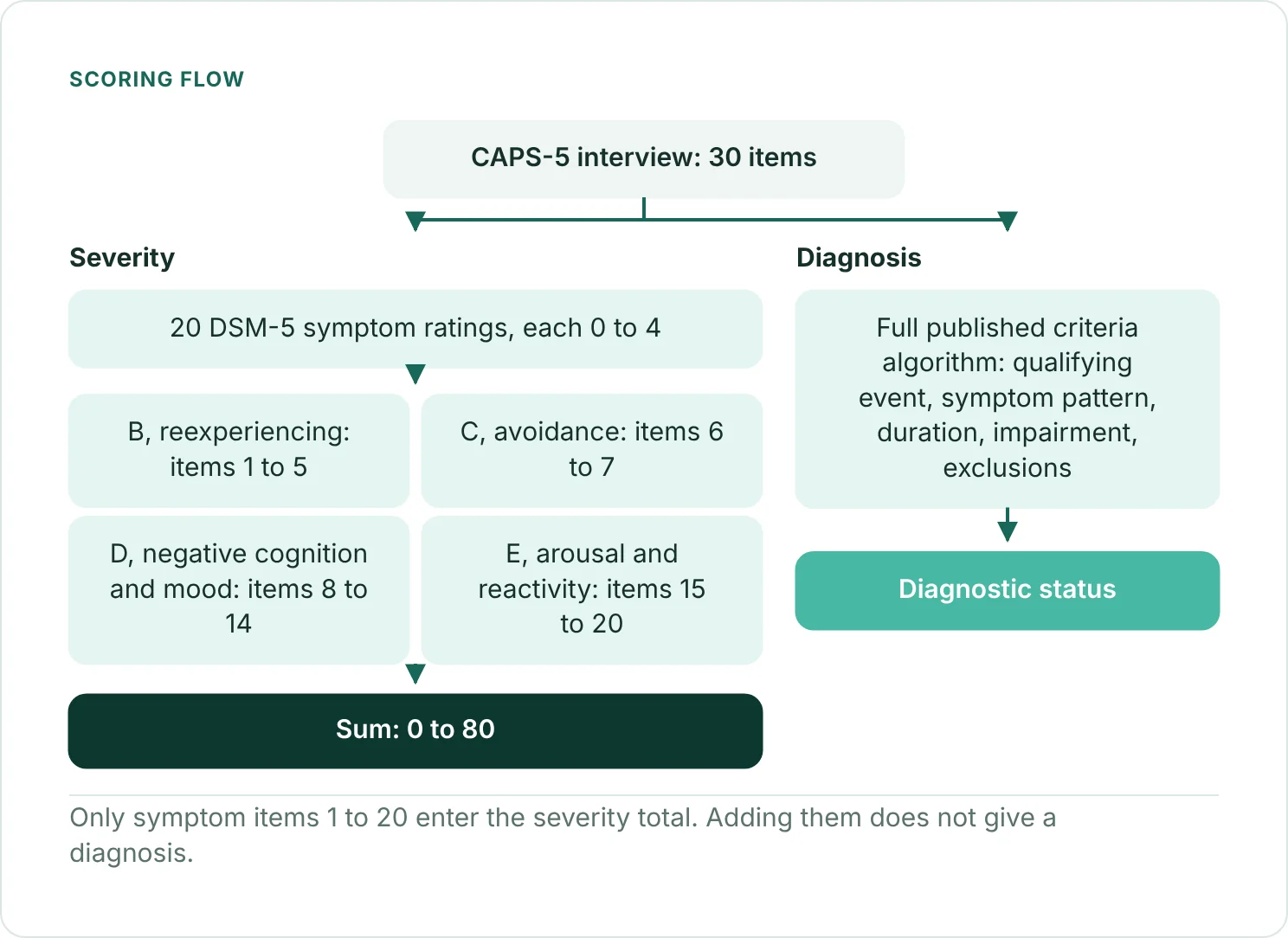
- Use the appropriate official CAPS-5 interview and rate each of the 20 DSM-5 symptoms on the clinician 0 to 4 severity metric.
- For a complete record, sum the 20 symptom ratings to obtain caps5_total, which ranges from 0 to 80. Do not sum all 30 interview responses.
- If cluster outcomes are prespecified, sum items 1 to 5, 6 and 7, 8 to 14, and 15 to 20 separately.
- Obtain PTSD diagnostic status through the full published CAPS-5 criteria algorithm, which covers the qualifying event, symptom pattern, duration, impairment and exclusions. It is not a total cutoff.
- Apply a missing-item rule set by the protocol. No developer-endorsed prorating rule was verified, so the code below requires complete ratings. Report how incomplete records were handled, and never treat a missing rating as zero.
* Illustrative syntax: caps1 to caps20 hold clinician severity ratings coded 0 to 4.
COMPUTE caps5_total = SUM.20(caps1 TO caps20).
COMPUTE caps5_B = SUM.5(caps1 TO caps5).
COMPUTE caps5_C = SUM.2(caps6 TO caps7).
COMPUTE caps5_D = SUM.7(caps8 TO caps14).
COMPUTE caps5_E = SUM.6(caps15 TO caps20).
EXECUTE.
* Diagnosis: use the official complete interview algorithm, not a total cutoff.# data: one row per interview; symptom ratings caps1 to caps20 coded 0 to 4.
symptom <- paste0("caps", 1:20)
stopifnot(all(vapply(data[symptom], function(x) all(is.na(x) | x %in% 0:4), logical(1))))
data$caps5_total <- rowSums(data[symptom], na.rm = FALSE)
data$caps5_B <- rowSums(data[paste0("caps", 1:5)], na.rm = FALSE)
data$caps5_C <- rowSums(data[paste0("caps", 6:7)], na.rm = FALSE)
data$caps5_D <- rowSums(data[paste0("caps", 8:14)], na.rm = FALSE)
data$caps5_E <- rowSums(data[paste0("caps", 15:20)], na.rm = FALSE)Interpreting CAPS-5 Scores
| Score or category | Interpretation |
|---|---|
| 0 to 80 total severity | Increasing severity of the 20 rated PTSD symptoms |
| Cluster sums | Symptom-specific severity across clusters B, C, D and E |
| DSM-5 PTSD diagnosis | Requires the full clinician-administered criteria algorithm; no total cutoff substitutes |
Source: Weathers et al. (2018); US Department of Veterans Affairs, National Center for PTSD (n.d.).
In longitudinal trials, both categorical diagnosis and continuous severity can matter, but each needs a prespecified endpoint. A lower follow-up severity score does not mean that all diagnostic criteria have resolved. Use a protocol-defined approach for repeated measures, treatment dropout and adjudication procedures.
Do not describe this 30-item clinician interview as a 30-item additive questionnaire. Clinical decisions belong to qualified personnel working under the proper version and diagnostic algorithm.
Psychometric Properties
| Property | Published finding | Source |
|---|---|---|
| Initial evaluation | The DSM-5 development study examined two samples of military veterans, not one universal population | Weathers et al. (2018) |
| Rater agreement | Depends on standardized training and protocol; report your own interrater coefficient if several interviewers rated | Weathers et al. (2018) |
| Construct validity | Relationships with other PTSD measures and related symptom constructs were evaluated | Weathers et al. (2018) |
| Diagnostic validity | Depends on the stated diagnostic standard, time window and sample | Weathers et al. (2018) |
| Time frames | Past-week, past-month and worst-month interviews are not interchangeable recall periods | US Department of Veterans Affairs, National Center for PTSD (n.d.) |
These are source-specific findings for a given population and version. They cannot be assumed to hold as reliability or accuracy estimates in a new sample.
Using the CAPS-5 in a Study
In a clinical trial, decide whether the primary endpoint is diagnosis, change in severity, or both. A continuous severity endpoint may use ANCOVA with baseline severity or a longitudinal mixed model, while diagnosis calls for a model suited to a binary outcome. Neither choice replaces a prespecified estimand and explicit missing-data assumptions.
In multisite studies, record interviewer training, blinding, and whether the same assessor rated several visits. Interrater reliability is especially useful when different clinicians assign severity. Keep the symptom-level interview record separate from computed analysis variables and from the final diagnostic decision, so that every derived value can be audited.
Reporting the CAPS-5
PTSD symptoms were assessed at [time points] using the Clinician-Administered PTSD Scale for DSM-5 (CAPS-5; Weathers et al., 2018). Trained [clinician role] administered the [past-month, past-week or worst-month] interview, and the 20 symptom ratings were summed to a severity score (range = 0 to 80), with higher scores indicating greater severity. PTSD diagnostic status was derived with the official DSM-5 algorithm. The prespecified analysis of [severity or diagnosis] adjusted for [covariates], and interviewer reliability was [procedure].
References
US Department of Veterans Affairs, National Center for PTSD. (n.d.). Clinician-Administered PTSD Scale for DSM-5 (CAPS-5). National Center for PTSD.
Weathers, F. W., Bovin, M. J., Lee, D. J., Sloan, D. M., Schnurr, P. P., Kaloupek, D. G., Keane, T. M., & Marx, B. P. (2018). The Clinician-Administered PTSD Scale for DSM-5 (CAPS-5): Development and initial psychometric evaluation in military veterans. Psychological Assessment, 30(3), 383-395. https://doi.org/10.1037/pas0000486
Frequently Asked Questions
Can I calculate CAPS-5 severity from questionnaire responses?
No. The CAPS-5 is a clinician-administered interview, and its ratings come from the structured interviewing rules.
Does a score above a fixed threshold show that someone has PTSD?
No. A diagnosis rests on the full criteria algorithm, not on summed symptom burden alone.
Should I analyze diagnosis or severity?
Choose according to the study objective. Both can be analyzed if they are planned in advance and reported transparently.
Can I use the past-week interview for a past-month endpoint?
Not without an explicit justification. The recall period changes the construct being assessed, so the versions are not interchangeable.
NEXT STEP
Need CAPS-5 Data Scored
or Checked?
OnlineSPSS is a statistical consultancy for researchers. Share your design and dataset, and a statistically trained Research Coordinator reviews it. The scope and one fixed project fee are confirmed before work begins.
No Commitment Required
Strictly Confidential
Fixed Project Fee
In-House PhD-Level Statisticians
Same-Day Response
Serving Researchers Since 2014