
Home / Resources / Psychological Measures / BSI and BSI-18
Brief Symptom Inventory:
BSI and BSI-18 Scoring
The Brief Symptom Inventory (BSI) and BSI-18 are related self-report measures of general psychological symptoms. Brief Symptom Inventory scoring differs by edition, with 53 items and nine dimensions for the BSI and 18 items and three domains for the BSI-18, so the sections below show how to tell them apart, which score metric to report, how the Global Severity Index works, and how to code and write up the results in SPSS and R.
What the BSI and BSI-18 Measure
The BSI and BSI-18 are related self-report assessments of general psychological symptoms. The original BSI reduces the longer SCL-90 family to 53 items, while the BSI-18 focuses on three domains, somatization, depression and anxiety, with six items each (Derogatis & Melisaratos, 1983; Derogatis, 2001).
Brief Symptom Inventory scoring underlies results in clinical and psychosocial outcomes research, including oncology. Zabora and colleagues (2001) evaluated the BSI-18 as a brief psychosocial screen in 1,543 patients with cancer. A cut point from a cancer sample should not be carried over to a community psychology sample without justification.
Structure of the BSI and BSI-18
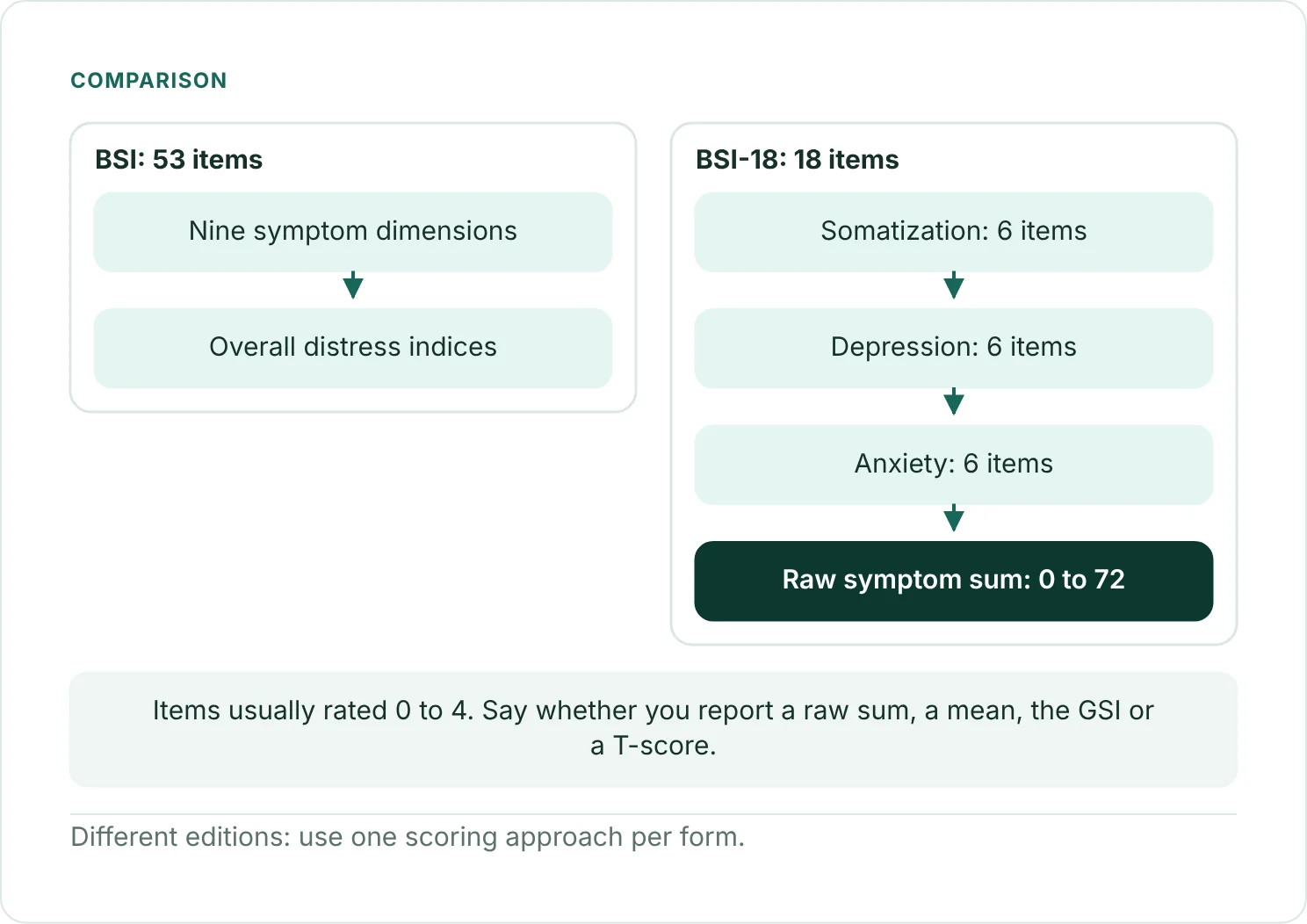
- BSI: 53 items across nine symptom dimensions, with overall distress indices.
- BSI-18: 18 items across somatization (six), depression (six) and anxiety (six).
- Responses: usually rated 0 to 4 for distress over the previous seven days. Verify the period for your form. Higher scores mean more distress.
- Metrics: the report must say whether a value is a raw sum, a mean, a Global Severity Index (GSI) or a T-score. A complete BSI-18 raw sum ranges from 0 to 72.
- Editions: the BSI-18 is not a rescaling of the BSI, and an 18-item result is not equivalent to the 53-item GSI.
The instrument itself is available from Pearson Clinical Assessment and the publisher manuals.
How to Score the BSI and BSI-18
- Identify whether the records hold the 53-item BSI or the 18-item BSI-18, and never share one scoring script across both.
- Obtain the domain scores and GSI from the approved scoring process or the exact publisher manual for that edition.
- Verify that each derived variable matches the data dictionary: raw sum or T-score, edition and reference period.
- Analyze the validated scores. Apply the missing-response rule given in the publisher manual for your edition, and record how incomplete forms were handled and whether any norm conversion was used. The code below does not reproduce an item key.
* Illustrative syntax for already-scored BSI-18 fields.
DESCRIPTIVES VARIABLES=bsi18_gsi bsi18_anxiety bsi18_depression bsi18_somatization
 /STATISTICS=MEAN STDDEV MIN MAX.
* Document the score metric before interpreting these values.# data: publisher-scored fields; variable names are examples.
vars <- intersect(c("bsi18_gsi", "bsi18_anxiety", "bsi18_depression", "bsi18_somatization"), names(data))
summary(data[vars])
# Confirm whether each variable stores raw scores or normed T-scores.Interpreting BSI and BSI-18 Scores
| Score band | Interpretation |
|---|---|
| Higher distress score | Greater reported symptom distress |
| Domain profiles | Descriptive results by domain, not stand-alone diagnoses |
| Clinical threshold or T-score | Use publisher norms and a validation in a comparable population |
Source: Derogatis (2001); Zabora et al. (2001).
A higher score indicates a larger burden of the relevant symptoms in the reference period. Before interpreting mean differences or labeling someone a probable case, identify the exact transformation, because some publications report raw sums and others normative T-scores, and both may be called a GSI. If a screening classification is used, state the threshold and the population it was validated in.
BSI-18 three-domain estimates are not direct replacements for nine-domain BSI outcomes. The abbreviation BSI alone does not identify the scoring algorithm.
Psychometric Properties
| Property | Published finding | Source |
|---|---|---|
| BSI development | 53-item inventory introduced as a shorter distress measure in the SCL family | Derogatis & Melisaratos (1983) |
| BSI-18 structure | Three groups of six symptom items with overall distress scoring | Derogatis (2001) |
| Oncology screening | BSI-18 evaluated in a source study of 1,543 patients with cancer | Zabora et al. (2001) |
| Structure | Alternatives to a simple nine-domain structure examined in SCL-90-R and BSI data | Urbán et al. (2014) |
| Reliability | Report coefficients for your cohort and edition where item data are available | Study-specific |
These are source-specific findings and cannot be assumed to hold as reliability or accuracy estimates in a new sample.
Using the BSI and BSI-18 in a Study
When comparing treatment arms or exposures, select one prespecified distress endpoint and justify whether an overall index or a particular domain matches the hypothesis. Where several domains are reported, separate confirmatory tests from exploratory description and manage multiplicity.
With baseline and follow-up scores, use a model suited to repeated measurements and to the actual score distribution. Do not infer change only from crossing an arbitrary T-score threshold. The methods should give the edition and manual, score type, reference population and missing-response approach.
Reporting the BSI and BSI-18
Psychological distress was measured with the [53-item Brief Symptom Inventory or 18-item Brief Symptom Inventory] (Derogatis & Melisaratos, 1983; Derogatis, 2001). The primary outcome was [GSI or named domain], calculated with [publisher scoring system, norms and edition]. Higher scores represented greater symptom distress. Missing responses were handled using [rule].
References
Derogatis, L. R. (2001). Brief Symptom Inventory 18 (BSI 18): Administration, scoring, and procedures manual. NCS Pearson.
Derogatis, L. R., & Melisaratos, N. (1983). The Brief Symptom Inventory: An introductory report. Psychological Medicine, 13(3), 595-605. https://doi.org/10.1017/S0033291700048017
Urbán, R., Kun, B., Farkas, J., Paksi, B., Kökönyei, G., Unoka, Z., Felvinczi, K., Oláh, A., & Demetrovics, Z. (2014). Bifactor structural model of symptom checklists: SCL-90-R and Brief Symptom Inventory (BSI) in a non-clinical community sample. Psychiatry Research, 216(1), 146-154. https://doi.org/10.1016/j.psychres.2014.01.027
Zabora, J., BrintzenhofeSzoc, K., Jacobsen, P., Curbow, B., Piantadosi, S., Hooker, C., Owens, A., & Derogatis, L. (2001). A new psychosocial screening instrument for use with cancer patients. Psychosomatics, 42(3), 241-246. https://doi.org/10.1176/appi.psy.42.3.241
Frequently Asked Questions
Is the BSI-18 just a short BSI score?
No. It is a separately specified 18-item instrument with three domains, and not a rescaling of the nine BSI dimensions.
Can I compare a BSI GSI with a BSI-18 GSI?
Only with a documented harmonization approach and evidence that the interpretation is comparable.
Is there a universal BSI-18 cutoff?
No. A cutoff must be justified for the study setting and score metric, and the metric must be named.
Should I report both the GSI and the three subscales?
Report the prespecified main outcome, and give subscales with a clear exploratory or confirmatory label.
NEXT STEP
Need BSI or BSI-18 Data Scored
or Checked?
OnlineSPSS is a statistical consultancy for researchers. Share your design and dataset, and a statistically trained Research Coordinator reviews it. The scope and one fixed project fee are confirmed before work begins.
No Commitment Required
Strictly Confidential
Fixed Project Fee
In-House PhD-Level Statisticians
Same-Day Response
Serving Researchers Since 2014