
Home / Resources / Psychological Measures / BIS-11
BIS-11:
Scoring and Interpretation
The Barratt Impulsiveness Scale, Version 11 (BIS-11), is a 30-item self-report measure of impulsiveness, rated from 1 to 4. BIS-11 scoring rests on an 11-item reverse key and on a decision about the subscales, because later analyses did not support the three original domains. Covered in turn are the key, code for the total and the domain sums, the limits of interpretation and wording for a methods section.
What the BIS-11 Measures
The BIS-11 is the eleventh version of Barratt’s impulsiveness scale, and Patton et al. (1995) report its factor structure. They proposed six first-order factors grouped into three second-order domains, which are attentional, motor and nonplanning impulsiveness. Respondents describe how they usually think and act, with no fixed recall window.
The proposed structure has been challenged. Reise et al. (2013) fitted competing models to a community sample (N = 691) and found low item correlations, redundant item pairs and cross-loadings, with poor fit for the confirmatory models, and they concluded that the three subdomains were not empirically supported. They also noted that reading the total as one common dimension of impulsivity presents challenges in interpretation. The score you interpret has to be named, and any domain claim needs support in your own data.
Structure of the BIS-11
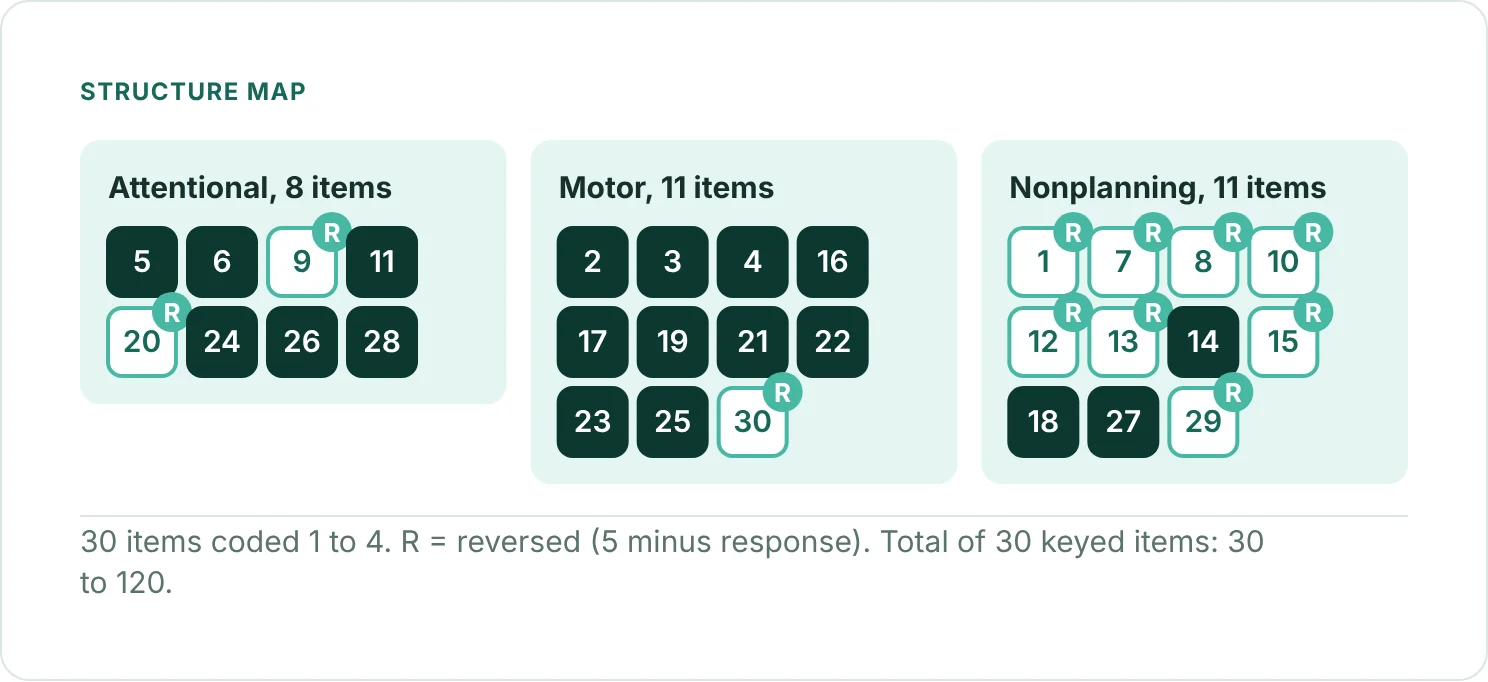
- Items: thirty statements rated 1 (rarely or never), 2 (occasionally), 3 (often) or 4 (almost always or always).
- Direction: eleven items are reverse scored (1, 7, 8, 9, 10, 12, 13, 15, 20, 29 and 30), so that their responses count as 4, 3, 2 and 1. After keying, higher scores mean more impulsiveness.
- Domains, as proposed by the authors: Attentional (8 items: 5, 6, 9, 11, 20, 24, 26, 28), Motor (11 items: 2, 3, 4, 16, 17, 19, 21, 22, 23, 25, 30) and Nonplanning (11 items: 1, 7, 8, 10, 12, 13, 14, 15, 18, 27, 29).
- Total: the sum of all 30 keyed items, from 30 to 120. The domain sums run from 8 to 32 for Attentional and from 11 to 44 for Motor and for Nonplanning.
- Versions: earlier versions and short forms have their own items and keys, and this key must not be applied to them.
- Translations: name the language and its source, since the factor structure can differ in translated or clinical samples.
The scale and its factor structure are described in Patton et al. (1995). The item numbers in this post follow the scoring protocol of the International Society for Research on Impulsivity (n.d.), so record which version of the form you administered.
How to Score the BIS-11
- Check that bis1 to bis30 follow the original item order and are coded 1 to 4, and that the survey platform has not already reversed any item.
- Reverse items 1, 7, 8, 9, 10, 12, 13, 15, 20, 29 and 30 by subtracting each response from 5. Items 2 to 6, 11, 14, 16 to 19, 21 to 28 stay as entered.
- Sum all 30 keyed items to obtain bis11_total, which ranges from 30 to 120.
- If domain sums are reported, build them from the item map in Structure, and state that their structure is not settled.
- Apply a missing-item rule set by the protocol. No developer-endorsed prorating rule was verified, so the code below requires every item of a score. Report how incomplete responses were handled.
* Illustrative syntax: bis1 to bis30 coded 1 to 4 in the original item order.
RECODE bis1 bis7 bis8 bis9 bis10 bis12 bis13 bis15 bis20 bis29 bis30 (1=4) (2=3) (3=2) (4=1) (ELSE=SYSMIS) INTO b1k b7k b8k b9k b10k b12k b13k b15k b20k b29k b30k.
COMPUTE bis11_total = SUM.30(b1k, bis2, bis3, bis4, bis5, bis6, b7k, b8k, b9k, b10k, bis11, b12k, b13k, bis14, b15k, bis16, bis17, bis18, bis19, b20k, bis21, bis22, bis23, bis24, bis25, bis26, bis27, bis28, b29k, b30k).
COMPUTE bis11_attentional = SUM.8(bis5, bis6, b9k, bis11, b20k, bis24, bis26, bis28).
COMPUTE bis11_motor = SUM.11(bis2, bis3, bis4, bis16, bis17, bis19, bis21, bis22, bis23, bis25, b30k).
COMPUTE bis11_nonplanning = SUM.11(b1k, b7k, b8k, b10k, b12k, b13k, bis14, b15k, bis18, bis27, b29k).
EXECUTE.# data: one row per respondent; items bis1 to bis30 coded 1 to 4 in the original item order.
x <- data[paste0("bis", 1:30)]
stopifnot(all(vapply(x, function(z) all(is.na(z) | z %in% 1:4), logical(1))))
rev_items <- c(1, 7, 8, 9, 10, 12, 13, 15, 20, 29, 30)
x[rev_items] <- lapply(x[rev_items], function(z) (5-z))
score <- function(k) ifelse(complete.cases(x[k]), rowSums(x[k]), NA_real_)
data$bis11_total <- score(1:30)
data$bis11_attentional <- score(c(5, 6, 9, 11, 20, 24, 26, 28))
data$bis11_motor <- score(c(2, 3, 4, 16, 17, 19, 21, 22, 23, 25, 30))
data$bis11_nonplanning <- score(c(1, 7, 8, 10, 12, 13, 14, 15, 18, 27, 29))Interpreting BIS-11 Scores
| Score | Interpretation |
|---|---|
| 30 to 120 | Continuous total; higher means more self-reported impulsiveness |
| Domain sums | Attentional 8 to 32, Motor 11 to 44, Nonplanning 11 to 44; interpret only with structural evidence from your sample |
| Clinical cutoff | Use a published cutoff only if it was validated for your population and version |
Source: Patton et al. (1995); Reise et al. (2013). No universal cutoff was verified.
Higher totals represent more self-reported impulsiveness on the original metric. The three domains are theoretically useful, but Reise et al. (2013) found that their structure was not supported in a community sample, so differences between domains should not be treated as settled in every population. A total is a trait measure for research and not a diagnosis.
Check that exactly the eleven items listed above were reversed, and only once. A key with an extra reversed item, or an export in which the survey platform already reversed some items, shifts the total without producing out-of-range values, so the error does not show in a range check.
Psychometric Properties
| Property | Published finding | Source |
|---|---|---|
| Proposed structure | Six first-order factors and three second-order domains | Patton et al. (1995) |
| Community-sample reassessment | N = 691; poor fit for unidimensional, six-factor, three-domain and bifactor models; a two-factor model offered as an alternative | Reise et al. (2013) |
| Item properties | Low or near-zero correlations for some items, redundant item pairs and cross-loadings | Reise et al. (2013) |
| Reliability | Estimate it in your own sample, and report the actual coefficient | Study-specific |
These are source-specific results and cannot be assumed to hold as reliability or structural estimates in a new sample or language version.
Using the BIS-11 in a Study
Choose between the total and the domain scores by a stated hypothesis. If domains matter, test the structure in your data, with confirmatory or exploratory factor analysis suited to four ordered response categories, and report internal consistency for each score you analyze, for example with omega alongside alpha. Where the domains do not hold, the total, or a structure supported by your data, is the safer analytic unit, and the limitation belongs in the methods.
When impulsiveness predicts a later outcome, consider timing, confounding and measurement error, and keep the wording associational. Plan sample size from the primary effect or the precision needed, and not from the 30 items. If scores come from several sites or from repeated occasions, use a model that respects that dependence, and check measurement invariance before comparing groups or languages.
Reporting the BIS-11
Impulsiveness was measured with the 30-item Barratt Impulsiveness Scale, Version 11 (BIS-11; Patton et al., 1995). Items were rated from 1 to 4, eleven items were reverse scored, and responses were summed to a total (range = 30 to 120), with higher scores indicating greater impulsiveness. The planned [total or domain] scores were analyzed, and missing responses were handled by [method]. Internal consistency in the present sample was [alpha or omega = XX, 95% CI XX to XX], and the structure was [evaluated by method and result].
References
International Society for Research on Impulsivity. (n.d.). BIS-11 administration and scoring [Web page].
Patton, J. H., Stanford, M. S., & Barratt, E. S. (1995). Factor structure of the Barratt Impulsiveness Scale. Journal of Clinical Psychology, 51(6), 768-774. https://doi.org/10.1002/1097-4679(199511)51:6<768::AID-JCLP2270510607>3.0.CO;2-1
Reise, S. P., Moore, T. M., Sabb, F. W., Brown, A. K., & London, E. D. (2013). The Barratt Impulsiveness Scale-11: Reassessment of its structure in a community sample. Psychological Assessment, 25(2), 631-642. https://doi.org/10.1037/a0032161
Frequently Asked Questions
Is the BIS-11 total 30 to 120?
Yes, once the reverse key is applied to all 30 responses and every item is answered.
Which BIS-11 items are reverse scored?
Items 1, 7, 8, 9, 10, 12, 13, 15, 20, 29 and 30, eleven in all, each recoded as 5 minus the response.
Should I always report the three subscales?
No. Their structure was not supported in a community sample, so report them only when the hypothesis calls for them and your data support the structure.
Can the BIS-11 diagnose an impulse-control disorder?
No. It is a self-report measure of impulsiveness and does not replace a diagnostic assessment.
NEXT STEP
Need BIS-11 Scores Set Up
or Checked?
OnlineSPSS is a statistical consultancy for researchers. Share your design and dataset, and a statistically trained Research Coordinator reviews it. The scope and one fixed project fee are confirmed before work begins.
No Commitment Required
Strictly Confidential
Fixed Project Fee
In-House PhD-Level Statisticians
Same-Day Response
Serving Researchers Since 2014