
Home / Resources / Psychological Measures / ASSIST
WHO ASSIST:
Scoring and Interpretation
The Alcohol, Smoking and Substance Involvement Screening Test (ASSIST) is a World Health Organization interview that screens several substance categories at once. ASSIST scoring yields one risk score per substance and not a single total, so this guide covers the substance-specific scores, the separate alcohol bands, interpretation as screening guidance, SPSS and R code, and reporting wording.
What the ASSIST Measures
The World Health Organization designed the ASSIST to identify patterns of tobacco, alcohol and other substance use associated with health risk, and to support brief intervention or referral. It does not produce a single numerical drug-risk score (World Health Organization, 2010).
It suits surveys and clinical studies that must separate tobacco, alcohol and drug categories. Humeniuk and colleagues (2008) examined its concurrent, construct and discriminative validity in 1,047 people recruited from drug treatment and primary care settings in several countries. Because the screening bands differ by substance, a correct analysis has to keep the substance-specific structure intact.
Structure of the ASSIST
- Questions: eight, with the substance questions asked for each category the person has used, so one instrument holds many score sets.
- Scoring: for each substance, the WHO method adds the answers to questions 2 to 7. Lifetime use (question 1) and injection (question 8) do not enter the risk score, and question 5 is not coded for tobacco.
- Weights: response options carry question-specific point values, so raw codes are not points.
- Bands: each substance has its own score and risk category, and alcohol has a different low-risk boundary from tobacco and the other drugs.
- Versions: record the version used. The standard is WHO ASSIST V3.0, and earlier or digital adaptations need to be identified.
- Translations: use a validated version for the intended population and name the language and its source. Record item order and administration mode in the data dictionary.
The instrument itself is available from the World Health Organization ASSIST manual and package.
How to Score the ASSIST
- Confirm that the instrument is WHO ASSIST V3.0 and that the raw responses match the documented coding.
- Apply the WHO question-specific scoring, handling questions that were not asked as the manual directs.
- Calculate one risk score for each substance with the official WHO method, never one score across substances.
- Classify each score with its own bands. For alcohol, 0 to 10 is low, 11 to 26 moderate and 27 or more high. For tobacco and the other drugs, 0 to 3 is low, 4 to 26 moderate and 27 or more high.
- The code below assumes the per-substance score was already calculated by the official method. It classifies scores and does not rebuild them from raw answers.
* Illustrative syntax: assist_alcohol and assist_tobacco already hold WHO-calculated scores.
RECODE assist_alcohol (0 THRU 10=1) (11 THRU 26=2) (27 THRU HI=3) INTO assist_alcohol_risk.
RECODE assist_tobacco (0 THRU 3=1) (4 THRU 26=2) (27 THRU HI=3) INTO assist_tobacco_risk.
VALUE LABELS assist_alcohol_risk assist_tobacco_risk 1 "Low" 2 "Moderate" 3 "High".
EXECUTE.# Inputs are WHO-calculated scores, not raw answers.
risk <- function(s, alcohol = FALSE) {
ifelse(is.na(s), NA_integer_,
ifelse(s >= 27, 3L, ifelse(s <= if (alcohol) 10 else 3, 1L, 2L)))
}
data$assist_alcohol_risk <- risk(data$assist_alcohol, TRUE)
data$assist_tobacco_risk <- risk(data$assist_tobacco, FALSE)Interpreting ASSIST Scores
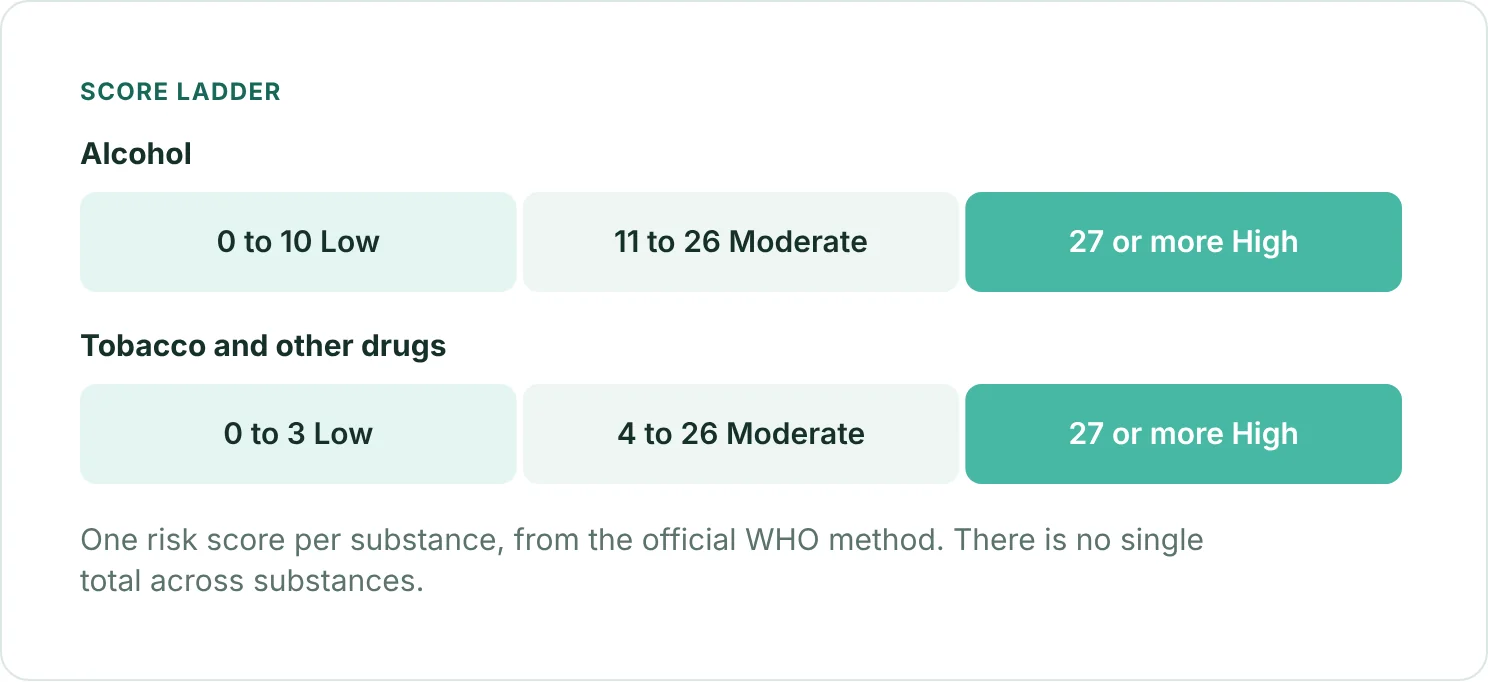
| Score band | Interpretation |
|---|---|
| Alcohol: 0 to 10 / 11 to 26 / 27 or more | Low / moderate / high WHO risk category |
| Tobacco and other drugs: 0 to 3 / 4 to 26 / 27 or more | Low / moderate / high WHO risk category |
| Single total across substances | Not a standard WHO ASSIST outcome |
Source: World Health Organization (2010), ASSIST manual; Humeniuk et al. (2008).
The categories are screening and brief-intervention guidance and not diagnoses of a substance use disorder. A moderate-risk score for one substance cannot be added to a high-risk score for another to form a calibrated global scale. In a manuscript, tabulate each relevant substance separately and state how multiple substance use was summarized.
The same score can fall in a different risk category for alcohol than for tobacco. A sum of raw item codes is not WHO ASSIST scoring.
Psychometric Properties
| Property | Published finding | Source |
|---|---|---|
| International validation | 1,047 participants from drug treatment (350) and primary care (697) settings were studied | Humeniuk et al. (2008) |
| Validity | Scores correlated with other substance-use measures and were higher for people with diagnoses of abuse or dependence | Humeniuk et al. (2008) |
| Cutoffs | ROC analysis produced cutoff scores with suitable sensitivity and specificity for most substances | Humeniuk et al. (2008) |
| Scoring and use | Question weights, substance-specific categories and brief-intervention guidance are set out in the manual | World Health Organization (2010) |
These are source-specific findings from the validation sample and cannot be assumed to hold as reliability or accuracy estimates in a new population.
Using the ASSIST in a Study
Define which substance categories count and give a denominator for each. Substances co-occur, and testing associations for several of them against several outcomes raises the risk of false-positive findings, so prespecify the primary substance endpoints and adjust exploratory results. Risk categories are ordered, so an ordinal model can use them without collapsing to a single cutoff.
In longitudinal work, classify every wave with the same version of the WHO algorithm, and distinguish a person who stopped using a substance from a person whose responses are missing. Survey-based prevalence estimates may need design weights and uncertainty that reflect the sampling design and not unweighted percentages. Store the original responses, the WHO-calculated scores and the risk labels in separate variables so the analysis can be reproduced.
Related guides: Ordinal Regression · Chi-Square Test · Sensitivity & Specificity (Diagnostic Accuracy) · Public Health
Reporting the ASSIST
Psychoactive substance involvement was assessed with the World Health Organization Alcohol, Smoking and Substance Involvement Screening Test (ASSIST, version [version]; World Health Organization, 2010). Risk scores were generated separately for [specified substances] using the WHO weighted method and classified with the substance-specific bands for low, moderate and high risk. The primary outcome was [prespecified substance and metric], and missing responses were handled by [method].
References
Humeniuk, R., Ali, R., Babor, T. F., Farrell, M., Formigoni, M. L., Jittiwutikarn, J., de Lacerda, R. B., Ling, W., Marsden, J., Monteiro, M., Nhiwatiwa, S., Pal, H., Poznyak, V., & Simon, S. (2008). Validation of the Alcohol, Smoking and Substance Involvement Screening Test (ASSIST). Addiction, 103(6), 1039-1047. https://doi.org/10.1111/j.1360-0443.2007.02114.x
World Health Organization. (2010). The alcohol, smoking and substance involvement screening test (ASSIST): Manual for use in primary care. World Health Organization.
Frequently Asked Questions
Is the ASSIST one total score?
No. It produces separate risk scores for each substance category.
Are the alcohol and cannabis cutoffs the same?
No. The low-risk boundary for alcohol is 0 to 10, and for tobacco and the other standard substances it is 0 to 3.
Can I sum raw question codes?
No. Use the question weights and the rules for questions that were not asked in the WHO manual, because raw codes are not points.
Does a high ASSIST score mean a person has an addiction?
No. It guides screening and further assessment and is not a diagnosis.
NEXT STEP
Need ASSIST Data Scored
or Checked?
OnlineSPSS is a statistical consultancy for researchers. Share your design and dataset, and a statistically trained Research Coordinator reviews it. The scope and one fixed project fee are confirmed before work begins.
No Commitment Required
Strictly Confidential
Fixed Project Fee
In-House PhD-Level Statisticians
Same-Day Response
Serving Researchers Since 2014