
Home / Resources / Psychological Measures / ASQ
ASQ Suicide Screening:
Workflow and Interpretation
The Ask Suicide-Screening Questions (ASQ) is a brief screening workflow of four yes or no questions, followed by one acuity question when the screen is positive, used in health care settings to identify who needs further suicide-risk assessment. ASQ suicide screening yields a screen result and an acuity pathway and not a severity score, so this guide covers how results are categorized, what the published accuracy supports, how to structure the data, and how to report aggregate findings.
What the ASQ Measures
Horowitz and colleagues derived the ASQ by testing 17 candidate questions against the Suicidal Ideation Questionnaire in 524 patients aged 10 to 21 at three urban pediatric emergency departments. The best-performing set was four questions (Horowitz et al., 2012). The tool exists to identify patients who need a fuller assessment. It does not quantify how severe suicidal thinking is, and it is not a diagnosis or a disposition decision.
A screen is only as useful as the response that follows it. Use of the ASQ presupposes trained staff, a defined pathway for positive and refused screens, a brief suicide safety assessment and timely clinical escalation. In research, that means the analysis describes how a screening program performed and what it found, and clinical management stays with institutional safety protocols.
Structure of the ASQ
- Screening questions: four yes or no questions. There is no validated 0 to 4 total, and a count of yes answers is not a severity score.
- Acuity question: a fifth question asked after a positive screen, which separates acute from non-acute positive status.
- Refusal: a refusal to answer is handled as a positive screen under the NIMH pathway and is never recoded as a negative answer.
- Pathways: the toolkit gives population and setting specific versions. Follow the one that matches your sample and record which was used.
- Data: keep separate variables for screen result, acuity result, refusal, completion of the safety assessment and disposition.
- Translations: use a validated version for the intended population and name the language and its source. If no validated translation exists, say so and describe how the version was adapted.
The instrument itself is available from the National Institute of Mental Health (NIMH) ASQ toolkit.
How to Score the ASQ
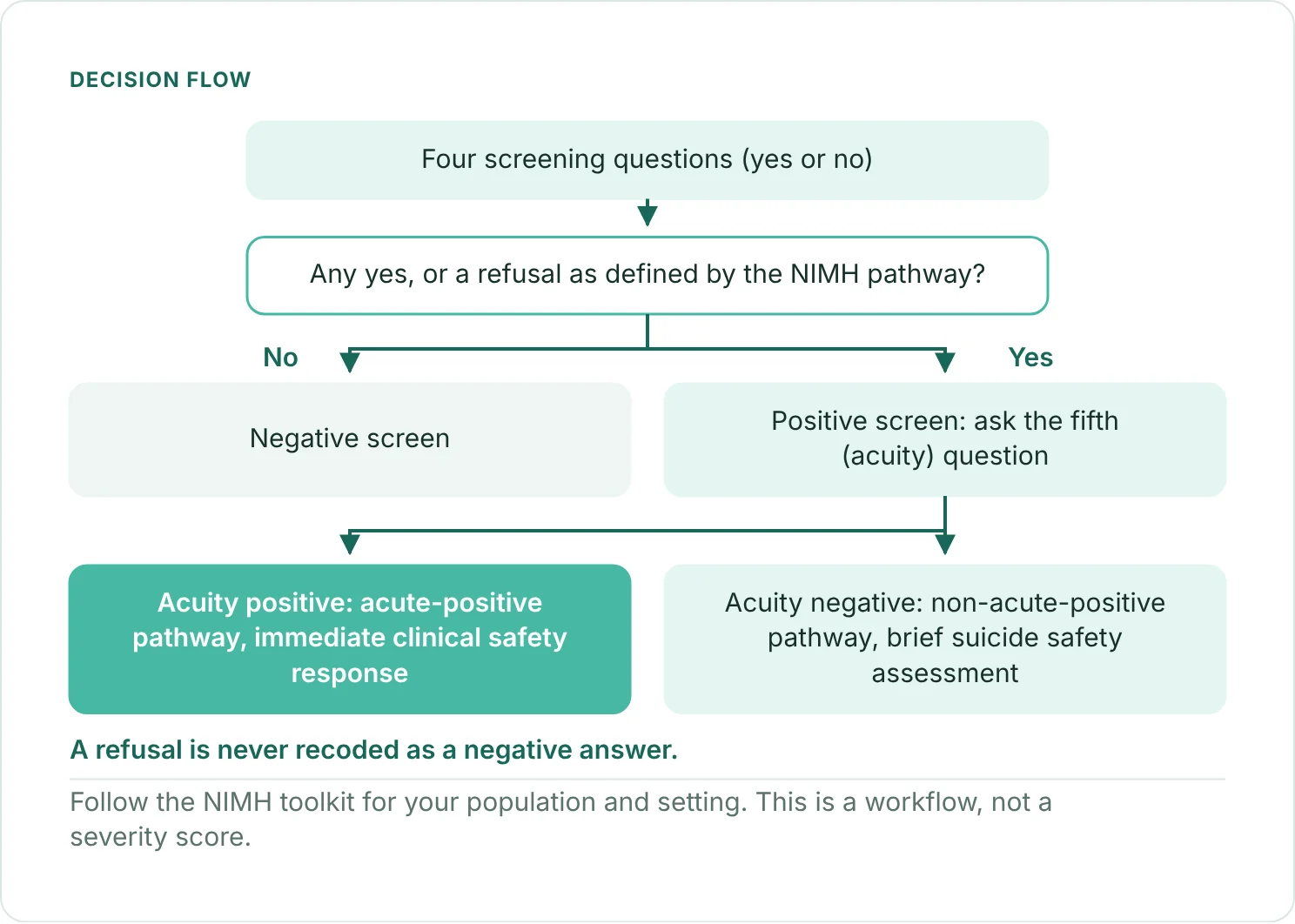
- Follow the NIMH toolkit for the relevant population and care setting, and obtain answers to the four screening questions.
- Classify the screen as positive if any answer is yes or if the patient refuses to answer as the pathway defines. Otherwise classify it as negative.
- For a positive screen, record the answer to the acuity question. A positive acuity answer is the acute-positive result, and a negative acuity answer is the non-acute-positive result.
- Record the safety assessment and disposition the pathway requires as separate variables. They are clinical process data and not part of a score.
- For analysis, do not sum the yes answers into a severity total, and report unscreened patients as unscreened and never as negative.
* Illustrative syntax: asq_screen_status is a verified categorical variable
* (negative, non-acute positive, acute positive); no classification is computed here.
FREQUENCIES VARIABLES=asq_screen_status.
CROSSTABS /TABLES=study_group BY asq_screen_status /CELLS=COUNT ROW.# data: one row per screening; asq_screen_status is a verified categorical variable.
table(data$asq_screen_status, useNA = "ifany")
prop.table(table(data$study_group, data$asq_screen_status), margin = 1)Interpreting ASQ Results
| Result | Interpretation |
|---|---|
| No screening answer positive | Negative screen |
| Any answer yes, or a refusal | Positive screen; the acuity question follows |
| Acuity question positive | Acute-positive pathway; immediate clinical safety response |
| Acuity question negative after a positive screen | Non-acute-positive pathway; brief suicide safety assessment |
Source: National Institute of Mental Health (n.d.), ASQ toolkit pathways, which govern for each population and setting.
These categories describe a clinical process, so they should not be presented as low, moderate or high severity bands. A negative screen means no screening trigger on that occasion and does not rule out risk, and a positive screen means a need for assessment and is not a prediction that a person will attempt suicide.
This page describes a screening workflow for research reporting and gives no guidance for managing an individual patient. Sites need their own escalation procedures, qualified assessors and privacy safeguards, and a negative result never overrides a clinical safety concern.
Psychometric Properties
| Property | Published finding | Source |
|---|---|---|
| Pediatric emergency department sample | 524 patients aged 10 to 21 at three urban hospitals; sensitivity 96.9% (95% CI 91.3 to 99.4) and specificity 87.6% (95% CI 84.0 to 90.5) against the Suicidal Ideation Questionnaire | Horowitz et al. (2012) |
| Adult medical inpatients | 727 adults at four hospitals; sensitivity 100% (95% CI 90 to 100) and specificity 89% (95% CI 86 to 91) against the Adult Suicidal Ideation Questionnaire | Horowitz et al. (2020) |
| Internal consistency | Not a central statistic for a brief categorical screening algorithm | Not applicable |
| Prediction | Accuracy against a criterion measure is not the same as predicting later suicidal behavior | Horowitz et al. (2012, 2020) |
These are source-specific results from particular samples and criterion measures and cannot be assumed to hold in a new setting or population.
Using the ASQ in a Study
Distinguish screening uptake, the positive-screen proportion, completion of the clinical assessment and the disposition outcome, and report the denominator at each step. Retrospective records can contain selective screening, documentation gaps and unequal follow-up, so unscreened patients must not be counted as negative. A study of later suicidal behavior needs its own outcome definition and observation window.
Descriptive counts and percentages with confidence intervals suit most reports. For comparisons, logistic regression or modified Poisson regression can model a prespecified binary outcome when event counts support it. Patients screened more than once need clustering by patient. Prospective collection of individual responses needs ethical review and a clinical response protocol before data are gathered.
Related guides: Logistic Regression · Poisson Regression · Missing Data Analysis · Medical, Health & Clinical Research
Reporting the ASQ
Suicide-risk screening status was recorded with the Ask Suicide-Screening Questions (ASQ; Horowitz et al., 2012), following the National Institute of Mental Health pathway for [population and setting]. The four screening answers were classified as a categorical screen and were not summed into a severity index. Positive or refused screens proceeded to the acuity question and the protocol-defined safety assessment. We summarize screening uptake, screen status and assessment completion in aggregate, and individual management followed institutional safety protocols.
References
Horowitz, L. M., Bridge, J. A., Teach, S. J., Ballard, E., Klima, J., Rosenstein, D. L., Wharff, E. A., Ginnis, K., Cannon, E., Joshi, P., & Pao, M. (2012). Ask Suicide-Screening Questions (ASQ): A brief instrument for the pediatric emergency department. Archives of Pediatrics & Adolescent Medicine, 166(12), 1170-1176. https://doi.org/10.1001/archpediatrics.2012.1276
Horowitz, L. M., Snyder, D. J., Boudreaux, E. D., He, J.-P., Harrington, C. J., Cai, J., Claassen, C. A., Salhany, J. E., Dao, T., Chaves, J. F., Jobes, D. A., Merikangas, K. R., Bridge, J. A., & Pao, M. (2020). Validation of the Ask Suicide-Screening Questions for adult medical inpatients: A brief tool for all ages. Psychosomatics, 61(6), 713-722. https://doi.org/10.1016/j.psym.2020.04.008
National Institute of Mental Health. (n.d.). Ask Suicide-Screening Questions (ASQ) toolkit [Web page].
Frequently Asked Questions
Does a positive ASQ result mean the patient will attempt suicide?
No. A positive screen identifies a need for prompt clinical assessment. It is not a prediction of a future attempt.
Can I use a total score of 0 to 4?
No. The ASQ is a categorical workflow and not a severity scale, so report screen and acuity categories.
How is a refusal to answer handled?
Under the NIMH pathway a refusal is treated as a positive screen. Do not recode it as a negative answer.
Can a study use the ASQ without a clinical response pathway?
No. Use depends on a defined pathway and staff able to assess and respond to positive screens.
NEXT STEP
Need ASQ Screening Data Analyzed
or Checked?
OnlineSPSS is a statistical consultancy for researchers. Share your design and dataset, and a statistically trained Research Coordinator reviews it. The scope and one fixed project fee are confirmed before work begins.
No Commitment Required
Strictly Confidential
Fixed Project Fee
In-House PhD-Level Statisticians
Same-Day Response
Serving Researchers Since 2014