
Home / Resources / Psychological Measures / AQ and AQ-10
Autism-Spectrum Quotient:
Scoring and Interpretation
The Autism-Spectrum Quotient (AQ) is a self-report measure of autism-related traits, available as a 50-item adult form and a 10-item short form (AQ-10). Autism Spectrum Quotient scoring counts keyed 0 or 1 responses, so this guide covers the two forms, why they are not rescalings of each other, the thresholds of 32 and 6 and their limited accuracy in referred samples, and how to compute keyed totals in SPSS or R.
What the Autism-Spectrum Quotient Measures
The 50-item adult form, developed by Baron-Cohen and colleagues, spans five areas: social skill, communication, attention switching, attention to detail and imagination (Baron-Cohen et al., 2001). The 10-item AQ-10 was later derived as a much shorter screening instrument (Allison et al., 2012).
An AQ total is a count of keyed trait endorsements and not a diagnostic assessment. A high score does not mean a person is autistic, and predictive performance changes with the referral setting. In a referred adult sample, AQ scores did not significantly predict diagnosis, with high sensitivity but low specificity, so the short form cannot be treated as accurate in every clinical context (Ashwood et al., 2016).
Structure of the AQ
- Items: the AQ-50 has 50 statements with four agreement options. The AQ-10 has ten selected items with its own key.
- Keying: conventional scoring converts the four options to a keyed 0 or 1, and the keyed direction depends on the item. Use the developer’s key for the exact form administered.
- Subscales: five trait areas are proposed for the AQ-50, but their factor structure is not stable across every validation setting. The AQ-10 is reported as a single total.
- Thresholds: a score of 32 on the AQ-50 has historical research use, and a score of 6 on the AQ-10 has been used as a prompt for further assessment. Neither transfers automatically across versions, genders or referral populations.
- Versions: child and adolescent versions are separately validated, so name the form and age group.
The instrument itself is available from the original AQ publications and the developers’ autism research resources.
How to Score the AQ
- Record whether the form administered was the AQ-50, the AQ-10 or an age-specific variant.
- Convert the four agreement options to keyed 0 or 1 indicators using the developer’s item directions for that form.
- Sum the 50 keyed indicators (0 to 50) for the AQ-50, or the ten keyed indicators (0 to 10) for the AQ-10.
- Handle incomplete responses as the form requires. Do not replace a missing answer with zero, and report the rule used.
- When you present a screen-positive group, name the cutoff, its source and the population, and keep it distinct from confirmed diagnosis.
* Illustrative syntax: item variables already hold keyed 0/1 indicators.
COMPUTE aq50_total = SUM.50(aq50_1 TO aq50_50).
COMPUTE aq10_total = SUM.10(aq10_1 TO aq10_10).
EXECUTE.
* Use only the form actually administered. Do not sum raw agreement labels.# data: one row per respondent; items already keyed 0/1 after developer keying.
aq_score <- function(prefix, n) {
cols <- paste0(prefix, seq_len(n))
stopifnot(all(cols %in% names(data)))
x <- data[cols]
stopifnot(all(vapply(x, function(z) all(is.na(z) | z %in% 0:1), logical(1))))
rowSums(x, na.rm = FALSE)
}
# data$aq50_total <- aq_score("aq50_", 50)
# data$aq10_total <- aq_score("aq10_", 10)Interpreting AQ Scores
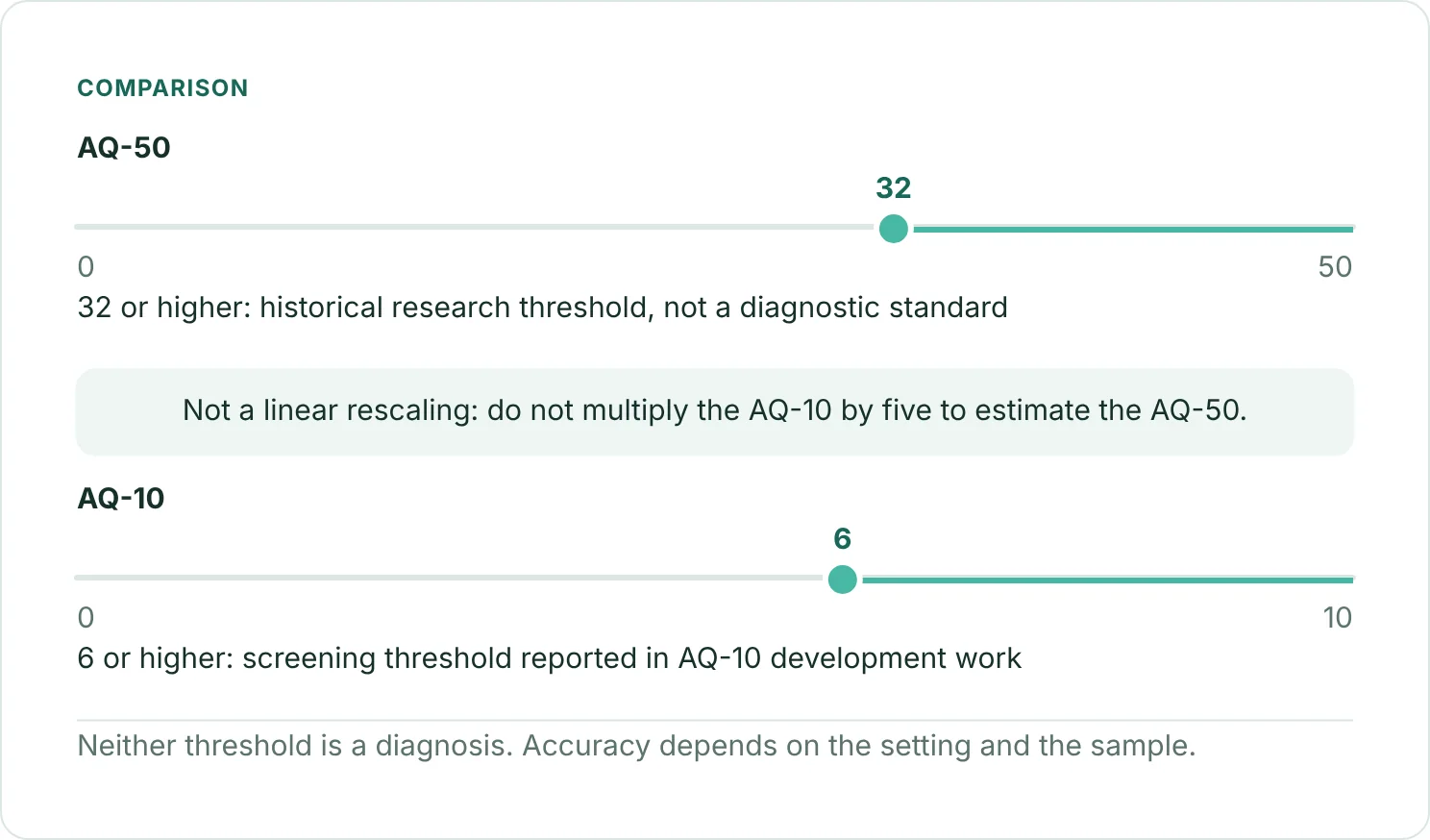
| Score | Interpretation |
|---|---|
| AQ-50, 0 to 50 | Count of keyed autism-related trait endorsements across the full questionnaire |
| AQ-50, 32 or higher | Historical research threshold from original case-control work, not a diagnostic standard |
| AQ-10, 0 to 10 | Count of keyed endorsements among the ten short-form items |
| AQ-10, 6 or higher | Screening threshold reported in AQ-10 development work, not universally predictive |
Source: Baron-Cohen et al. (2001); Allison et al. (2012); Ashwood et al. (2016).
Treat AQ totals as continuous indicators when the aim is to study individual differences. If you use a threshold, cite the validation study and its population. In 476 adults referred to a national diagnostic service, the AQ-10 at a cutoff of 6 had sensitivity of .77 (95% CI .72 to .82) and specificity of .29 (95% CI .20 to .38), and AQ scores did not significantly predict diagnosis (Ashwood et al., 2016).
An AQ total is not an autism diagnosis. The AQ-50 and AQ-10 differ in content and performance, and the AQ-10 is not a linear rescaling of the AQ-50, so do not multiply it by five. Screening data must not stand in for confirmed clinical status.
Psychometric Properties
| Property | Published finding | Source |
|---|---|---|
| AQ-50 development | Scores compared between autistic adults and comparison groups in a case-control design | Baron-Cohen et al. (2001) |
| AQ-10 development | Short-form items were selected and studied for screening in initial case and control samples | Allison et al. (2012) |
| Referral-setting accuracy | High sensitivity but low specificity at the AQ-10 cutoff of 6 in referred adults | Ashwood et al. (2016) |
| Reliability | No single coefficient is asserted; estimate internal consistency in your own sample | Study-specific |
These are source-specific findings and cannot be assumed to hold as reliability or accuracy estimates in a new sample.
Using the AQ in a Study
AQ totals can be continuous outcomes or predictors in studies of autistic traits, provided interpretation stays within the construct. If the endpoint is a confirmed autism diagnosis, use a separate diagnostic reference standard instead of treating the AQ classification as the truth. Accuracy questions are diagnostic-accuracy designs, with sensitivity, specificity and predictive values reported with confidence intervals.
Document age, self-report versus informant version, co-occurring psychiatric conditions and the referral context, since in a referred sample generalized anxiety disorder appeared to inflate AQ scores and produce false positives (Ashwood et al., 2016). For keyed 0/1 items, Cronbach’s alpha equals KR-20; an ordinal coefficient based on tetrachoric correlations is an alternative when you model the items. Avoid reading a higher AQ score as a full explanation of behavioral differences.
Reporting the AQ
Autism-related traits were measured with the [AQ-50 or AQ-10] (Baron-Cohen et al., 2001; Allison et al., 2012). Raw agreement responses were converted to keyed binary indicators following [form-specific scoring instructions] and summed to [0 to 50 or 0 to 10] totals. Results were analyzed [continuously or with a prespecified screening threshold], and no AQ result was treated as a stand-alone diagnosis.
References
Allison, C., Auyeung, B., & Baron-Cohen, S. (2012). Toward brief “red flags” for autism screening: The Short Autism Spectrum Quotient and the Short Quantitative Checklist in 1,000 cases and 3,000 controls. Journal of the American Academy of Child & Adolescent Psychiatry, 51(2), 202-212.e7. https://doi.org/10.1016/j.jaac.2011.11.003
Ashwood, K. L., Gillan, N., Horder, J., Hayward, H., Woodhouse, E., McEwen, F. S., Findon, J., Eklund, H., Spain, D., Wilson, C. E., Cadman, T., Young, S., Stoencheva, V., Murphy, C. M., Robertson, D., Charman, T., Bolton, P., Glaser, K., Asherson, P., . . . Murphy, D. G. (2016). Predicting the diagnosis of autism in adults using the Autism-Spectrum Quotient (AQ) questionnaire. Psychological Medicine, 46(12), 2595-2604. https://doi.org/10.1017/S0033291716001082
Baron-Cohen, S., Wheelwright, S., Skinner, R., Martin, J., & Clubley, E. (2001). The autism-spectrum quotient (AQ): Evidence from Asperger syndrome/high-functioning autism, males and females, scientists and mathematicians. Journal of Autism and Developmental Disorders, 31(1), 5-17. https://doi.org/10.1023/A:1005653411471
Frequently Asked Questions
What are the AQ-50 and AQ-10 score ranges?
AQ-50 totals run from 0 to 50 and AQ-10 totals from 0 to 10, each under its own keyed binary rule.
Does an AQ-50 score of 32 or more mean autism is diagnosed?
No. The threshold comes from an original research context and does not replace diagnosis.
Can I multiply the AQ-10 by five to estimate the AQ-50?
No. The ten items do not reconstruct all 50, so the two totals are not interchangeable.
Is the AQ-10 accurate in every clinical setting?
No. In a referred adult sample it showed high sensitivity but low specificity, so performance depends on the setting and sample.
NEXT STEP
Need AQ Scores Verified
or Analyzed?
OnlineSPSS is a statistical consultancy for researchers. Share your design and dataset, and a statistically trained Research Coordinator reviews it. The scope and one fixed project fee are confirmed before work begins.
No Commitment Required
Strictly Confidential
Fixed Project Fee
In-House PhD-Level Statisticians
Same-Day Response
Serving Researchers Since 2014