
AI Reporting Guidelines:
CONSORT-AI, SPIRIT-AI, TRIPOD+AI and TRIPOD-LLM
AI reporting guidelines are study-design-specific checklists, not one rule for any manuscript that used ChatGPT. CONSORT-AI concerns trial reports of AI interventions; SPIRIT-AI concerns their protocols; TRIPOD+AI addresses clinical prediction model studies; and TRIPOD-LLM covers studies of large language models in relevant biomedical settings. The correct choice depends on what the study evaluates, not merely whether an author used AI to draft code (Liu et al., 2020; Cruz Rivera et al., 2020; Collins et al., 2024).

Transparent disclosure of AI assistance is a related but separate question. A doctoral project or observational study that used an AI tool to draft R syntax does not automatically become a CONSORT-AI trial.
Which AI reporting guideline should you use?
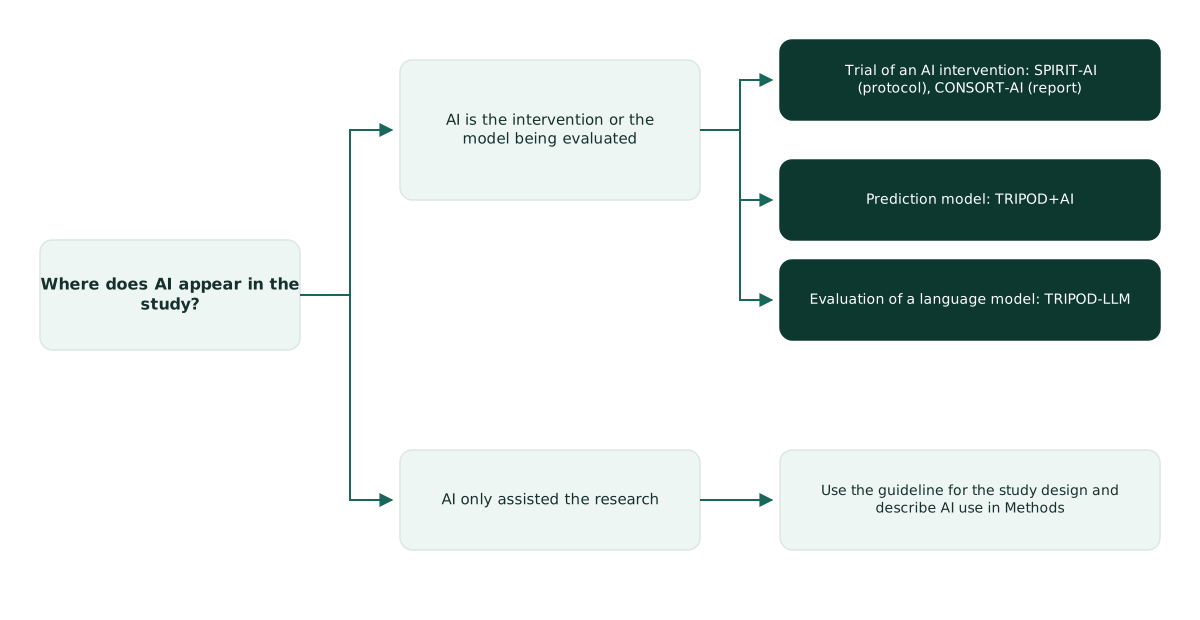
POLICY TABLE · Last checked November 2026 · rechecked every six months
| Guideline | Typical study question | Main reporting focus |
|---|---|---|
| CONSORT-AI | Does an AI-enabled clinical intervention improve outcomes in a randomized trial? | Trial reporting plus AI-specific intervention description, interactions, outputs and errors |
| SPIRIT-AI | How will a planned clinical trial of an AI intervention be designed? | Protocol details about the AI intervention and its planned evaluation |
| TRIPOD+AI | How was a diagnostic or prognostic prediction model developed or validated? | Transparent reporting of model participants, predictors, development and validation, including conventional regression and machine-learning approaches |
| TRIPOD-LLM | How was an LLM studied or evaluated in a relevant biomedical task? | Model/task specification, datasets, evaluations, prompts and reporting details tailored to LLM research |
The table simplifies scope; authors should consult the complete original checklist and relevant parent guidance, not rely on a summary.
CONSORT-AI: reporting trials that evaluate AI interventions
Liu et al. (2020) developed CONSORT-AI as an extension of the CONSORT framework for reports of clinical trials of interventions involving AI. It provides AI-specific reporting details such as the intervention’s intended use, human-AI interaction, information required to interpret outputs and how failures are handled.
CONSORT-AI should be interpreted alongside the general CONSORT guidance appropriate at publication. In 2026, that includes CONSORT 2025 for general randomized trial reporting (Hopewell et al., 2025). An author should check the target journal’s checklist submission instructions.
SPIRIT-AI: specifying an AI trial before it begins
Cruz Rivera et al. (2020) developed SPIRIT-AI as a protocol-reporting extension. It helps authors describe what the AI component does, its role in clinical care or decision-making, and how the trial will examine it. Protocol reporting is not the same as publishing a completed trial’s results.
A researcher preparing a non-AI drug comparison study with AI-assisted statistical programming should usually consult the relevant general trial protocol/reporting guidance, plus the journal’s AI-use disclosure rules, rather than claiming that SPIRIT-AI is automatically required.
TRIPOD+AI: clinical prediction models, not only deep learning
Collins et al. (2024) updated the TRIPOD reporting framework to cover clinical prediction models developed or evaluated using regression or machine learning. Its purpose is to make model design, data sources, handling of missing values, performance, evaluation and reproducibility understandable to readers.
A model’s high discrimination statistic does not remove the need to report calibration, applicable populations, missing data and validation methods. Nor should the presence of AI-generated text in a conventional analysis make it a prediction-model study.
TRIPOD-LLM: studies evaluating large language models
Gallifant et al. (2025) developed TRIPOD-LLM with modular reporting items for studies using large language models in biomedical contexts. It is relevant when model capabilities and performance are themselves being studied: for example, evaluating LLM output against reference labels or task-specific evidence. The guideline addresses factors specific to LLM evaluation, including model and task identification.
An author should check the most current guideline documents and journal policy before submission because the LLM research landscape and reporting expectations continue to change.
If AI only drafted code, what should the paper report?
Suppose the researcher used a generative AI tool to draft general SPSS syntax but the real dataset remained in an approved environment and the final script was inspected by the research team. The paper should follow its usual study-design reporting guideline and the journal’s AI disclosure policy. It should not use CONSORT-AI solely because a coding assistant was involved.
The ICMJE places responsibility for accuracy and integrity on human authors, and discusses transparent reporting of AI use (ICMJE, 2026). The disclosure should identify the task and the checks actually carried out, and should never promise that a journal will accept a given wording.
Example checklist selection
POLICY TABLE · Last checked November 2026 · rechecked every six months
| Your project | Starting point |
|---|---|
| Randomized trial comparing an AI-assisted triage tool with standard care | CONSORT plus CONSORT-AI |
| Protocol for that trial | SPIRIT plus SPIRIT-AI |
| Development of a model predicting 30-day readmission | TRIPOD+AI |
| Benchmark study comparing LLMs on clinical document classification | Consider TRIPOD-LLM according to study purpose |
| Retrospective cohort analyzed with AI-drafted code | Relevant observational-study guideline and journal AI disclosure; not automatically CONSORT-AI |
Frequently asked questions
Is CONSORT-AI mandatory if I use ChatGPT for analysis?
Not simply because you used ChatGPT. The study must fall within the guideline’s intended scope, and journals can specify their own requirements.
Is TRIPOD+AI only for neural networks?
No. It covers clinical prediction model reporting regardless of whether a regression or machine-learning approach is used (Collins et al., 2024).
Do reporting guidelines replace methods validation?
No. A complete checklist helps readers understand a study; it does not establish the statistical correctness of the underlying analysis.
Results Reporting & InterpretationNot sure which reporting checklist fits your study? A statistician reviews what the study evaluated and how it was analyzed, so the reporting matches what was done.
Results Reporting & Interpretation
OnlineSPSS provides Results Reporting & Interpretation as agreed methodological, analytical and statistical reporting support, carried out by in-house PhD-level statisticians. The research question, substantive interpretation, conclusions and overall responsibility for the study remain with the researcher or research team.
References
- Collins, G. S., Moons, K. G. M., Dhiman, P., Riley, R. D., Beam, A. L., Van Calster, B., Ghassemi, M., Liu, X., Reitsma, J. B., van Smeden, M., Boulesteix, A.-L., Camaradou, J. C., Celi, L. A., Denaxas, S., Denniston, A. K., Glocker, B., Golub, R. M., Harvey, H., Heinze, G., … Logullo, P. (2024). TRIPOD+AI statement: Updated guidance for reporting clinical prediction models that use regression or machine learning methods. BMJ, 385, e078378. https://doi.org/10.1136/bmj-2023-078378
- Cruz Rivera, S., Liu, X., Chan, A.-W., Denniston, A. K., Calvert, M. J., & SPIRIT-AI and CONSORT-AI Working Group. (2020). Guidelines for clinical trial protocols for interventions involving artificial intelligence: The SPIRIT-AI extension. Nature Medicine, 26, 1351–1363. https://doi.org/10.1038/s41591-020-1037-7
- Gallifant, J., Afshar, M., Ameen, S., Aphinyanaphongs, Y., Chen, S., Cacciamani, G., Demner-Fushman, D., Dligach, D., Daneshjou, R., Fernandes, C., Hansen, L. H., Landman, A., Lehmann, L., McCoy, L. G., Miller, T., Moreno, A., Munch, N., Restrepo, D., Savova, G., … Bitterman, D. S. (2025). The TRIPOD-LLM reporting guideline for studies using large language models. Nature Medicine, 31, 60–69. https://doi.org/10.1038/s41591-024-03425-5
- Hopewell, S., Chan, A.-W., Collins, G. S., Hróbjartsson, A., Moher, D., Schulz, K. F., Tunn, R., Aggarwal, R., Berkwits, M., Berlin, J. A., Bhandari, N., Butcher, N. J., Campbell, M. K., Chidebe, R. C. W., Elbourne, D., Farmer, A., Fergusson, D. A., Golub, R. M., Goodman, S. N., … Boutron, I. (2025). CONSORT 2025 statement: Updated guideline for reporting randomised trials. BMJ, 389, e081123. https://doi.org/10.1136/bmj-2024-081123
- International Committee of Medical Journal Editors. (2026). Recommendations for the conduct, reporting, editing, and publication of scholarly work in medical journals: Use of AI by authors. https://www.icmje.org/recommendations/browse/artificial-intelligence/ai-use-by-authors.html
- Liu, X., Cruz Rivera, S., Moher, D., Calvert, M. J., Denniston, A. K., & SPIRIT-AI and CONSORT-AI Working Group. (2020). Reporting guidelines for clinical trial reports for interventions involving artificial intelligence: The CONSORT-AI extension. Nature Medicine, 26, 1364–1374. https://doi.org/10.1038/s41591-020-1034-x
Last reviewed November 2026 by the OnlineSPSS Statistical Team. Worked examples use hypothetical values and are not client data.
NEXT STEP
Need this done for
your study?
Share your research in about a minute and receive a complimentary assessment the same day: scope, timeline and one fixed fee.
No Commitment Required
Strictly Confidential
Fixed Project Fee
In-House PhD-Level Statisticians
Same-Day Response
Serving Researchers Since 2014