
AI in Systematic Reviews and Meta-Analysis:
Where It Helps and What Stays Human
Used well, AI in systematic reviews can prioritize search records, assist title and abstract screening, and draft structured extraction fields. Evidence is strongest when AI works within a predefined, human-checked process. It does not eliminate the need to justify search coverage, eligibility decisions, risk-of-bias judgments or the statistical synthesis (Fleurence et al., 2026; Page et al., 2021).

A systematic review is a series of scientific decisions, not simply a long reading exercise. Automation is valuable when it makes those decisions faster to process and easier to document without hiding their basis.
Which systematic-review tasks are appropriate for AI support?
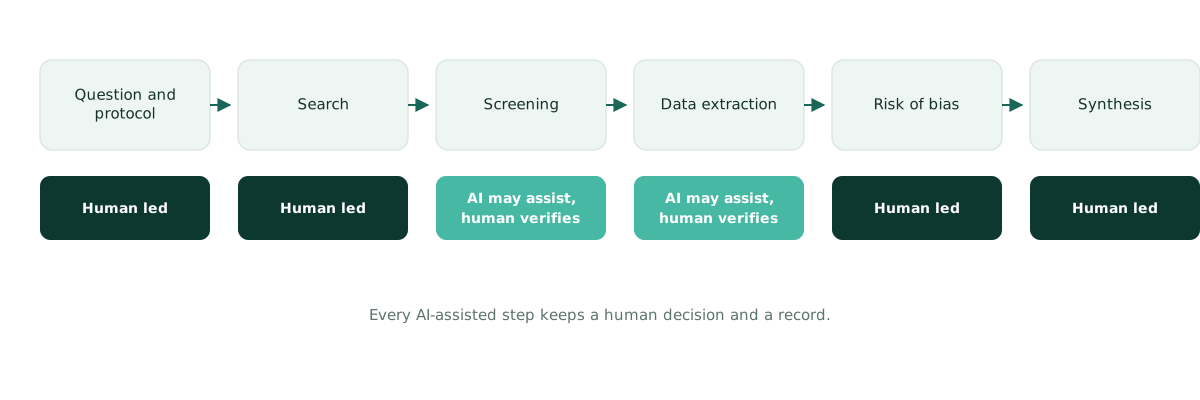
| Review step | Potential role for AI | Human responsibility |
|---|---|---|
| Search planning | Suggest synonyms, query variants or search strings | Confirm databases, search strategies and coverage |
| Deduplication and record preparation | Identify likely duplicate citations | Check uncertain matches and preserve counts |
| Title and abstract screening | Prioritize or propose inclusion/exclusion labels | Apply eligibility criteria, validate exclusions and resolve disagreements |
| Full-text review | Highlight passages related to criteria | Make final inclusion decisions and document reasons |
| Data extraction | Propose structured fields from published reports | Verify each field against the source document |
| Risk of bias | Surface relevant passages | Apply the appropriate assessment tool and justify judgments |
| Meta-analysis | Suggest calculations, code or visualizations | Decide whether outcomes, designs and estimates can be pooled |
The 2026 ISPOR good-practices report synthesized a body of empirical evaluations and supported supervised AI use particularly for high-recall screening and structured first-pass extraction. It did not recommend autonomous end-to-end generation of systematic reviews (Fleurence et al., 2026).
What do the RAISE recommendations add for AI in systematic reviews?
The Responsible use of AI in evidence SynthEsis (RAISE) recommendations provide a framework for researchers, methodologists and developers. A joint position statement from Cochrane, the Campbell Collaboration, JBI and the Collaboration for Environmental Evidence endorses their aims and supports AI and automation where human oversight, methodological rigor and transparent disclosure are maintained (Flemyng et al., 2025). This is a positive framework for responsible adoption, not a blanket objection to AI.
What does “human-in-the-loop” actually mean?
It means assigning people explicit decisions and checks within the workflow, not merely reading the final AI-generated manuscript. For example, reviewers might define eligibility criteria in advance, audit a sample or all proposed exclusions as warranted, check extracted numerators and denominators against each publication, and resolve conflicts using a specified procedure.
The strength of oversight should reflect the task and risk. A missed trial during screening may have a different consequence from a typo in an extracted study year. There is no universal AI accuracy percentage that applies to every tool, language, review type and screening strategy.
Why is complete searching different from rapid summarizing?
A chatbot’s narrative of “the available evidence” is not, by itself, a reproducible systematic search. A formal review requires documented sources and dates, a defensible search strategy, eligibility rules and transparent accounting of records. PRISMA 2020 supplies a framework for reporting those elements, including the use of automation tools in screening (Page et al., 2021).
AI-generated citations should also be confirmed against the original publications. If an AI tool suggests a study, check its bibliographic record, eligibility and relevant data rather than treating a plausible reference as verified.
Can AI support meta-analysis statistics?
Yes, for preparatory tasks such as organizing extraction forms, suggesting scripts, and checking whether effect-size calculations have been implemented consistently. In a meta-analysis, the decision to combine studies requires attention to comparable populations, interventions/exposures, outcomes, time points, study design and heterogeneity. A forest plot generated correctly from unsuitable effect estimates remains unsuitable for inference.
How should AI-assisted screening and extraction be reported?
Describe the tool, task, review stage, decision rule, human verification process, record counts and any disagreements. If automation removed records before human screening, report that process transparently in the flow diagram. PRISMA 2020’s explanation and elaboration specifically addresses automation in the review process (Page et al., 2021).
Illustrative Methods wording:
[Tool/version] was used to support [screening or extraction] according to prespecified criteria. [Reviewers] verified [records or fields] against original sources, and disagreements were resolved using [process]. All final eligibility and methodological judgments were made by the review team. Automation-related exclusions and record counts are reported in the PRISMA flow diagram.
This wording must match the actual review workflow and the journal’s current AI disclosure policy.
Frequently asked questions
Can ChatGPT do a systematic review by itself?
It can assist with stages, but a fully defensible systematic review also needs documented search methods, source verification, eligibility judgments and appropriately checked synthesis. The ISPOR report does not support autonomous end-to-end reviews (Fleurence et al., 2026).
Is AI screening acceptable under PRISMA 2020?
PRISMA 2020 includes reporting guidance relevant to automation; that does not amount to blanket approval of every tool or screening procedure. Methods and error checking still need to be documented (Page et al., 2021).
What is the biggest statistical risk in AI meta-analysis?
A calculation may be technically correct while the studies, effect measures or time points are not sufficiently comparable to pool. That decision requires research judgment.
Meta-Analysis & Evidence SynthesisNeed the synthesis statistics checked? An in-house statistician can carry out or review the meta-analysis from your extracted data, while your team keeps the scientific decisions.
Meta-Analysis & Evidence Synthesis
OnlineSPSS provides Meta-Analysis & Evidence Synthesis through in-house PhD-level statisticians, who can carry out or review the meta-analysis from your extracted data. Your team keeps the scientific decisions. Scope, deliverables and one fixed project fee are confirmed before work begins.
References
- Flemyng, E., Noel-Storr, A., Macura, B., Gartlehner, G., Thomas, J., Meerpohl, J. J., Jordan, Z., Minx, J., Eisele-Metzger, A., Hamel, C., Jemioło, P., Porritt, K., & Grainger, M. (2025). Position statement on artificial intelligence (AI) use in evidence synthesis across Cochrane, the Campbell Collaboration, JBI and the Collaboration for Environmental Evidence 2025. Environmental Evidence, 14, Article 20. https://doi.org/10.1186/s13750-025-00374-5
- Fleurence, R. L., Qureshi, R., Aggarwal, R., Bian, J., Dawoud, D., Delnoij, D., Faden, R. R., Klijn, S., Sonabend, R., & Chhatwal, J. (2026). Generative artificial intelligence for systematic literature reviews: A good practices report of an ISPOR special task force. Value in Health. Advance online publication. https://doi.org/10.1016/j.jval.2026.08.007
- Page, M. J., McKenzie, J. E., Bossuyt, P. M., Boutron, I., Hoffmann, T. C., Mulrow, C. D., Shamseer, L., Tetzlaff, J. M., Akl, E. A., Brennan, S. E., Chou, R., Glanville, J., Grimshaw, J. M., Hróbjartsson, A., Lalu, M. M., Li, T., Loder, E. W., Mayo-Wilson, E., McDonald, S., … Moher, D. (2021). The PRISMA 2020 statement: An updated guideline for reporting systematic reviews. BMJ, 372, n71. https://doi.org/10.1136/bmj.n71
Last reviewed November 2026 by the OnlineSPSS Statistical Team. Worked examples use hypothetical values and are not client data.
NEXT STEP
Need this done for
your study?
Share your research in about a minute and receive a complimentary assessment the same day: scope, timeline and one fixed fee.
No Commitment Required
Strictly Confidential
Fixed Project Fee
In-House PhD-Level Statisticians
Same-Day Response
Serving Researchers Since 2014